






Product | 10/23/2026
A Technical Overview of Ledger Atom™
Ledger Atom™ is a security and privacy device that pairs a hardened Standard Mode OS with a certified Secure Element running Ledger OS™, so it can run everyday apps* while securing your wealth, AI agents, and privacy.
Before You Dive In:
- Software that controls a screen can be tricked into showing you anything, so Ledger signers feature a secure screen driven by Ledger OS™, with private keys protected offline in a Secure Element.
- Ledger Atom™ changes the form factor, not the security model. Ledger OS still runs on a certified Secure Element but controls a dedicated switch chip that can trigger a secure display for all the actions that matter: securing your wealth, AI agents, and privacy.
- Ledger Atom is designed to add direct connectivity without loosening the security properties behind every Ledger signer. A Standard Mode leveraging a general-purpose, open-source-based OS runs on a separate chip, while Ledger OS is built on a Common Criteria EAL6+ certified Secure Element.
- This blog post serves as a summary of the full Ledger Atom Whitepaper.
The Root of Trust Behind Ledger Atom
Every Ledger signer to date has operated on a simple, effective security model: no direct internet connectivity, and a screen controlled exclusively by Ledger OS running on a certified Secure Element. Ledger Atom keeps that model but changes the form factor.
General-purpose operating systems handle a wide variety of tasks, so they are built for performance and flexibility rather than to act as a root of trust. So, the question that inspired Ledger Atom was, how do you add direct connectivity to a Ledger signer without asking a general-purpose operating system to be your root of trust?
Put simply, Ledger Atom puts a second, independent environment next to Standard Mode and keeps your keys, your seed, and your signatures inside it, isolated at the hardware level.
Secure Mode & Standard Mode
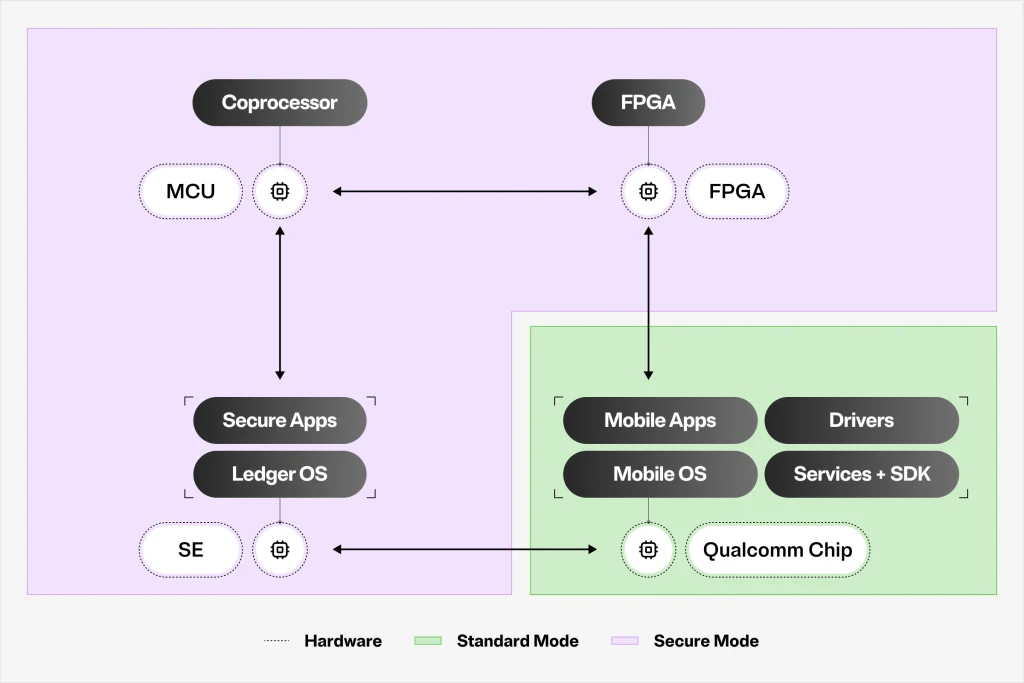
Ledger Atom contains two independent execution environments on one physical device.
Standard Mode runs on a hardened Qualcomm chip, which handles things like the camera, wired and wireless connectivity, and everyday apps*, including the Ledger Wallet™ app and third-party apps.
Secure Mode runs Ledger OS, the same operating system behind every Ledger signer, on a Common Criteria EAL6+ certified Secure Element, with its own coprocessor for rendering and its own dedicated chip acting as a physical switch between the two worlds.
Ledger Atom switches into Secure Mode automatically whenever you are about to do something sensitive, such as a transaction approval or a login in an app compatible with Ledger OS.
The keys, the PIN, and the signing operation are managed exclusively by Ledger OS, and the architecture is designed so that they never leave that standalone hardware stack and stay invisible, at the hardware level, to Standard Mode and the apps running on it.
Unlocking works the same way, with your fingerprint or pattern unlocking Standard Mode, and a separate Ledger OS PIN, designed not to be transmitted to, stored by, or accessible from Standard Mode, for authorizing anything sensitive. Standard Mode also has its own dedicated hardened chip for its credentials, separate from the one running Ledger OS.
Standard phones can also pair their operating system with a dedicated security chip, which is a genuine improvement over software-only key storage. On Ledger Atom, the Ledger OS Secure Element is a second, separate chip with its own firmware, and it drives a screen Standard Mode cannot access, which is what matters for high-value operations like signing a transaction or approving a login.
The FPGA, the Secure Screen & the Secure Bar
The component that enforces Secure Mode is an FPGA (Field Programmable Gate Array), a chip that sits physically between the Qualcomm chip and the screen on Ledger Atom, intercepting the display and touch buses directly. Only Ledger OS can command it to switch modes.
The moment Ledger OS needs your approval for something sensitive, that chip cuts Standard Mode off entirely, discarding its video signal and blocking its touch events, so the screen is driven exclusively by Ledger OS instead.
A reserved strip at the top of the display, the Secure Bar, is always rendered by that same chip under the exclusive control of Ledger OS. The chip discards anything Standard Mode tries to draw in that area, which reduces the likelihood that Standard Mode can reproduce it.
As a result, the Secure Bar tells you at a glance whether Secure Mode is active. It reads SECURE when Secure Mode is active and STANDARD when it isn’t. What’s more, a physical Privacy Switch on Ledger Atom cuts power to the camera and microphone at the circuit level, independent of any software. The Secure Bar shows the switch state, and whenever Secure Mode is active, the camera, the microphone, and other sensors such as the accelerometer are turned off automatically, regardless of the switch’s position.
What an Attacker with Full Standard Mode Control Can’t Do
The honest concern with any connected signer is that connectivity might expand the attack surface. An attacker with partial or full control of Standard Mode can read anything Standard Mode has access to, alter a transaction request before it reaches Ledger OS, or show you a convincing screen right up until Secure Mode takes over.
But on Ledger Atom, the architecture is designed so that the same attacker cannot read your seed. They cannot see what Ledger OS displays in Secure Mode or inject a touch event, because the display bus is physically isolated by the FPGA.
An attacker cannot approve a transaction on your behalf, because approval requires a physical tap on a touch path under exclusive Secure Mode control. And they cannot make Standard Mode pass as Secure Mode: Standard Mode can draw a fake approval screen, but it cannot draw the Secure Bar, so the bar will not show SECURE.
Your seed is generated by Ledger OS at setup and is not exposed in clear to Standard Mode or to any software interface. Ledger Atom is designed with the same secure seed handling as on every other Ledger signer, while removing the dependency on a second, untrusted device to attain connectivity.
AI Agent Approvals & Proof of You™ on Ledger Atom
AI is already acting on your behalf. The question is whether you control what it does. Ledger Agent Intent, built on the open Ledger Agent Stack, lets agents propose transactions while every critical action still requires your approval in Secure Mode**. Agents propose. You approve. Your Ledger signer enforces.
Ledger OS renders the details on the Secure Screen. You approve with a physical tap, and Secure Mode is designed so that no software running in Standard Mode can forge that approval. Your private keys are not shared with the agent. Ledger Agent Intent is in beta and is available on compatible Ledger signers today and at its best on Ledger Atom.
Each of these approvals is Proof of You™: a signature designed to ensure a real human was physically present when authorizing a given action. It requires physical interaction with a secure, isolated screen and a confirmation tied to a hardware chip, and it applies to actions that route through Ledger OS.
The Ledger Atom SDK & Secure Applications
Third-party apps are designed to run in Standard Mode on Ledger Atom*. For developers who want to add hardware-backed approvals, the planned Ledger Atom SDK is an additive extension of the standard SDK: it doesn’t replace or wrap any of its standard APIs, and it follows the model of Ledger’s existing Device Management Kit, with the BLE or USB transport replaced by an on-device Ledger Atom Bridge. Developers who already build for Ledger signers will recognize the model.
Apps that need hardware-backed approvals use Secure Applications, which run inside Ledger OS and handle parsing the request, rendering the Secure Screen, managing the confirmation flow, and returning a result.
Secure Applications are built with Ledger’s Secure SDK, either by Ledger or by third-party publishers, who own their Secure Application and remain responsible for it. Before one is made available for download, it goes through Ledger’s technical and security review and signature process, which means a new Secure Application moves on our security timeline rather than a developer’s release schedule. Those reviews and signatures are technical requirements of the platform and do not constitute an endorsement or guarantee of the application.
The Secure SDK is designed so that a malformed or malicious request from Standard Mode cannot cause a Secure Application to sign something the user didn’t see and confirm: the Secure Application builds its own clear-signing display from raw parsed data, never from a pre-rendered frame provided by Standard Mode.
CSPN, Common Criteria EAL6+ & Ledger Donjon
We don’t ask anyone to take our word for any of this. CSPN is a product-level certification issued by ANSSI, the French National Cybersecurity Agency, and it evaluates the security functions users directly rely on: key storage, transaction signing, Secure Screen integrity, PIN handling, and the Genuine Check mechanism, which is designed to let you verify that the Ledger OS and the main sensitive chips in your device are genuine.
Physical tamper protection covers the entire Secure Mode hardware stack. The Ledger OS Secure Element, its graphic coprocessor MCU, and the FPGA are located in a physically protected area of the PCB, enclosed behind active anti-tampering detection. A second tamper perimeter covers the device opening required for normal maintenance. Upon opening, this second tamper perimeter will trigger. It can only be reset through a controlled Ledger-supervised process, making undetected physical implants significantly harder.
Ledger signers undergo a CSPN evaluation at launch, and an evaluation of Ledger Atom as a complete system is planned, covering whether the security properties described in the whitepaper are correctly implemented and are resistant to bypass. CSPN certifies product behavior, not the underlying chip.
The chip-level certification is Common Criteria EAL6+, which the Ledger OS Secure Element carries and which matches the class of assurance on the Secure Elements in Ledger signers from the Nano S Plus™ onwards. EAL6+ evaluates the chip’s physical and logical tamper resistance, including resistance to side-channel attacks, fault injection, and hardware probing, and it applies to the chip rather than to the software running on it or the broader device architecture.
Ledger Donjon’s review of the split-world architecture behind Ledger Atom starts from the explicit assumption that Standard Mode is owned by an attacker, and evaluates whether the Secure Mode boundaries hold under that condition. External audits commissioned by Ledger cover the hardware, the firmware, and the software path from an app through to Ledger OS, and Ledger’s policy is to publish audit results and findings soon after launch.
Firmware artifacts shipped on Ledger Atom are built reproducibly: a clean rebuild from the same pinned sources and toolchain produces a bit-for-bit identical result that any party can independently verify. Production signing requires a quorum of three individuals from separated roles, enforced by HSM-backed signing infrastructure, and the process is designed so that no single employee can authorize a firmware update to production devices.
Ledger Atom: Secure Your Wealth, AI Agents & Privacy
Standard Mode gives Ledger Atom its direct connectivity, Ledger OS gives it the same security properties behind every Ledger signer, and a physical switch between them decides which one controls the screen at any given moment. The Secure Element holds the keys. The FPGA enforces the boundary. The Secure Bar shows you which side of it you’re on. The architecture is designed so that this boundary holds even when Standard Mode is fully compromised, and the Common Criteria certification, the planned CSPN evaluation, and Ledger Donjon’s review each address a different layer of that design.
The security model hasn’t changed. What’s around it has: the speed and scale of AI, with the security and approvals you control, all in Ledger Atom.
Read the full Ledger Atom™ whitepaper for the complete threat model against a fully compromised Standard Mode, the certification scope, and the SDK details for developers building on the platform.
*App availability depends on certifications and licences and will be confirmed before your device ships.
**For more info, please visit Agent Intent on ledger.com