






Thought leadership | 05/15/2026
Ledger N3xt at Cambridge – New Laws of Financial Gravity
Ledger N3XT visited the University of Cambridge for a two-day engagement with the Cambridge Blockchain Society, where the next generation of builders posed some of the hardest questions in digital identity, agentic AI, and decentralized ownership.
Before You Dive In:
- Ledger N3XT is a long-term education program supporting blockchain clubs and university students worldwide, providing tailored content, access to industry experts, and on-campus events to inspire the next generation of builders and founders in the digital ownership space.
- As part of the Ledger N3XT program, the Ledger team visited the University of Cambridge for a two-day engagement with the Cambridge Blockchain Society, including a fireside chat, private dinner, and meetings with professors and students.
- Over two days of conversation, Ledger and Cambridge students tackled some of the most pressing questions in digital ownership today, from the privacy implications of on-chain transactions to the security risks of AI agents acting on your behalf.
There is something uniquely inspiring about discussing the future of digital identity and value exchange with the next generation of young, switched-on builders, in an academic venue that is 800 years old. That was last week, where Ledger N3XT brought us to the University of Cambridge for what turned out to be one of the most energising university engagements we’ve done.
Two days of activities included an intimate dinner, a campus tour, and a series of conversations that illustrated the enormous potential for collaboration and the shared desire to make that happen. It all began with a fireside chat with Cambridge Blockchain Society (CBS), where the students had done their homework.
The Students Were Ready
I’ve done my fair share of these informal conversations, but what struck me most in this fireside was not the enthusiasm – you expect that from a room of blockchain society members at Cambridge. It was the precision. These students came with real questions, and they weren’t interested in easy answers.
Kisso Selvan, the co-chairman of the CBS, ran a tight and genuinely curious conversation. We covered agentic AI, digital identity, biometrics, the tension between proof-of-humanity and proof-of-ownership. The room followed every turn.
Then the floor opened, and things got sharper.
George, a Master’s student, pushed on something that doesn’t get asked enough:
Do you see Ledger evolving from securing digital assets to becoming a group of human identity? And if so, is it more about protecting humanity, or controlling who has access to that identity in a decentralised world?
That question has layers I appreciated. It sits at the exact intersection where Ledger actually operates, and he’d clearly thought about it before walking in.
Rishi, studying Computer Science, went further, directly challenging the architecture:
A physical screen-click isn’t a very big deterrent, because if you’re willing to take it apart, it’s very easy to just have a signer chip and get direct access.
Rishi wasn’t wrong to push. That kind of adversarial thinking is how the Ledger Donjon constantly improves security of Ledger products and the wider ecosystem. He also raised the on-chain privacy problem:
Once you send me two pounds for a coffee, I can see your entire transaction history, everything you own, your entire network.
Real concern. Real implications. My answer covered ZK proofs and layered privacy architecture, but the question deserved a deeper response, and one of the Ledger signers allocated for the best questions.
Another student asked whether renting proof-of-humanity to an agent creates a structural vulnerability, essentially asking whether Ledger’s model survives the economics of identity markets. That one made me pause.
I genuinely wished I could have rewarded everyone who asked something worth following up on. Which, for the record, was most of the room.
The conversation didn’t stop when the session ended. It continued over drinks, and by the time we sat down for dinner a couple of hours later, people were still mid-sentence from the afternoon’s discussions.
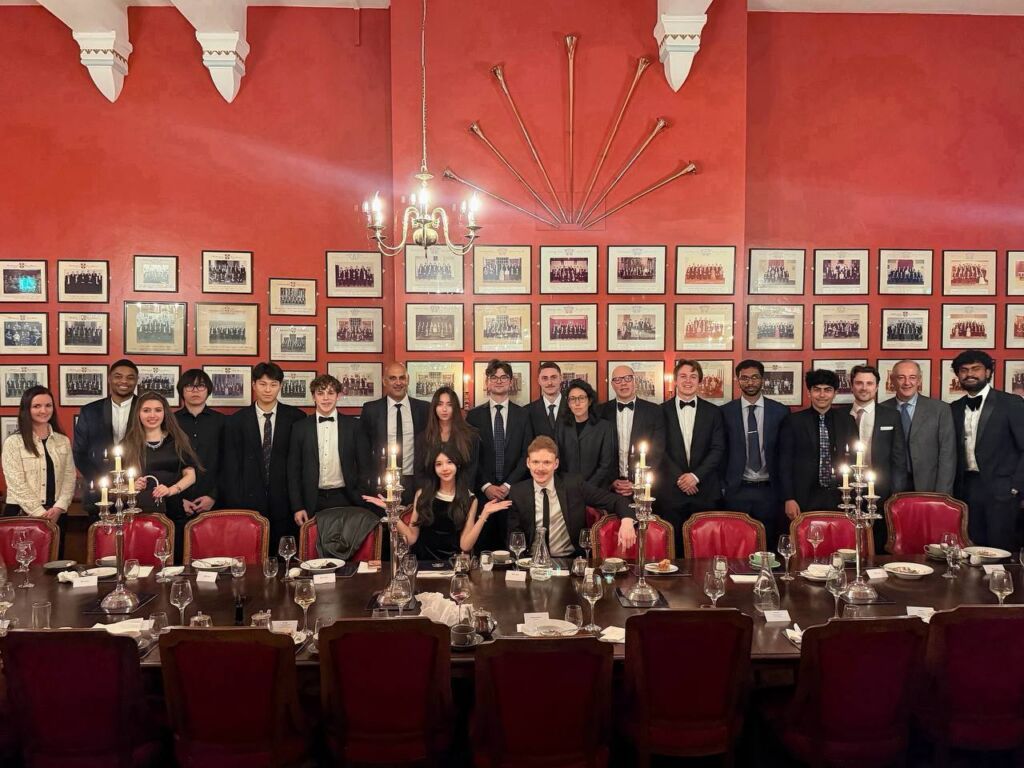
Dinner at The Cambridge Union
The Oratory in Cambridge has been hosting these kinds of conversations for longer than most institutions have existed. It carries the specific kind of gravity that old rooms acquire when enough serious people have sat in them over two centuries.
The private room we were in that evening had photographs on the walls, academics, entertainers, alumni, acting as a visual record of the range of people who have passed through and left something behind. You feel the weight of that in a way that’s hard to manufacture, but that legacy acted as a great appetiser for the discussions that flowed freely across and around the table.
Someone at the table was genuinely exploring whether decentralised settlement infrastructure could eventually function across planetary networks; not metaphorically, but architecturally.
Someone else was building in the identity space and worried about the specific challenge of synthetic identity at scale: not bots pretending to be people, but people building fractured digital selves that no single verification layer can reconcile. These weren’t idle topics. These were working problems for people who are actively building.
What struck me was the optimism. Cautious, rigorous, occasionally sceptical, but fundamentally optimistic. This generation isn’t waiting for the infrastructure to mature. They’re deciding what it should look like, and Ledger would love to harness and guide some of that energy.
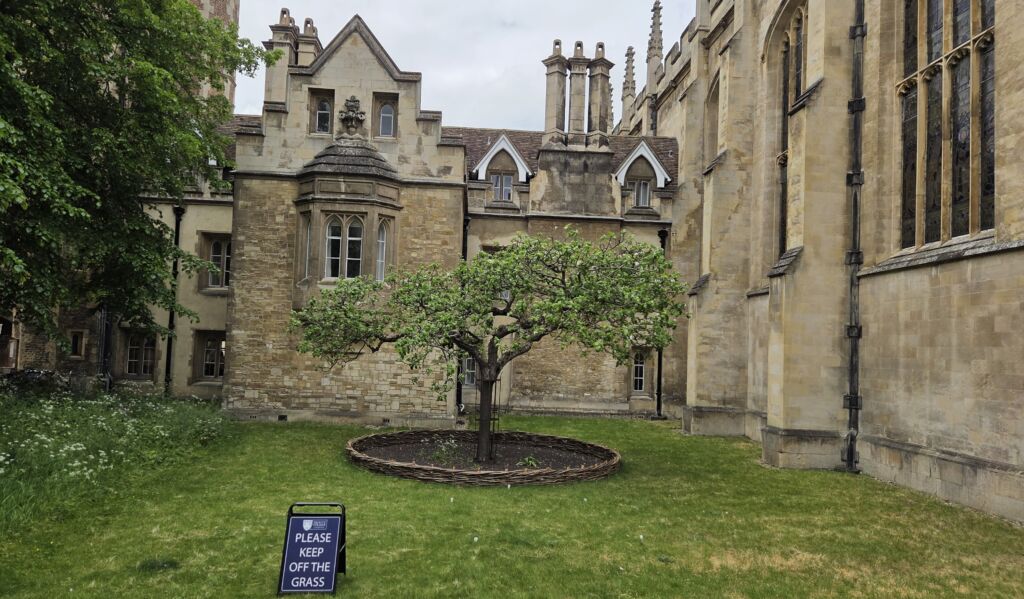
Newton’s Tree & What Comes Next
The campus tour the following day grounded everything differently. Trinity College’s Great Hall, the Christopher Wren Library, and the famous apple tree descended from the one that reportedly interrupted Newton’s afternoon. You walk through spaces where the intellectual density is palpable, the students’ pride in their connection to that history, unmistakable. The shadow of what has been figured out here over centuries is not subtle.
What I kept thinking was: the questions being asked – about cryptographic identity, about agentic systems and human consent, about how ownership functions in a world where value is increasingly digital – they are fundamental for this generation. The answers will matter as much as anything. They will be the new laws of financial gravity.
The meetings that followed with professors and students were the part I’m most excited about. We laid the groundwork for real collaboration. The intellectual rigour at Cambridge, the kind of questioning that doesn’t accept a neat answer and keeps pulling at the thread, that aligns with exactly how Ledger is thinking about the next decade of challenges
We will be back. And I think the conversation that started in that fireside chat has a lot further to run.
Ariel Wengroff, EVP Marketing & Communications, Ledger