



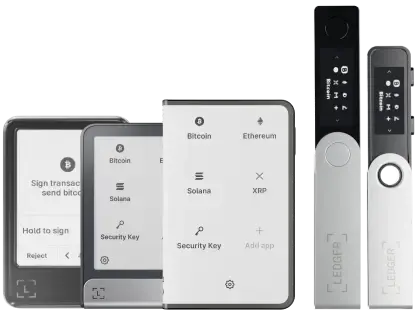
Compare Ledger signers






What is Bitcoin (BTC)?
Bitcoin is a revolutionary concept: a purely peer-to-peer version of electronic cash. It operates on a decentralized network where every transaction is recorded on a public ledger called the blockchain, eliminating the need for banks or institutions to act as intermediaries.
Origins and Technology
- Birth of a Digital Currency: Bitcoin was introduced in 2009 through the famous whitepaper, “Bitcoin: A Peer-to-Peer Electronic Cash System,” by the unknown person or group called Satoshi Nakamoto.
- Proof-of-Work (PoW): The network is secured and transactions are validated using a consensus mechanism called Proof-of-Work mining. This process requires computing power, making the network secure and tamper-proof.
Limited Supply (Digital Gold)
- The 21 Million Cap: Bitcoin’s supply is strictly capped at 21 million coins, making it a deflationary asset.
- Scarcity and Halving: This scarcity is encoded directly in the protocol through “halving” events, which cut the reward miners receive for validating blocks approximately every four years. This predictable issuance schedule has led many to view BTC as “digital gold”.
Key Benefits
- Decentralization and Censorship Resistance: No single government or institution controls the Bitcoin network.
- Global Accessibility: Anyone with an internet connection can access and use Bitcoin.
- Low Transaction Fees: The absence of intermediaries often allows for lower transaction fees compared to traditional wire transfers. However, these fees are market-dependent and fluctuate based on network congestion.
- Fast Transactions: Bitcoin transactions are fast, and speed is further improved by Layer-two solutions like the Lightning Network.
Challenges
While Bitcoin remains the most recognized and valuable cryptocurrency, users should be aware of its volatility, scalability limits, and the environmental concerns sometimes associated with Proof-of-Work mining.

 Bitcoin Cash
 Ethereum
 Tether
 Stellar