Switching hardware wallets? Migrate to Ledger safely in a few steps.

Learn more

IOTA wallet

The right hardware wallet for your IOTA

Looking for a hardware wallet to secure your IOTA? Join 8+ million customers who trust Ledger wallets to secure and manage their crypto.

  • Secured by Ledger™

Trusted by over 8 million customers

IOTA wallet
Ledger Secured Solution

How to secure your IOTA ?

Connect your Ledger hardware wallet to a compatible third-party wallet to secure and manage your IOTA.

Ledger hardware wallet

Ledger hardware wallet stores your private keys and allow you to sign transactions offline, making them resistant to malicious attacks and threats.

Metamask

With Metamask, you can send/receive, swap IOTA, view transaction history, and more.

How to get a IOTA wallet?

1
Buy a Ledger hardware wallet

Buy a Ledger hardware wallet

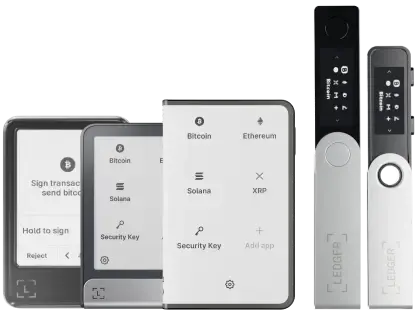
Choose the certified secure Ledger signer that best fits your lifestyle. All Ledger devices protect your private keys with the industry-leading Secure Element chip and constantly updated Ledger OS™.

Ledger touchscreen signers give you extra control with Clear Signing, Transaction Check, and a large display for greater everyday ease. Classic Ledger swivel signers give you the battle-tested security features you need to get started with self-custody.

Compare devices

2
Connect your Ledger device to Metamask

Connect your Ledger device to Metamask

  • Visit the official Metamask website and download and install Metamask.
  • Connect your Ledger signer to Metamask.
3
Start your IOTA journey securely

Start your IOTA journey securely

With your Ledger signer connected to Metamask, you can review and sign transactions securely.

What is IOTA?

IOTA is a network designed for fast, low-cost transactions and digital asset activity. Originally built around a feeless, IoT-focused data structure called “the Tangle”. The network underwent a major protocol upgrade in 2025 that moved IOTA to an object-based Layer 1 architecture supporting smart contracts.
IOTA now uses a Delegated Proof-of-Stake consensus model, where a decentralized set of validators — elected through community staking — confirm transactions, rather than miners. The network supports smart contracts through the Move programming language, alongside EVM compatibility. This allows developers to build decentralized applications and tokenized assets on IOTA.
Transactions on IOTA typically cost around 0.005 IOTA, based on the network’s reference gas price, with a portion of that fee burned rather than paid out. A portion of each transaction fee is burned rather than redistributed, while new tokens are issued as staking rewards. Storing data on-chain also requires a storage deposit, which the protocol returns when that data is deleted.

Choice of 8,000,000+ customers

“Ledger = peace of mind. I'm sure some of us know that unsettling feeling when you know you need a Ledger but haven't quite organized yourself to get it sorted. If I did it all again, I'd start with having a Ledger.”

Janet Onagah @Janet_Oganah

"I got hacked in January and lost 1000s worth of NFTs. I felt disgusted, lost, and willing to quit. Until my friend told me he's ordering a Ledger. So, we bought the duo deal. Since then, I've been sleeping."

PrimeNic.eth @primenic_eth

“I use multiple Ledgers. Different colours = different uses.Public Wallet. Never touch long term storage. Day to day fund holdings. A back up just in case.”

winny.eth @winnyeth

"I have 3 Ledgers. Hot Wallet: minting/drawings etc. Main wallet: store most NFTs. Vault wallet: cold storage of crypto."

2160 @rekt2160

“I have 5 Ledger total. My personal NFT bag. 1 for testing. And 1 for each of my 3 daughters.”

Fanzo 🧢 11.11.22 @iSocialFanz

"If I could, I would name my Ledger Hagrid. Cause it's the keeper of my keys."

Petrica Butusina @PetricaButusina

"My Ledger is already called "Stew". As it is the steward who looks after my crypto & NFTs, so I can sleep at night."

Lkmland Crypto 💫 @LkmlandCrypto

"Ledger makes cold storage downright easy. My NFTs land infinitely safer and I don’t have to feel as paranoid about connecting to new smart contracts."

Matt Oney @MattOney93

Cryptocurrencies similar to IOTA supported by our hardware wallet

Bitcoin, Ethereum, USDT, Solana and more…

FAQ

Find answers to some of the most common questions.

Not in the traditional sense. IOTA uses its own architecture rather than a standard blockchain. Its current version supports smart contracts and staking similarly to many blockchain networks.

Yes. Since IOTA’s 2025 Rebased upgrade, transactions carry a small fee (typically around 0.005 IOTA) rather than being entirely feeless as in IOTA’s original design.

When you first buy cryptocurrency, you’re issued with two keys: public and private.

  • A public key serves as an address that can be shared with other parties to perform transactions.
  • A private key represents a randomly generated number that signs transactions and protects your assets from malicious attacks. If it gets compromised or lost, you won’t be able to access your cryptocurrency wallet to spend, withdraw, or transfer your cryptocurrencies.

To safeguard and keep track of your keys, you can use online or offline wallets. Online wallets, also known as hot wallets, store private keys on systems or devices that are connected to the internet. Hot wallets are easy and convenient to use, however, they come with several drawbacks. Besides being susceptible to attacks and a honeypot for hackers, with hot wallets, the custody of private keys is often entrusted to a third party such as a crypto exchange, which means you never have full control over your funds. The safer choice are specialized hardware wallets that store private keys offline. Stealing private keys from a hardware wallet would require physical access to the wallet and corresponding PIN or the recovery phrase. What’s more, with hardware wallet, you don’t need to rely on third party custodians.

Ledger signers are industry-leading hardware wallets. With more than eight million customers, Ledger signers have several layers of security that protect private keys, and hence your assets:

  • Your private keys are stored on secure element chips.
  • A PIN code and a 24-word recovery phrase are required to access the wallet.
  • Ledger crypto wallets have been built using highly durable materials for protection against physical damage.

With full isolation between private keys and your computer/mobile, Ledger crypto wallets keep your keys secure and give you complete control over your coins.

Not in the traditional sense. IOTA uses its own architecture rather than a standard blockchain. Its current version supports smart contracts and staking similarly to many blockchain networks.

Yes. Since IOTA’s 2025 Rebased upgrade, transactions carry a small fee (typically around 0.005 IOTA) rather than being entirely feeless as in IOTA’s original design.

When you first buy cryptocurrency, you’re issued with two keys: public and private.

  • A public key serves as an address that can be shared with other parties to perform transactions.
  • A private key represents a randomly generated number that signs transactions and protects your assets from malicious attacks. If it gets compromised or lost, you won’t be able to access your cryptocurrency wallet to spend, withdraw, or transfer your cryptocurrencies.

To safeguard and keep track of your keys, you can use online or offline wallets. Online wallets, also known as hot wallets, store private keys on systems or devices that are connected to the internet. Hot wallets are easy and convenient to use, however, they come with several drawbacks. Besides being susceptible to attacks and a honeypot for hackers, with hot wallets, the custody of private keys is often entrusted to a third party such as a crypto exchange, which means you never have full control over your funds. The safer choice are specialized hardware wallets that store private keys offline. Stealing private keys from a hardware wallet would require physical access to the wallet and corresponding PIN or the recovery phrase. What’s more, with hardware wallet, you don’t need to rely on third party custodians.

Ledger signers are industry-leading hardware wallets. With more than eight million customers, Ledger signers have several layers of security that protect private keys, and hence your assets:

  • Your private keys are stored on secure element chips.
  • A PIN code and a 24-word recovery phrase are required to access the wallet.
  • Ledger crypto wallets have been built using highly durable materials for protection against physical damage.

With full isolation between private keys and your computer/mobile, Ledger crypto wallets keep your keys secure and give you complete control over your coins.

Related Resources

Stay in touch

Announcements can be found in our blog. Press contact:
[email protected]

Subscribe to our
newsletter

New coins supported, blog updates and exclusive offers directly in your inbox


Your email address will only be used to send you our newsletter, as well as updates and offers. You can unsubscribe at any time using the link included in the newsletter. Learn more about how we manage your data and your rights.