





Product, Thought leadership | 04/21/2026
Ledger Wallet™ 4.0: The Swap Experience Self-Custody Deserves
The newly rebuilt Swap Tab in Ledger Wallet 4.0 centers around a marketplace model, giving users maximum choice and clarity for their token swaps.
Before You Dive In:
- Swap is one of the most fundamental experiences in crypto and one of the hardest to get right.
- This post covers how we rebuilt the Swap Tab in Ledger Wallet 4.0 around a marketplace model
- Learn why we obsess over removing friction without removing control, and what’s coming next.
- This is the second article in a series looking at how Ledger Wallet is being rebuilt around those things users told us they care most about. Read about the Home Tab redesign here.
There’s something almost magical about swapping tokens in self-custody. At any time of the day or night, in full autonomy, you can exchange one asset for another. 24/7, no questions asked, no intermediary deciding whether you’re allowed to. For many of the tokens we cover in Ledger Wallet, this can be a fully trustless, decentralized experience.
This is one of crypto’s most fundamental promises, and honestly, one of the hardest to deliver on in a way that’s both powerful and usable. Because the reality is messier than the ideal. Some routes require multiple approvals or centralized providers. Cross-chain swaps add complexity. Slippage can eat your value if you’re not paying attention. And the more options you give users, the more overwhelming it can become.
That tension between maximum choice and actual clarity is what drove every decision in the new Swap Tab.
A Marketplace with Options
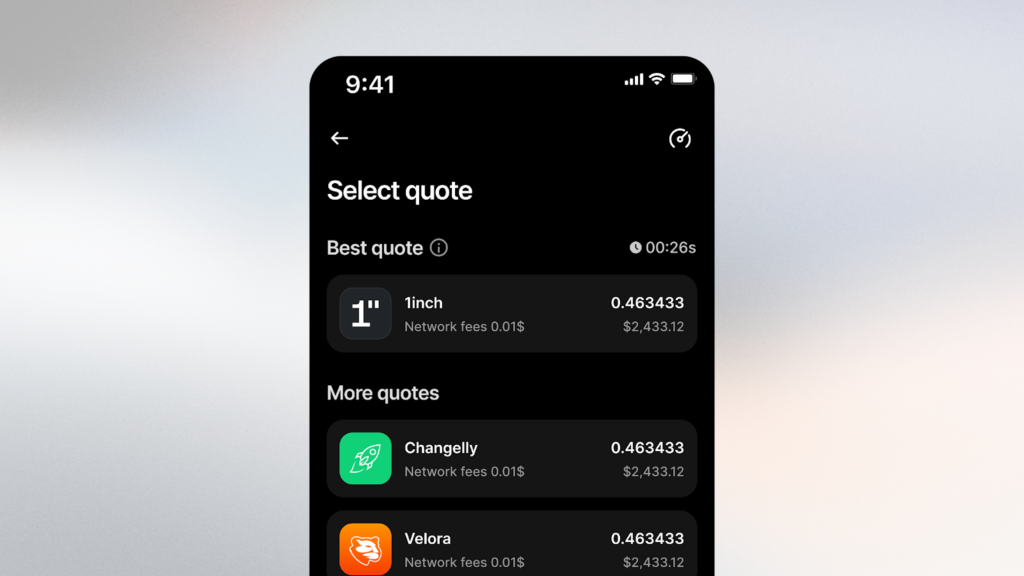
The first design principle: Ledger Wallet should never lock you into a single swap provider. We integrate a wide range of centralized and decentralized providers – Uniswap, 1inch, OKX DEX, Near Intent, ThorChain, Velora, Exodus, Changelly, and more – and we treat this as a marketplace.*
Why does this matter? Three reasons.
- Competition benefits the user. When multiple providers compete for your swap, you get better rates. That’s the whole point of a marketplace – providers compete, you win.
- Resilience. If you depend on a single provider and there’s a market event or liquidity crunch, you’re stuck. With a marketplace model, you always have options. You’re never blocked.
- Coverage. No single provider covers every coin on every network. By aggregating providers, we can present swaps from more places to more places and as protocols like Near Intent and ThorSwap mature, the decentralized options keep expanding.
Making the Experience Feel Natural
A marketplace is only useful if users can navigate it without a manual. Here’s where the UX work comes in.
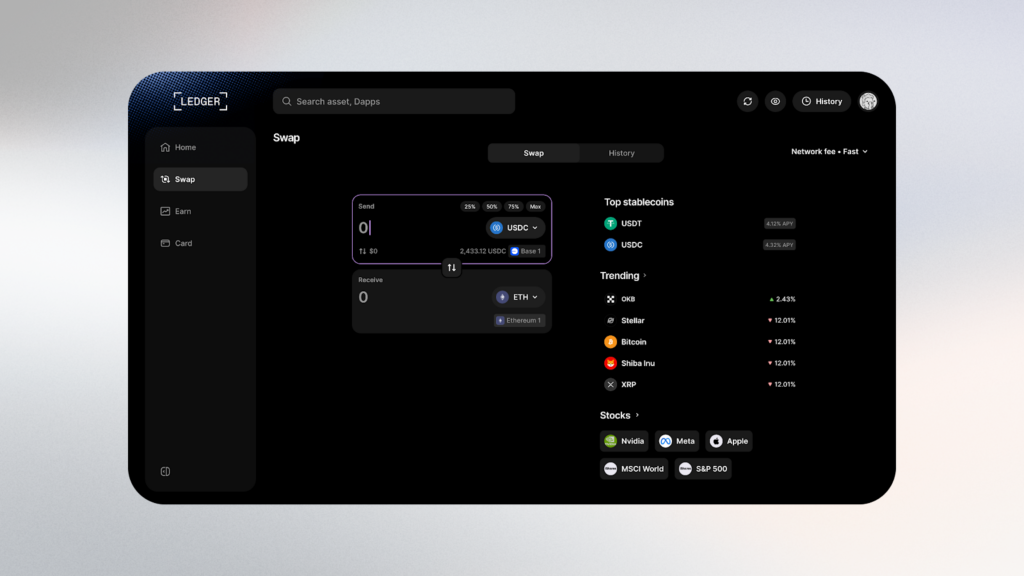
- Trending assets and stablecoins up front. A lot of users swap into stablecoins to capture market volatility, it’s one of the most common trading patterns. So we surface trending assets and popular stablecoins directly in the Swap Tab, giving you faster access to the trades you’re most likely to make. This also helps surface market trends you might not be actively tracking.
- Input in dollars or euros, not just crypto. Let’s be honest, most users don’t think in 0.00042 ETH. They think in euros or dollars. Being able to input your swap amount in fiat makes the experience more familiar and natural. It sounds like a small thing, but it fundamentally changes how intuitive a swap feels.
- Gas sponsoring. There’s nothing more frustrating than wanting to swap USDC on Base and realizing you don’t have ETH on Base to pay for the gas. We recently launched support for gas sponsoring to remove this friction entirely – you can swap without needing the gas token. It’s currently available for select pairs and providers, but we’ll be expanding this significantly. The goal: gas should never be the reason you can’t make a trade.
Swap is crypto's purest expression of autonomy. Any asset, any time, 24/7, no permission needed.
— Guillaume Mathias (@gm4thi4s) April 21, 2026
With the new Ledger Wallet 4.0 Swap Tab, we rebuilt this from the ground up. Here's how. 🧵
Protecting You Without Slowing You Down
Choice without education isn’t empowerment — it’s the paradox of choice. This is something we think about constantly at Ledger, and it applies directly to swaps.
High slippage and loss-of-value warnings. We added a clear warning system that flags when a swap would result in significant slippage or loss of value. It’s easy to overlook slippage — especially when you’re moving fast or the market is volatile. Rather than hoping users manually check every detail, we draw your attention to the problem before you confirm. Not to block you, but to make sure the choice is informed.
This is the balance we’re always trying to strike: protect users without taking away their agency. You’re free to proceed — but you’ll do it with your eyes open.
What’s Coming Next
We’re not done. A few things on the roadmap:
- Swap tracking. DEX swaps can settle in seconds; centralized or cross-chain swaps can take much longer. We’re building better real-time tracking so you always know where your swap stands.
- More gas sponsoring pairs. We’re expanding support for gas sponsoring across more tokens and providers — the goal is for gas friction to disappear entirely.
- Simpler token approvals and smoother device interactions. We’re also working on simplifying the approval steps required for certain swaps and improving how Ledger Wallet interacts with your device during the signing flow. Fewer taps, less friction, same security.
To discover everything that’s new in Ledger Wallet 4.0 refer to Release Notes and look out for an update in July detailing all the updates being rolled out over the coming months.
Built with Your Feedback
One thing I want to highlight: we have a “Share your feedback” option directly in the swap experience. We mean it. Don’t hesitate to drop us a note on what you’d like to change, what you love, what you hate.
If something feels off, tell us. We’re building this with you, not just for you.
Unlock the Full Potential of Ledger Wallet
Make sure you have the latest version of Ledger Wallet to discover the app’s innovations. To learn how to update the Ledger Wallet app on your computer or mobile, check out this tutorial. For a full overview of the new interface and changes, see Ledger Wallet 4.0 overview.
Guillaume Mathias, Executive Vice President of Product
Disclaimers:
*Ledger does not provide any financial advice or recommendation. Crypto transaction services are provided by third-party service providers. Ledger provides no advice or recommendations to use any of these third-party services.