








Legislation | 06/30/2026
Your Keys, Your Crypto: What MiCA Reveals About Asset Ownership
July 1st, 2026 marks the end of the grace period under MiCA, the EU's Markets in Crypto-Assets regulation. Exchanges operating in Europe must now hold a MiCA licence. For the millions of Europeans holding digital assets on centralised exchanges, the questions are natural: what changes, what does it mean for your assets, and what does it mean to truly own your crypto in the first place?
Before You Dive In:
- MiCA requires all crypto-asset service providers operating in the EU to hold a licence from a national regulator, bringing a formal regulatory structure to the crypto industry in Europe.
- Whether an exchange is MiCA-licensed or not, assets held on that exchange are held by a third party on your behalf, which is how custodial asset models work by design.
- Self-custody, where you hold your own private keys and control your assets directly, such as using a Ledger signer, is a different model entirely, and MiCA provides a timely reason to understand the difference.
What MiCA Changes for Exchanges
On July 1st, 2026, the grace period will end for the EU’s crypto regulatory framework – the Markets in Crypto-Assets regulation (MiCA). For the first time, any crypto-asset service provider operating across the European Union must hold a Crypto-Asset Service Provider (CASP) licence from an EU national regulator, bringing the industry under a single, consistent regulatory standard.
As part of this new standard, licensed providers must meet formal requirements covering asset segregation, minimum capital reserves, and consumer protection standards. These requirements are designed to give users of crypto services the kind of structural safeguards that exist across the broader financial industry. Exchanges that cannot meet those requirements must wind down their EU operations through an orderly process, which includes a clear mechanism for users to withdraw their assets before any closure takes effect.
MiCA represents a significant step toward regulatory clarity for service providers, setting clear and consistent rules across EU member states. For European crypto holders, the practical result is a clearer picture of which providers are authorised to operate and the obligations they carry.
What MiCA Doesn’t Change: The Principle of Asset Ownership
While MiCA reshapes how exchanges operate, it does not change the underlying structure of how digital asset ownership works.
When you hold assets on an exchange, whether that exchange is MiCA-licensed or not, those assets are held by a third party on your behalf. More specifically, the exchange holds the private keys controlling those assets; you simply hold a claim on them.
This is how custodial models work for digital assets like Bitcoin. It is analogous to a bank holding funds on deposit. The bank is regulated, your funds are protected by various legal frameworks, and you have access to them through the bank’s systems, but the funds are not directly in your hands. The high-profile failures of exchanges like Mt.Gox, Celsius and FTX, to name but a few, illustrate the potential risks to users of custodial models for digital assets.
Self-custody is a distinct model. When you hold your own private keys, you hold control over the asset directly. There is no intermediary between you and the asset. No third party’s regulatory status, operational continuity, or business decision affects your access to it. This was the vision of Satoshi Nakamoto, Bitcoin’s anonymous creator.
This distinction exists entirely independently of MiCA, which regulates services carried out by licensed exchanges. Self-custody refers to direct ownership of an asset, but it does not replace those services, nor can it restore access to those services in the event that a service provider ceases its operations.
What MiCA does is make this a natural moment to ask which model applies to your assets and decide what is best for you.
How Self-Custody Works in Practice
If you decide you want to hold your own private keys and want to explore the Ledger ecosystem, the process has three key steps.
Step 1: Choose a signer (hardware wallet)
Ledger signers allows you to create and store your private keys in an offline secure element chip, and enable you to securely verify and sign for your transactions.
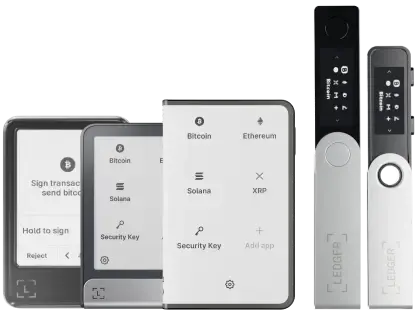
This hardware wallet comparison page shows you the current range, from Ledger’s touchscreen signers for daily use, to our classic Ledger Nano™ signers. Each runs on the same security architecture.
Step 2: Set it up with Ledger Wallet™
Ledger Wallet™ is the all-in-one crypto app that pairs with your Ledger signer. It gives you a single interface to manage your assets, check balances, and initiate transactions through authorised third party providers. Ledger Wallet™ handles the interface, and your signer secures your transactions.
Step 3: Move your assets from your exchange to Ledger Wallet™
Once your signer is set up and your wallet address is generated, log in to your exchange and navigate to the withdrawal section for the asset you want to move. Paste your Ledger wallet address as the destination, double-check it matches exactly, and confirm the withdrawal. The transaction will be broadcast to the blockchain, and, once confirmed, your assets will be accessible through your Ledger WalletTM app, at which point they sit under your direct control.
For a full walkthrough of the process, the Ledger help centre covers each step in detail.
MiCA: A New Chapter for Crypto in Europe
MiCA raises the standard for how custodial providers operate in Europe. Understanding the difference between a custodial model and self-custody is simply useful knowledge for anyone holding crypto, and this moment is a good time to get clear on it.
If you want to learn more about what holding your own keys looks like in practice, explore the current range of Ledger signers and find the one that fits how you want to hold your assets.
FAQs
What Is MiCA and What Does It Mean For Crypto Holders?
MiCA, the Markets in Crypto-Assets Regulation, is EU-wide legislation requiring all crypto-asset service providers operating in the EU to hold a CASP licence from a national regulator. For holders, the practical effect is that exchanges operating in Europe must now meet formal requirements around asset segregation, capital adequacy, and consumer protection.
Does MiCA Affect Digital Ownership Wallets Like Ledger?
MiCA regulates crypto-asset service providers: exchanges, custodians, trading platforms, and similar entities. Ledger signers are hardware devices that allow you to hold your own private keys. They are not service providers, so the licensing framework does not apply to them. When you control your assets through a Ledger signer, you are not using a third-party service to hold them on your behalf.
What Is The Difference Between Custodial and Non-Custodial Crypto Storage?
In a custodial model, a third party (typically an exchange) holds the private keys to your assets on your behalf. In a non-custodial model, you hold your own private keys. Ledger signers are non-custodial devices: you generate and store your keys on the device, which they never leave. No third party’s operational status affects your access to the assets themselves, though services built on top, such as trading or staking, still require a compliant provider.
If My Exchange Loses Its MiCA Licence, What Happens To My Crypto?
MiCA requires providers that cannot meet licensing requirements to wind down EU operations in an orderly way, including a process for users to withdraw their assets. If your exchange ceases EU operations, you should expect to receive communication about how to retrieve your funds.
How Do I Move My Crypto From An Exchange To A Ledger signer?
Set up your Ledger signer and install Ledger Wallet™. Once your wallet address is generated, log in to your exchange, navigate to the withdrawal section for the asset you hold, and enter your Ledger wallet address as the destination. Confirm the transaction on your Ledger signer’s secure screen. Once the transaction is confirmed, your assets will arrive under your direct control. The Ledger help centre has step-by-step guidance for the setup process.