
Tokenizing SNAP Benefits
 Research Competition
Rebuilding SNAP’s $113 Billion Infrastructure on Eligibility Tokens, Cryptographic Receipts, and Stablecoin Settlement
Due to its organizational properties of immutability, transparency, and traceability, blockchain offers immutable audit trails where every transaction is permanently recorded, smart contracts that enable programmable compliance and instant policy updates at scale, and zero-knowledge proofs that enable privacy-preserving verification. These properties address the core failures of current systems: mutable and siloed audit trails become immutable and transparent, transaction costs of $0.50–$2.00 drop to $0.001–$0.01, settlement times of 2–3 days collapse to seconds, and single-datacenter redundancy gives way to decentralized validators. Given this potential, the paper explores how blockchain can be used to administer and coordinate complex social service programs.
Through the extended illustrated example of the Supplemental Nutrition Assistance Program (SNAP), the paper discusses how blockchain can be utilized to administer a complex social service program. The proposal is a three-phase blockchain implementation framework: Phase 1 introduces soulbound ERC-1155 eligibility tokens to eliminate redundant verification across benefit programs; Phase 2 implements cryptographic receipt proofs using SHA-256 hashing and AES-256-GCM encryption for real-time fraud detection while preserving privacy; and Phase 3 achieves full tokenization of SNAP dollars as USDC-backed stablecoins with NFC tap-to-pay functionality on a permissioned Polygon zkEVM fork. The paper then addresses blockchain’s particular capacity to mitigate fraud and waste, facilitate interoperability across agencies and jurisdictions, and decrease frictions for beneficiaries. Several estimates presented in this paper are modeled based on publicly available data and comparable systems and should be interpreted as directional rather than exact.
1. Theoretical Background: Current SNAP System Architecture and Challenges
Administering social services represents a complex coordination challenge. Programs spanning healthcare, nutrition assistance, income support, and housing must verify eligibility, distribute benefits, detect fraud, and coordinate across federal, state, and local jurisdictions, often serving overlapping populations through siloed systems. The Supplemental Nutrition Assistance Program (SNAP), America’s primary food security safety net, distributes $113 billion in annual benefits to 41.6 million Americans through 250,000 authorized retailers, yet the system is fundamentally inefficient: fraud detection operates with 6–18 month lags costing $6.4 billion annually, bureaucratic burden consumes an estimated 832 million hours of recipients’ time annually, derived from 41.6 million recipients facing roughly five cross-program verification interactions per year at approximately four hours each, merchant settlement delays of 2–3 days create working capital burdens for the 250,000 authorized retailers, while EBT system administration costs taxpayers approximately $6 billion annually, and stigma-driven non-participation results in $50 billion in unclaimed benefits from 25% of eligible people. There are 50 isolated systems across these programs. The Oregon SNAP database can’t connect with the Lifeline Internet Program. NYC SNAP cannot engage with the MTA and the transit authority. Florida SNAP can’t talk to Florida community colleges. This lack of interoperability leads to bloated verification systems that force recipients to prove eligibility repeatedly, amounting to billions of dollars in annual administrative costs spent on redundant verification across programs.
Current EBT System Architecture
Currently, the Flow of the EBT architecture is this:
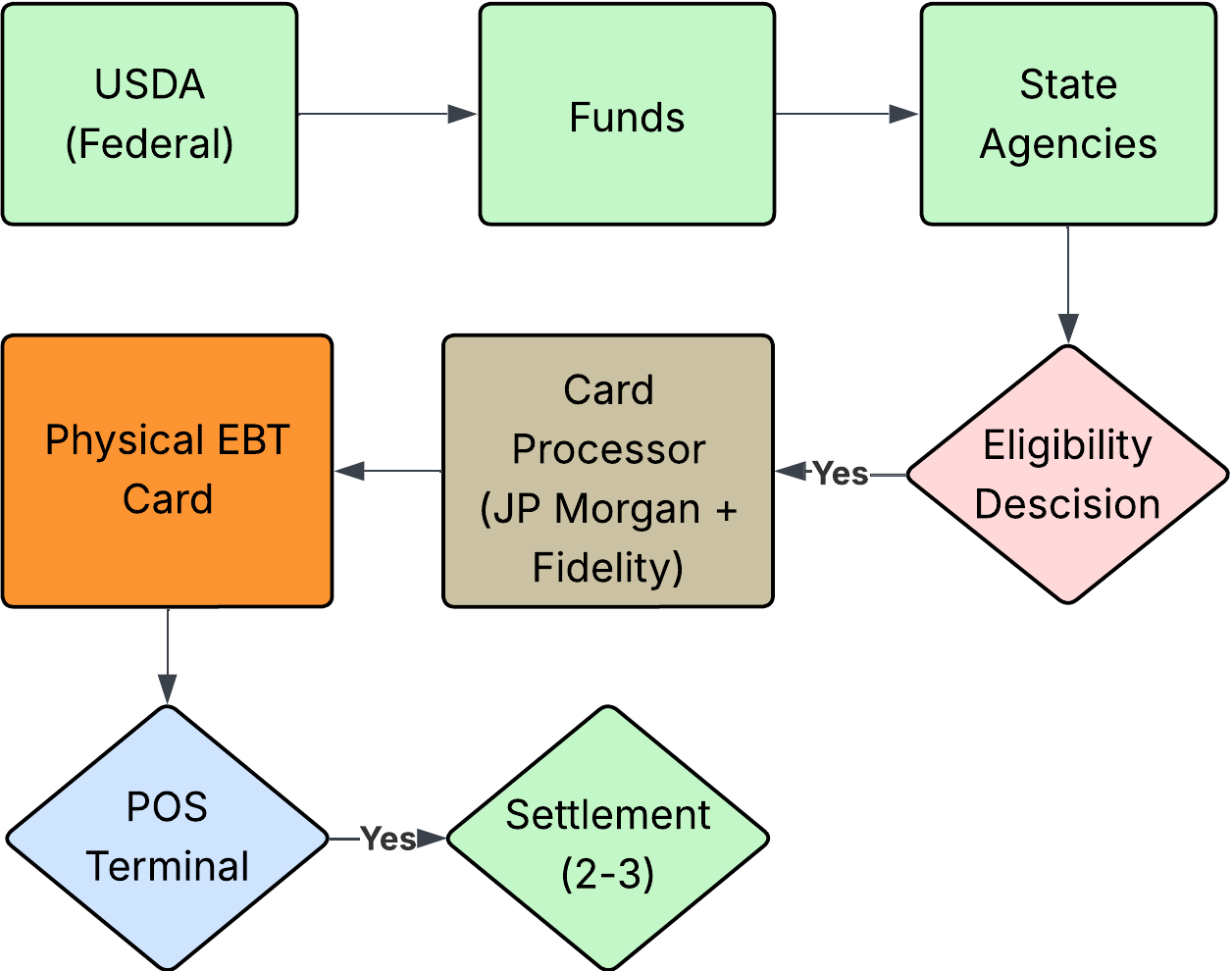
A glaring issue with this settlement flow is the time it takes for merchants to receive funds, which is 2-3 days. Each transaction costs $0.5-$2, with merchants and the government taking the fall, totaling $250 million-$1 billion per year.
Fraud Crisis In SNAP
The fraud issue within SNAP is much worse than most realize, and the prevention measures are insufficient. The Trafficking and benefits resale account for $1.7 billion in losses annually, according to the USDA’s conservative estimate. Card Skimming is another large issue in the payments world, exploding 300% between 2020 and 2023. The scammers install card readers at gas stations and grocery stores that capture your card number and PIN, thereby draining your account and cloning your card. Over $70 Million was stolen across 9 states during 2022. Retailer Fraud is also a major problem, with a 5-year period that busted over 3,500 retailers for trafficking, according to the USDA. The store owners buy the EBT benefits for cash, ring up fake transactions, and get reimbursed by the government. With a little digging, some multi-state trafficking rings have accumulated over $20 Million before being caught. The largest issue is overpayment, which costs US taxpayers $4 billion annually. In 2023, the payment accuracy rate was 89%, with the remaining 11% mostly due to overpayments at a 9.26% clip. Overpayments occur when people don’t report their income change immediately, so the state doesn’t find out for 6 to 18 months on average.
Bureaucratic Nightmare
The burden between recipients and states is outlandish. To apply for SNAP, 15 pages of documents must be submitted, including pay stubs, class schedules, and scholarships received for students, and other government documents. According to the USDA, States have 30 days to process your application, but they offer an expedited 7-day service for very low-income applicants or those who have exhausted their resources. According to the USDA, 1 in 4 eligible people don’t even apply for SNAP due to the shame and negative stigma. $50 Billion in unclaimed benefits is lost annually (# of People * Average Benefits).
2. So, Where Does Blockchain Come Into Play?
With blockchain integration, the info is now universally verified. The programs would query the blockchain directly, and no custom integrations would be needed.
This is a brief comparison of the proposed solution:
| Challenge | Centralized Database | Blockchain Solution |
|---|---|---|
| Fraud detection | Days/weeks later | Real-time, on-chain |
| Cross-state transfers | Manual takes weeks | Instant, automated |
| Audit trail | Mutable, siloed | Immutable, transparent |
| Transaction cost | $0.50-$2.00 | $0.001-$0.01 |
| Recipient proof | None (trust state) | Cryptographic verification |
| Settlement time | 2-3 days | Seconds |
| Privacy | Visible card use | Pseudonymous addresses |
| System redundancy | Single datacenter | Decentralized validators |
The main advantages of this modular design are as follows:
- Privacy Through Cryptography
- ZK Proofs prove eligibility without revealing personal data
- No visible poverty card (reduces stigma)
- Interoperability
- 1 Infra for benefit programs
- Cross-state mobility
- Future-proof for CBDCs and private stablecoins
Three-Phase Implementation Framework
Phase 1: Eligibility Tokens – This solves bureaucratic redundancy by proving eligibility once
Phase 2: Receipt Proofs – This solves fraud detection without surveillance
Phase 3: Full Tokenization – This solves the inefficiency of systems, cost reduction, and instant settlement
3. Phase 1: Eligibility Tokens
Before tokenizing the payments and benefits, proof of eligibility is required. When a state verifies someone for any benefit, but in this example, it’s SNAP, they issue a digital credential, or NFT, proving the eligibility status.
A soulbound ERC-1155 token will be used for this process. A soulbound token, or SBT, is a transferable, publicly verifiable digital token that represents a user’s on-chain identity. ERC-1155 is the ETH standard for managing multiple token types under a single smart contract, which will be useful for various credentials in the same wallet. The standard would be modified to prevent any transfers or sales, with its sole purpose to represent identity. This step is the first of many to prevent a secondary market for eligibility credentials. The token will contain a Program Type, Expiration Date, and Issued Authority (from whichever state). These will not contain any personal information like name, SSN, or income.
The L2 will use ZK Proofs uniquely. To prove eligibility for some program, the wallet will generate a cryptographic proof off-chain, typically on your phone. The verifiability proof claims you hold a valid credential without revealing private data.
If the digital option is selected, the user verifies their phone number, downloads the official application, and receives on-chain instant verification. For current SNAP recipients, an SMS message will notify them that benefits are going digital and that they must set up a wallet. The actual wallet design will be split into two vastly different clusters. With the majority having phones, a noncustodial wallet where users control their private keys will be provided, with a twist. The wallet will use biometric authentication, such as fingerprint or face ID. To recover said wallet, 3-5 contacts will be designated, and any 2 or 3 of them can sign it with a multisig. For the roughly 15% of SNAP recipients who don’t have smartphones or who don’t want to manage their own wallets, a custodial option is available in which the state holds the keys in a hardware security module. These users receive a physical NFC card they can tap at checkout, and it’s linked to a blockchain address managed by the state.
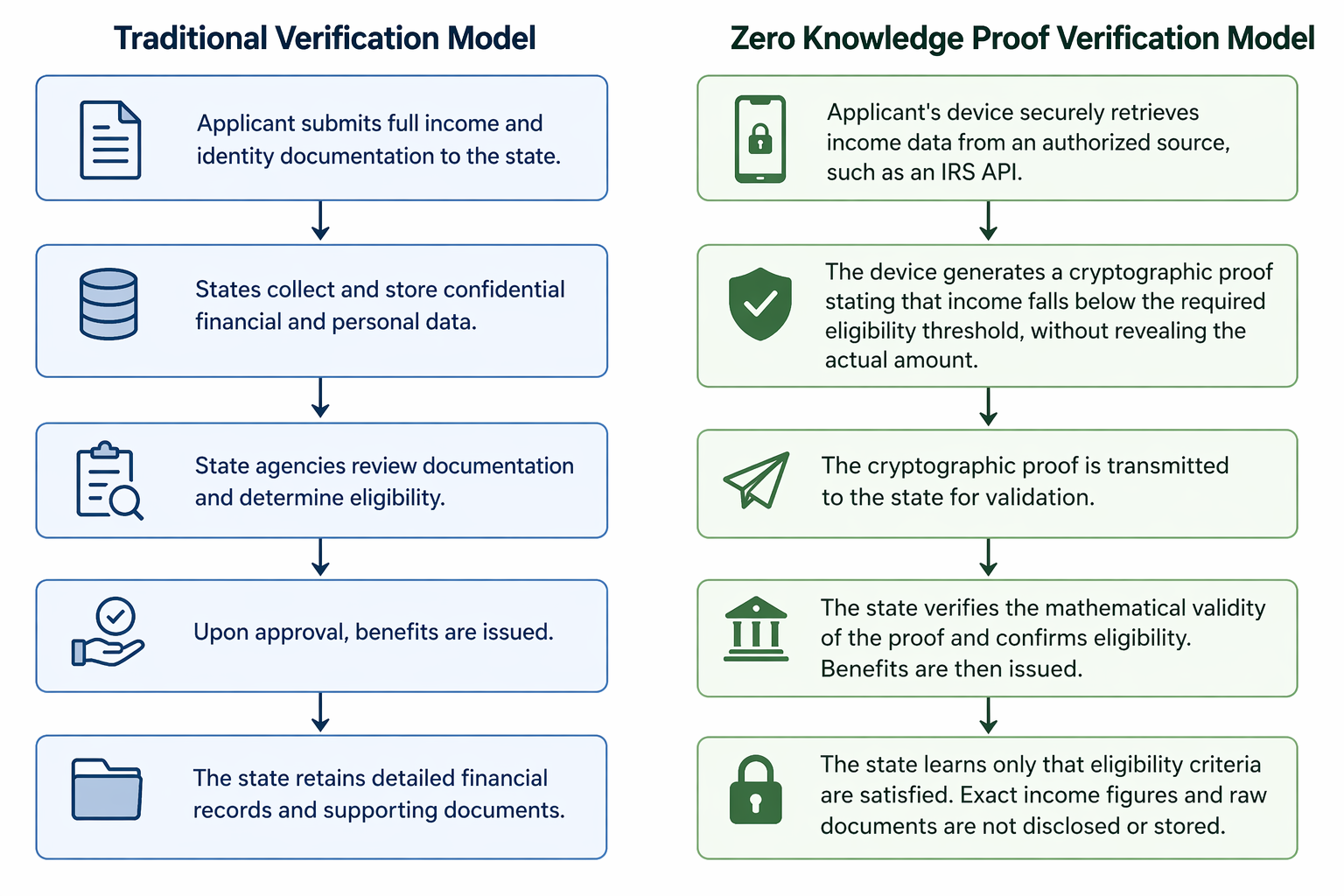
Weeks later, when applying for a Lifeline internet discount, the recipient clicks “verify eligibility” on the provider’s website, scans a QR code with the wallet application, and a ZK proof confirms eligibility instantly without revealing personal income data. The discount is applied in seconds, eliminating the need for duplicate applications, document uploads, and waiting periods. The same credential can be used for reduced transit fares, college application fee waivers, utility deposit waivers, and housing priority verification, with eligibility confirmed digitally and in real time. By reducing verification friction across programs, this model increases benefit uptake, lowers administrative burden, and ensures that eligible households receive support that currently goes unclaimed.
Phase 1 is distributing wallets to the 41.6 million people on SNAP. The state departments will be taught how to mint tokens, manage multi-sig wallets, and integrate legacy databases with smart contracts, which will be instrumental for Phases 2 and 3.
4. Phase 2: Cryptographic Receipt Proofs
With noncustodial wallets built for Phase 1, Cryptographic receipts and Proof of Transaction are next. Phase 2 addresses fraud detection without compromising privacy by tokenizing transaction attestations rather than the transaction itself. Each SNAP purchase’s hash, generated from the receipt, will be recorded on-chain, with the itemized data remaining encrypted off-chain, creating an immutable audit trail, enabling large-scale pattern detection, and preserving individuals’ privacy.
Technical Architecture
This is first explained with 3 Primary APIs
- USDA FNS Product Eligibility API
- Output = Boolean Eligibility per item/category classification
- State Benefits Verification API
- Output: Eligibility Status, Benefit Balance, Token Expiration
- Merchant Registry API
- Output: Authorization status, Fraud Detection, Transaction Limits
When a SNAP recipient purchases goods, the merchant’s POS system transmits the itemized transaction to an offchain validator, which queries the APIs in parallel. Once complete, it will calculate the eligible subtotal and generate a structured receipt containing the merchant ID, timestamp, eligible amount, item count, and attestation. The storage will be split into on-chain and off-chain components (an encrypted database). On-chain, a SHA-256 hash of receipt metadata will be committed to Polygon. The transaction cost for this would be $0.01. Off-chain, the full itemized receipt, including the UPC codes, prices, and product descriptions, will be encrypted using AES-256-GCM and stored either in an IPFS or state-managed database. Added GCM mode to further ensure data confidentiality. Also, this encryption standard is considered quantum-resistant with 128-bit security. The US government adopted AES in 2001, making it the global encryption standard, so the transfer is relatively native. Federal Privacy Law requires SNAP purchase data to be protected from unauthorized access, hence the upgraded encryption standard. To link the hash and encryption, Merkle proofs will be used. The SHA-256 hash will be computed and recorded on-chain when the receipt is stored off-chain. The tamper detection would come into play if a modification of the off-chain receipt occurs, as it won’t match the on-chain record. If patterns occur, an investigator will be granted access to decrypt the receipts through the smart contract. Also, recipients and merchants can access their own transaction history and key shares, which are part of Shamir Secret Sharing, for their transactions.
Fraud Detection
Current fraud systems rely on quarterly audits of 90-180-day-old data, excluding the 6-18-month detection lag, resulting in unrecoverable funds. To combat this, a fraud detection engine will be connected via WebSocket to an ETH node. The system will profile baseline behavior for each 41.6 million wallets alongside the merchants, for tx frequency, order size, geographic patterns, etc. A disparity or pattern interruption will trigger a red flag, thus calling in the investigator.
The Fed Reserve Payment Study looked at the Fraud Rate: Pre-2010 (0.18% of transaction volume) vs. Post-2015 with real-time monitoring (0.06%), a 67% decrease. So, delaying to real-time achieves around a 65% reduction in fraud. The current loss of Trafficking is $1.7B, whereas the theoretical reduction is 100 percent. Due to the long rollout, fraud reduction will be positioned at 85%. For retailer fraud, pattern monitoring reduces detection time from 9 months to days. Healthcare and tax fraud systems, which recently moved to predictive analytics, saw reductions of 70-80%. To use a conservative midpoint, a 75% reduction will be used. Overpayments are due to delayed income reporting, but Phase 2 doesn’t have a major role in this fraud, with a slight 5% reduction from automated crosschecks. With current fraud equaling $6.4 billion, Phase 2 will save ~ $2 billion, lowering fraud from 5.7% to 3.9%.
Privacy Preserving Research via ZK Proofs
The current constraints facing SNAP research are binary, where you can violate privacy by accessing the itemized data or accept the complete blindness of data. Introducing ZK Proofs enables selective disclosure at scale.
A query could be as follows: “For each California ZIP code, what percent of SNAP spending goes to produce, dairy, protein, processed foods?” The query then executes as a zkSNARK computation, enabling one party to prove to another that they know a secret without revealing it. The circuit then proves that:
- Only ZIP aggregated data was used (no individual transactions)
- UPC mapping used the USDA database
- Percentage Calculations are arithmetically correct
- No PII Entered computation
An example output would be: ZIP 91208: 23% Protein, ZIP 90210: 67% Processed Foods. Current government regulations prevent itemized access and the disclosure of nutritional impact. Zero-knowledge circuits enable the aggregation of statistics without individual access, making privacy violations technically impossible and enabling an evidence-based policy for the first time in SNAP history.
Phase 2 scales Phase 1’s infrastructure to a large scale, where recipients already have wallets and merchants query the blockchain to verify eligibility. The tech adds 2-3 seconds of latency. The merchants now have a single canonical source, rather than the 50 bespoke state systems. This audit layer also proves that validators are executing their checks correctly, where Merkle proofs reveal what data the validator used.
5. Phase 3: Full Tokenization with NFC Integration
Security Benefits of NFC vs. Magnetic Stripe
| Attack Vector | Current EBT Card | NFC SNAP Wallet |
|---|---|---|
| Card skimming | Vulnerable ($70M+ lost in 2022) | Impossible (no static data transmitted) |
| Card cloning | Possible (mag stripe can be copied) | Impossible (private key never leaves device) |
| Lost/stolen card | Can be used until reported (24-48hr window) | Biometric required (phone) or instant remote disable (card) |
| PIN theft | Shoulder surfing possible | Biometrics can’t be shoulder-surfed |
Onto Phase 3, which tokenizes SNAP dollars as stablecoins and includes NFC tap-to-pay. The benefits become USDC-backed tokens that settle instantly, while smart contracts enforce all eligibility rules.
For the overall blockchain architecture, a forked Polygon zkEVM will be used. Having this over building a rollup from scratch will deliver the tech in under 1 year with a $5-10m cost. The permissioned fork will enable SNAP-specific governance while still adhering to the blockchain trilemma. If deployed to Polygon, they would control the sequencer, the USDA would have no governance input, and it would delete the sole purpose of a “decentralized” procedure.
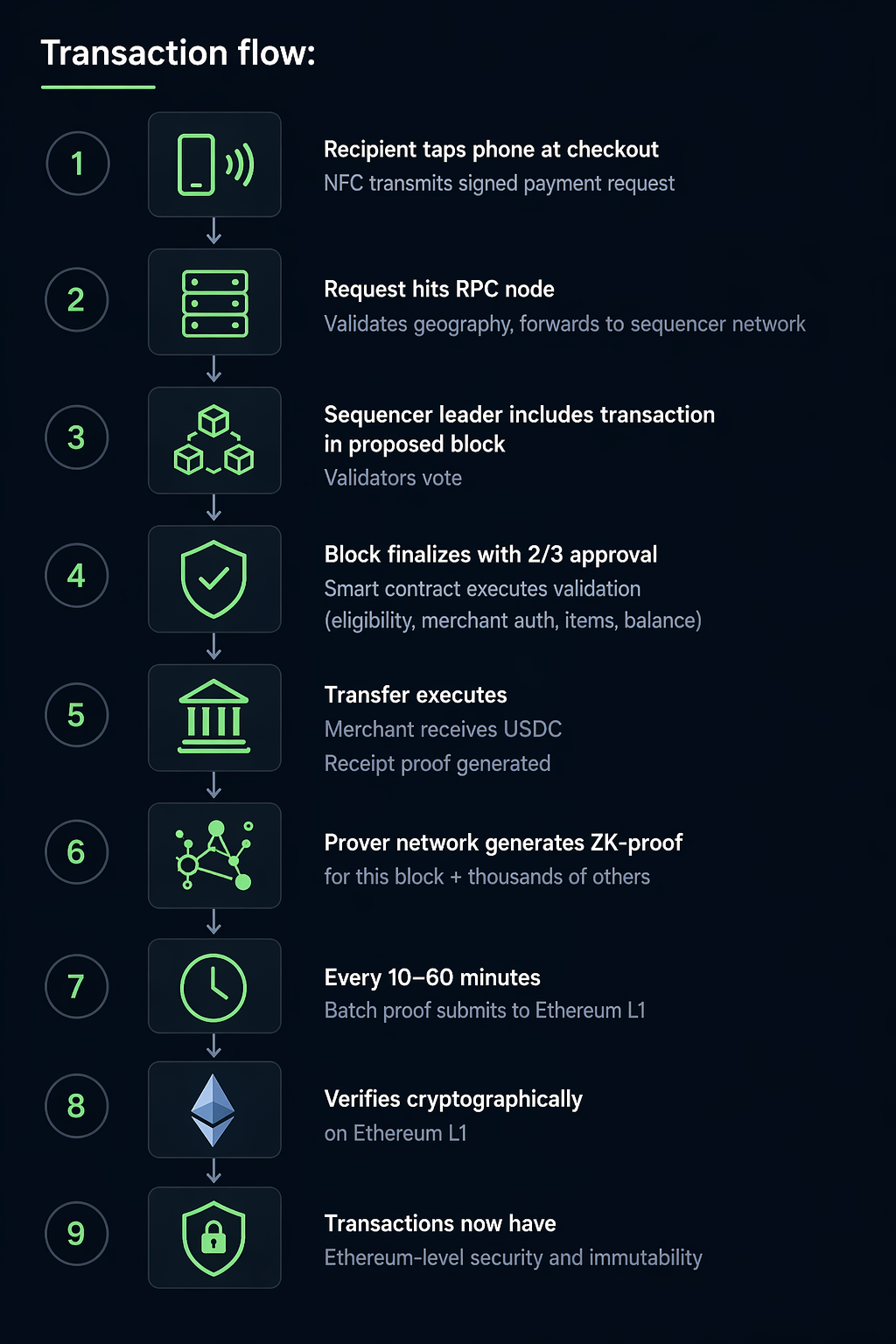
Ethereum will provide transaction finality and immutability. The zkproof verification, state root (Merkle root of L2 account balances), and batch metadata will all be stored on ETH. The zkEVM fork will execute all SNAP transactions focused on privacy and speed, with a block time and finality of 3 seconds. The transaction cost is $0.001-$0.01, but will be state-subsidized.
The NFC payment experience will be enabled by a non-custodial smartphone wallet. The transaction will be identical to the Apple Pay UX. The phone’s secure element will generate a cryptographically signed payment request by using the SNAP recipient’s private key. The cryptographic signature will then include the transaction amount, a nonce to prevent repeat attacks, and a timestamp. The phone will then display (ex, “SNAP Purchase: $67.41”) with FaceID. Using biometrics, the recipient will authenticate the transaction, then transmit it to the terminal and forward it to the merchant’s RPC connection to the rollup. The transaction then proceeds to the sequencer network, where the block leader validates the signature, verifies the sender address, and queries the smart contract to complete validation.
Speed Comparison
| Payment Method | Transaction Time | User Actions |
|---|---|---|
| Cash | 15-30 seconds | Count bills, receive change, pocket change |
| Current EBT swipe | 9-14 seconds | Insert card, enter PIN, wait for authorization, remove card |
| Chip card insert | 10-15 seconds | Insert card, wait for chip read, enter PIN if required, remove card |
| NFC tap-to-pay | 3-5 seconds | Tap phone/card, biometric/PIN if prompted, done |
| QR code scan | 10-20 seconds | Open app, find the scanner, align the camera properly, hold steady, and wait for recognition |
Currently, 62% of Americans used contactless payments in 2024 (Fed Reserve Payment Study), with 80%+ under age 40. The updated blockchain system for SNAP will facilitate offline transactions, whereas transactions in the current system will fail in areas with spotty cell coverage. The NFC transactions can operate where the phone stores the recent balance and eligibility status in local storage. The terminal will sign the transaction and queue it on-chain once connectivity resumes, with the signature preventing double-spending.
Phase 2 left card-skimming losses at over $200 million annually. The transition to NFC crypto payments in Phase 3 eliminates skimming attacks. The smart contract will verify the signature and ensure that the nonce hasn’t been used before. With no transmitted static data, NFC tap-to-pay significantly reduces the attack surface, unless skimmers relay signals from the victim’s pockets to terminals elsewhere. An estimated 95% reduction in Phase 3 card skimming is estimated to save over $190 million annually.
The introduction of Phase 3’s smart contracts will enable automated monthly income verification from the IRS, quarterly reporting, tax filings, state employment records, and SSA benefits data. The current system catches 40% of overpayments at 6 months, with an average overpayment of $600, and 35% at 12 months. In Phase 3, 70% of overpayments are caught within 1 month, and 8% within 6 months. By calculating a weighted average, the overpayment is reduced from $705 to $178 per person, representing a 75% reduction.
Phase 3 Fraud Reduction
| Category | Current | Phase 2 | Phase 3 | Reduction | Method |
|---|---|---|---|---|---|
| Trafficking | $1.7B | $250M | $250M | $1.45B (85%) | Real-time detection |
| Retailer Fraud | $500M | $125M | $125M | $375M (75%) | Anomaly flagging |
| Card Skimming | $200M | $200M | $10M | $190M (95%) | NFC cryptography |
| Overpayments | $4.0B | $3.8B | $1.0B | $3.0B (75%) | Automated verification |
| Total | $6.4B | $4.375B | $1.385B | $5.015B (78%) | Combined |
Total Economic Impact Calculations
The annual savings calculated are as follows:
- Fraud Reduction: $5.015B
- Tx Fees: $622.5M
- Admin Efficiency: $1.5B
Combined, the US government is saving $7.1B, which is 6.3% of the current $113B budget.
The time returned to the consumer saves Americans an estimated 832M hours in Phase 1 and 100M hours in Phase 3, totaling 932M hours annually. With stigma reduction from NFC privacy and automated verification, an increase of 5-8 million people are eligible to claim benefits, costing $10-15B annually in newly claimed benefits.
6. Methodology and Limitations
Several estimates presented in this paper are modeled based on publicly available data and comparable systems and should be interpreted as directional rather than exact. The blockchain framework portrayed in this paper is based on estimates rather than observed outcomes. The figures used, such as fraud savings, were based on assumptions and comparisons with similar systems in recent years and were therefore presented as directional values rather than exact figures.
The cost estimates for infrastructure deployment are approximate as well and will ultimately depend on execution, vendor selection, and rollout scale. Implementation would need to preserve administrative due process protections and account for the privacy treatment of wallet addresses as pseudonymous identifiers under existing federal and state regulations. The electronic records that are recognized under ESIGN and UETA indicate that blockchain-based credentials may satisfy legal document requirements when aligned with statutory standards.
7. Broader Significance Beyond SNAP
SNAP framework extends to the 150M+ Americans and the $2.8T federal benefit budget.
| Program | Users | Budget | Key Implementation Features | Timeline |
|---|---|---|---|---|
| SNAP (Base Layer) | 41.6M | $113B | Eligibility tokens, receipt proofs, NFC payments | Live / baseline |
| WIC | 9M | $6B | Same architecture as SNAP, eligibility tokens, receipt proofs, NFC payments | 18 months |
| Medicaid | 90M | $800B | ZK-based eligibility, health data privacy, automated prior auth, pharmacy validation | 3 to 4 years |
| Unemployment Insurance | State dependent | $30B | Identity verification, cross-state wage checks, automated eligibility rules | 2 years |
| Housing Vouchers | 2.3M households | $31B | Income privacy tokens, automated rent payments, and portability across jurisdictions | 2 to 3 years |
| School Lunch Programs | 30M | $15B | Tap-to-eat NFC, automatic eligibility via SNAP linkage, stigma reduction | 18 months |
A unified infrastructure creates network effects impossible under siloed systems. The single wallet holds credentials to multiple programs, states share eligibility infrastructure, and the fraud detection identifies the cross-program schemes. The interoperability breakthrough addresses a fundamental American safety net failure: 50 independent state systems, separate benefit program infrastructure, and repeated poverty-proof requirements. Fragmented eligibility systems across federal and state programs create substantial administrative inefficiencies, requiring recipients to repeatedly verify the same information across agencies.
Tokenizing SNAP moves eligibility, receipts, and payments into a system where cryptographic proofs can verify information without revealing the underlying data. However, the blockchain does not solve the final trust problem by itself. A ZK proof can prove that a wallet holds a valid eligibility credential, and a cryptographic signature can prove that a private key authorized a payment, but the system still needs to know that the person using the key is the intended recipient.
This is where the physical device becomes part of the trust model. In Phase 3, the phone’s secure element holds the private key, while biometric authentication is used before the transaction is signed. For recipients without smartphones, the state-managed NFC card and hardware security module create the same physical boundary in a different form. The software verifies the rules, but the device is where the authorization begins.
This framework supports Ledger’s Revenge of the Atoms position that ownership and trust cannot exist only as remote code. The credential can be on-chain, the receipt can be hashed, and the payment can settle through a smart contract, but the final authorization still depends on something the recipient physically controls. At the same time, requiring a separate hardware wallet for every SNAP recipient would add another device, another onboarding process, and another barrier for a program already dealing with accessibility problems. The hardware layer therefore matters most as the root of authorization, not as a requirement for a specific product.
For SNAP, privacy and ownership are connected. A system that proves eligibility without revealing income data still fails if someone else can authorize the transaction. The strongest version of the architecture anchors the credential cryptographically, keeps the underlying data private, and makes the final payment dependent on a physical device controlled by the recipient.
8. Conclusion
This paper presents a 3-phase blockchain implementation framework addressing the systemic failures of the United States Government, specifically in the SNAP sector. Phase 1 introduces the soulbound ERC-1155 tokens, which eliminate an estimated 832 million hours of redundant verification and address the 18–25% of eligible Americans who forgo benefits entirely, by distributing wallets to 41.6 million recipients. Phase 2 installs cryptographic receipt proofs using the SHA-256 hashing and AES-256-GCM encryption to achieve $2 Billion in annual fraud reduction. This occurs through a real-time pattern detection, which enables privacy-preserving nutritional research via zkProofs on Ethereum. Phase 3 presents full tokenization of the SNAP process, where SNAP dollars are USDC-backed stablecoins with NFC functionality on a permissioned Polygon zkEVM fork operated by a consortium of 50 state nodes, 5 USDA nodes, and 3 tech operators, leading to $7.1 Billion in annual savings. This framework provides a viable pathway to modernizing the American safety net infrastructure of $2.8 Trillion.
- Artemis Analytics. Stablecoin Dashboard. Artemis Terminal, 2026. app.artemisanalytics.com/stablecoins
- Artemis Analytics. USDC Asset Overview. Artemis Terminal, 2026. app.artemisanalytics.com/asset/usdc
- Artemis Analytics. USDT Asset Overview. Artemis Terminal, 2026. app.artemisanalytics.com/asset/usdt
- Biggs, Andrew G., and Aaron Yelowitz. Reducing Waste and Fraud in SNAP. Mercatus Center, May 2025. mercatus.org
- Board of Governors of the Federal Reserve System. Trends in Noncash Payments, 2024. Federal Reserve, Mar. 2025. federalreserve.gov
- Circle Internet Group. USDC Transparency and Attestation Reports. Circle, 2024. circle.com/en/usdc
- Clearly Payments. The Contactless Payments Market Overview in the USA for 2024. Clearly Payments, 4 Sept. 2024. clearlypayments.com
- Congressional Research Service. Supplemental Nutrition Assistance Program: A Primer on Eligibility and Benefits. R42505, 2024. congress.gov/crs-product/R42505
- Congressional Research Service. Supplemental Nutrition Assistance Program: Errors and Fraud. IF10860, Apr. 2025. congress.gov/crs-product/IF10860
- Congressional Research Service. SNAP: Benefit Theft Through Electronic Benefit Card Skimming. IN12419, Jan. 2025. congress.gov/crs-product/IN12419
- Dale, Brady. “Stablecoin Transactions Rose to Record $33 Trillion in 2025.” Bloomberg, 8 Jan. 2026. bloomberg.com
- Federal Reserve Bank of Atlanta. Diary of Consumer Payment Choice, 2025. Federal Reserve Financial Services, 2025. frbservices.org
- Government Accountability Office. Food Stamp Trafficking: FNS Could Enhance Program Integrity by Better Targeting Stores Likely to Traffic and Increasing Penalties. GAO-07-53, 13 Oct. 2006. gao.gov/assets/a252574
- Government Accountability Office. Improper Payments: USDA’s Oversight of the Supplemental Nutrition Assistance Program. GAO-24-107461, Sept. 2024. gao.gov/products/gao-24-107461
- Monkovic, Mia, and Ben Ward. Characteristics of Supplemental Nutrition Assistance Program Households: Fiscal Year 2023. U.S. Department of Agriculture, 2025. fns-prod.azureedge.us
- Pew Research Center. “What the Data Says About Food Stamps in the U.S.” 14 Nov. 2025. pewresearch.org
- Pulvera, Richard, et al. “The Association of Safety-Net Program Participation with Government Perceptions, Welfare Stigma, and Discrimination.” Health Affairs Scholar, 2023. pmc.ncbi.nlm.nih.gov
- U.S. Census Bureau. “SNAP Eligibility and Access.” Oct. 2024. census.gov
- U.S. Department of Agriculture. FY 2023 Budget Summary. 2022. usda.gov
- U.S. Department of Agriculture, Economic Research Service. “SNAP Key Statistics and Research.” 2024. ers.usda.gov
- U.S. Department of Agriculture, Economic Research Service. “SNAP Spending Rose and Fell with Pandemic-Era Changes.” Amber Waves, June 2024. ers.usda.gov
- U.S. Department of Agriculture, Food and Nutrition Service. “Addressing Stolen SNAP Benefits.” 2024. fns.usda.gov
- U.S. Department of Agriculture, Food and Nutrition Service. “SNAP Data Tables.” Feb. 2026. fns.usda.gov
- U.S. Department of Agriculture, Food and Nutrition Service. “SNAP Eligibility.” 2025. fns.usda.gov
- U.S. Department of Agriculture, Food and Nutrition Service. “SNAP Payment Error Rates.” 2024. fns.usda.gov
- U.S. Department of Agriculture, Food and Nutrition Service. The Extent of Trafficking in SNAP: 2015–2017. 2019. fns.usda.gov
- U.S. Department of Agriculture, Food and Nutrition Service. Trends in SNAP Participation Rates: FY 2020 and 2022. 2024. fns.usda.gov
I certify that the research, analysis, architecture, calculations, and conclusions in this paper are my original work. External claims and data are cited in the Works Cited. AI tools were used as a working and editing tool, and I reviewed and take responsibility for the final paper.
Cameron Coleman · August 8, 2026
