






Revenge of the Atoms | 03/13/2026
Revenge of the Atoms
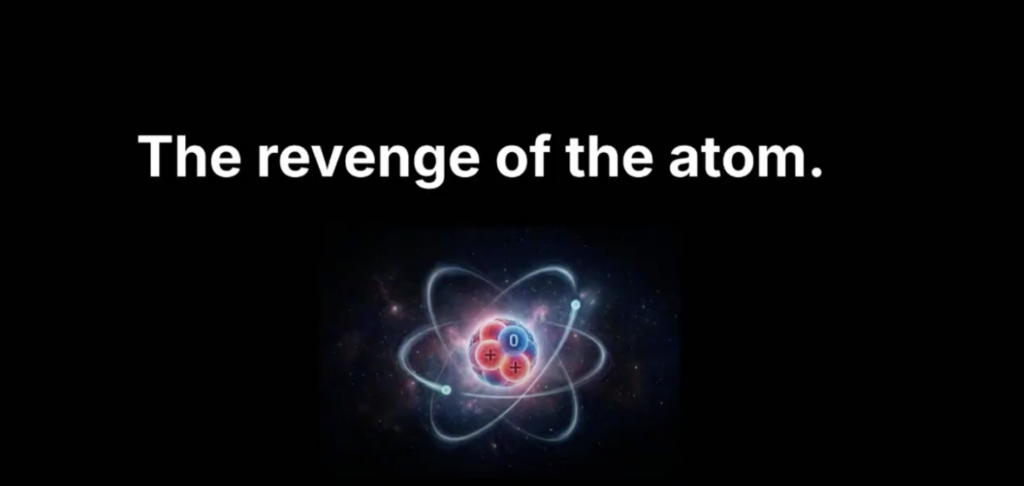
The security model that got us here will not get us to the next chapter. Software defenses are crumbling under AI assault, while the value at stake grows exponentially. Ledger’s opportunity is to extend our proven hardware from protecting your Bitcoin to governing your entire digital life. The atoms are taking their revenge. Ledger is the weapon.
We are witnessing the collision of two tectonic shifts, Blockchain and AI, that will fundamentally redefine the concept of trust. If you aren’t paying attention, you aren’t building for the future
By Pascal Gauthier, Chairman & CEO of Ledger
The Tokenization of Everything
Blockchain has achieved the “impossible”: it allows ownership to exist natively on the Internet. For the first time, value moves at the speed of information.
The inherent scale of the internet ensures that trillions of dollars in assets – real estate, equities, bonds, commodities – are shifting to the blockchain as tokenized digital assets. But it’s not just wealth. Our identities are moving, too. In the U.S., you can fly domestically with a digital passport on your phone. In 2025, China rolled out their National Internet Identity. The European Union has set a deadline of 2026 for the rollout of a Digital EU Identity Wallet to every citizen. Soon, every critical aspect of our lives – our wealth, our credentials, our rights – will be stored digitally by default.
In 2026 the future of work is becoming clear: humans will be orchestrators of AI agents. As Notion CEO Ivan Zhao put it, each of us becomes “a manager of infinite minds” who, in the words of Microsoft CEO Satya Nadella, “macro-delegate and micro-steer”. Soon every knowledge worker will have at least one and likely many AI agents they are delegating to. Our success in the workforce of tomorrow will be relative to how good we are at managing a fleet of agents.
Your agents will do whatever you ask them to do. But this begs a fundamental question, the same question your bank or your crypto exchange struggles with 24 hours a day: How does your agent know you are you? Communicating via your phone or your computer, it’s impossible to know.
At Ledger, we’ve spent twelve years preparing for this. With over eight million devices sold, we protect a significant portion of the world’s digital assets. But the technology we pioneered – Secure Elements and hardware-anchored keys – is no longer just about “crypto.” It is the essential governance, identity, and security layer for the next phase of the internet.
AI is Eating Software
While value is being tokenized, AI is commoditizing the entire software industry. The old moats are collapsing overnight. Software is no longer “eating the world”; AI is eating software.
We are entering what I call the Economy of Action. Soon, the primary actors in our financial system won’t be humans clicking buttons; they will be autonomous AI agents. These agents will research, negotiate, and transact in milliseconds, 24/7. But there is a massive problem: Software cannot secure an AI-driven world.
The Security Crisis: Code is Not Bedrock
For thirty years, we’ve relied on software to protect our digital lives. It was “good enough” until it wasn’t. In 2025 alone, cybercrime losses hit an estimated $10.5 trillion. Now, AI has turned “good enough” into “extinct.”
AI is destroying software-based security before our eyes:
- Machine-Speed Exploits: AI probes code for vulnerabilities millions of times faster than any human hacker.
- Deepfakes & Social Engineering: You can no longer trust your eyes or ears. If a CEO can be deepfaked on a Zoom call to authorize a wire transfer, your software-based “identity” is worthless.
- Agent Hijacking: As we give AI agents authority over our money, they become the ultimate targets. Your AI agent will do whatever you ask it to do. But how does it know you are the one asking? And how can you be sure you are talking to the agent you believe you are?
Software security is probabilistic – code fighting code. In that war, the attacker only needs to be right once. To survive the AI assault, we must move the “root of trust” out of the reach of code.
The Physics of Trust
How do you secure a world where AI can defeat any software defense?
The answer is deterministic hardware.
In a future of autonomous agents, security must shift from a “battle of algorithms” to a “boundary of physics.” Software operates on the same plane as the threats it faces. Hardware does not. By anchoring trust in immutable silicon – Secure Elements logically isolated from the operating system – we create a physical barrier that AI cannot cross.
Deterministic hardware ensures that even the most advanced AI cannot extract a private key, because it is physically barred from the digital interface. You cannot patch physics. You cannot social-engineer a chip. You cannot inject a prompt into a hardware gate. The atoms are fighting back, and in this fight, physics always wins.
The Ledger Inevitability
Ledger has evolved from a “crypto vault” into the infrastructure layer for the agentic economy. We are uniquely positioned because:
- The Proven Blueprint: We aren’t theorizing. We are shipping. Our hardware-anchored governance allows agents to propose transactions while the human retains the “kill switch.” This is the “steering lock” for autonomous systems. AI solutions can already be used via the Ledger Device Management Kit from developers.ledger.com where developers can build Ledger as a steering lock for their applications.
- Proof of Human: In a world flooded with synthetic bots, distinguishing a human from an AI is existential. Ledger provides cryptographic attestation that an action was authorized by a real person physically interacting with hardware. No deepfake can replicate a physical button press. The full spectrum here is: Proof of Ledger, Proof of Owner (as in, I am the person who created this agent), Proof of Human, Proof of Unique Human (I am not sharing my identity but I have a credential that verifies I am unique), and Proof of You (a credential that identifies you as a certain human).
- The Global Base: We already have over eight million “anchors” in the wild. While others are trying to build hardware distribution from zero, we are already protecting billions in assets and expanding into identity and agent authorization.
See our AI Security Roadmap – Published on April 14th, 2026, explaining how to secure an agent with a hardware root of trust.
The Choice Ahead
Every major technology transition has an inflection point. In the early internet, encryption seemed optional until e-commerce made it mandatory. Today, hardware-anchored security is transitioning from “nice to have” to the “invisible infrastructure” of the modern world.
The security model that got us here will not get us to the next chapter. Software defenses are crumbling under AI assault while the value at stake grows exponentially. Ledger’s opportunity is to extend our proven hardware from protecting your Bitcoin to governing your entire digital life.
The atoms are taking their revenge. Ledger is the weapon.
Trust must be built on bedrock, not code.
Pascal Gauthier is the CEO of Ledger, the global leader in digital asset security.
Disclaimer
Crypto transaction services are provided by third-party service providers. AI agents are third-party tools and not provided, operated, or endorsed by Ledger. Ledger provides no financial advice or recommendations on the use of these third-party services or any AI agent.