









Enterprise, Revenge of the Atoms | 04/23/2026
Green Audits, Red Balances: Why Your Treasury Needs Clear Signing
In 2025, the digital asset industry witnessed a series of catastrophic failures that redefined our understanding of institutional security. This article deconstructs how giants like Bybit and SwissBorg fell victim to hackers, and outlines the transition every organization must make to a Clear Signing and Zero Trust architecture to survive the next generation of AI-driven threats.
Before You Dive In:
- Major institutional players are losing billions despite green audits because they rely on software interfaces that can be manipulated to hide malicious transactions.
- Clear Signing transforms unreadable hexadecimals into human-readable intent on a tamper-proof hardware screen, creating a hardware-rooted source of truth.
- To secure digital ownership, organizations must move beyond reactive insurance and static audits toward a Zero Trust architecture centered around Clear Signing and hardware-backed security.
The Mirage Of Traditional Security
For many leadership teams, security is viewed as a collection of defensive layers: encrypted databases, complex passwords, and high-level experts. However, digital asset security is a foundation with three pillars. If any single leg fails, your entire treasury falls.
- Seed Protection: This is your foundation. It ensures your master keys never touch the internet, and it’s what Ledger signers are built to do.
- Governance: This process is designed to ensure that no individual has the power to move funds unilaterally.
- Clear Signing: Provides additional reassurance that the data your signer approves matches your actual intent.
The exploits at Bybit and SwissBorg proved that you can have perfect keys and perfect governance, but if you lack Clear Signing, you are still vulnerable.
Why Institutional Defenses Are Failing
Many organizations operate under the false assumption that being small makes them invisible, or that their current tools are good enough. In reality, the threat landscape has shifted. Here is where the traditional model breaks down.
The Governance Trap
Governance is a human workflow, but attackers exploit the technical gap. Even if your policy requires five executives to approve a transfer, governance won’t save you if those five people are looking at standard computer screens.
During the Bybit attack, the software interface was hijacked. While the approvers thought they were moving funds to an internal wallet, the underlying, unreadable code actually granted an attacker total control. The attack proved a crucial point; governance without clarity is just an illusion.
The Danger Of Software-Only Interfaces
Many modern organizations rely on a patchwork of 3rd-party dashboards and APIs to manage their flow. Unfortunately, with every new software layer comes a new vulnerability.
The SwissBorg hack utilized a compromised API, while Bybit fell victim to a supply chain attack. If you rely on a web browser or a software-based wallet to tell you what you are signing, you cannot be certain that the information you receive is an accurate representation of what you will actually sign.
The AI-Powered Threat
The old logic suggested that hackers only targeted whales. Today, AI-driven automation has scaled cybercrime. Automated scripts now scan every corner of the blockchain for any weakness.
For an AI agent, a small treasury is no longer an invisible target. In this environment, being under the radar is no longer a viable security strategy.
From Security By Ritual To Security By Architecture
For too long, organizations have treated risk as a financial line item to be covered by external safety nets. However, the staggering rise in stolen funds (reaching $3.4 billion in 2025) demonstrates that these reactive measures are no longer enough to stem the tide. To survive, organizations must move to security grounded in Zero Trust architecture.
Insurance Is Not Prevention
While cyber insurance provides a financial safety net, it is not a proactive defense. As attacks become more sophisticated, premiums are skyrocketing, and many policies now include strict negligence clauses. This can impact organizational claims if a loss occurs because an employee was tricked into technically authorizing a malicious transaction via a hijacked interface.
Audits Are Not Active
Smart contract audits are essential for verifying the integrity of the underlying code, but they merely provide a static screenshot of the system at a given moment in time.
An audit cannot protect an organization if the software interface used to interact with that code is compromised, or if any changes to the code are introduced after the audit. Even a perfectly audited vault is effectively useless if an attacker manipulates the user interface to trick signers into handing over control.
Real security requires an active, hardware-rooted enforcement layer that operates independently of the software environment.
Ledger Enterprise Multisig: From Blind Trust to Verified Certainty
Ledger Enterprise Multisig is an enforcement layer designed to close the gap between user intent and on-chain execution. By migrating from security by ritual to security by architecture, organizations can eliminate human-centric vulnerabilities.
Verified Intent
Ledger Enterprise Multisig ensures that every transaction is parsed into plain, human-readable language before it is signed.
Instead of asking executives to approve a cryptic 0x hash, the system displays the exact nature of the transaction (e.g., “Send 500 ETH to whitelisted Market Maker A”). This clarity ensures that the authorizing parties are providing informed consent rather than simply rubber-stamping code they cannot understand.
The Secure Screen
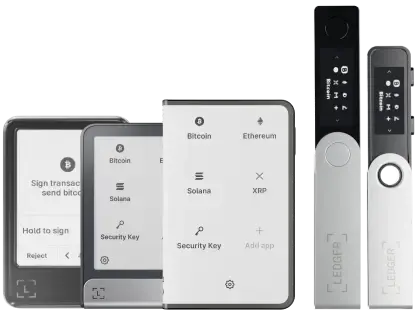
Transaction information is delivered through a Secure Screen, powered by a Secure Element chip that remains entirely isolated from the internet. As this screen is physically disconnected from your computer’s operating system, it provides a strong defence against UI-spoofing and browser-in-the-middle attacks.
Even if your computer is fully compromised by malware, the Secure Screen is designed to display transaction data independently of the host machine.
Proactive Protection
To prevent errors before they occur, Ledger Enterprise Multisig integrates real-time automated transaction checks directly into the signing workflow. This proactive defense scans for interactions with malicious contracts, phishing addresses, or sanctioned lists, displaying a clear warning on the signer device itself. Unlike software-based alerts that can be suppressed by a compromised frontend, these hardware-enforced warnings ensure that signers are alerted to risks in a tamper-proof environment.
Digital Ownership At Scale
Ledger Enterprise Multisig allows organizations to manage institutional-grade funds with the agility of a startup and the security of a global bank.
By utilizing a cryptographically signed and fully encrypted Secure Address Book and hardware-enforced policy controls, enterprises can scale their operations without increasing their attack surface. This architecture ensures that true digital ownership is maintained through every governance change and digital asset transfer, providing a seamless bridge between operational flexibility and uncompromising security.
The Path To Verified Certainty
The era of trusting your computer screen is over. As AI makes attacks more sophisticated and frequent, the only path forward is a Zero Trust model. Adopting a security-by-design architecture is not just about protecting funds; it is about ensuring operational continuity.
To secure your organization’s future and move toward a Clear Signing standard, visit the Ledger Enterprise Multisig platform and take control of your digital ownership.
Disclaimer
Ledger Enterprise is a technology provider, not a regulated financial institution, custodian, or Crypto Asset Service Provider (CASP). We provide secure IT infrastructure and software to enable self-custody; we do not manage, control, or take possession of client funds or digital assets. This document is provided for informational purposes only and does not constitute financial, legal, or regulatory advice or a financial promotion. Digital assets are inherently high risk. In the United Kingdom, this material is directed solely at investment professionals and high-net-worth companies as defined under the Financial Services and Markets Act 2000 (Financial Promotion) Order 2005. It is not intended for, nor should it be relied upon by, retail clients.
Crypto transaction services are provided by third-party service providers. AI agents are third-party tools and not provided, operated, or endorsed by Ledger. Ledger provides no financial advice or recommendations on the use of these third-party services or any AI agent.