



Compare Ledger signers






The Battleground Against Phishing Attempts
Read the article
Discover our devices
Ledger ecosystem
Learn Web3
Work with Ledger
Even with Ledger or what you would think is coming from Ledger. Ledger and Ledger support will never ask for them.
You should never enter your 24 words anywhere other than directly into your device.
#StopTheScammers
Phishing attempts are targeting Ledger customers.
Phishing attacks are unfortunately an all too common threat when using the internet. This page aims to make a list of some examples of phishing attacks we have received at Ledger targeting our customers. If you have any doubts about the authenticity of a communication from Ledger, you can refer to the list below highlighting some recent phishing campaigns.

Scammers will ask you to download a fake Ledger Wallet (formerly Ledger Live) application that will trigger a transaction on your Ledger device. You must absolutely reject that transaction.
Some phishing attempts claim that Ledger will 'deactivate' or 'block' your device for KYC reasons. Ledger is not in a position to 'block' or 'deactivate' your device. Any request asking you to do this is an attempt to scam you.
Remember: A Ledger device is used for the purposes of self-custody. The nature of cryptocurrency accounts is such that there is no identity directly associated with any account.
Be cautious, fake domain names are sometimes very close with a subtle spelling difference such as “legder”, “leqder”, “ledqer”, “lèdger” or “ledgёr”
Please also be aware of what you may think is a ledger.com domain name but is in fact not!
See for example:
ledger.com-a42-encryption-m6-email.rg37-s8-smtp (dot) cloud
Authentic Ledger domain names are:
@ledger.fr
@ledger.com
@ledgerwallet.com
@ledger.zendesk.com
Please take a moment to review our help center article on this topic for more information related to legitimate Ledger domains, including both websites and email addresses.
As soon as you receive a so-called Ledger communication via text message, WhatsApp, Telegram, phone call or postal letter, assume that it is a phishing attempt, report it as spam, and block the sender.
Ledger will also never prompt you to contact us via any method other than via our official support channels (our chat widget in the bottom-right corner here).
Ledger will only communicate via email and official social media channels:
Fake Emails
Stay vigilant: These are the latest active phishing campaigns. Remember to double-check the sending email address.
While Ledger does send out occasional marketing emails, we do not send out emails asking you to update device firmware/operating system, enable 2fa, or other similar actions.
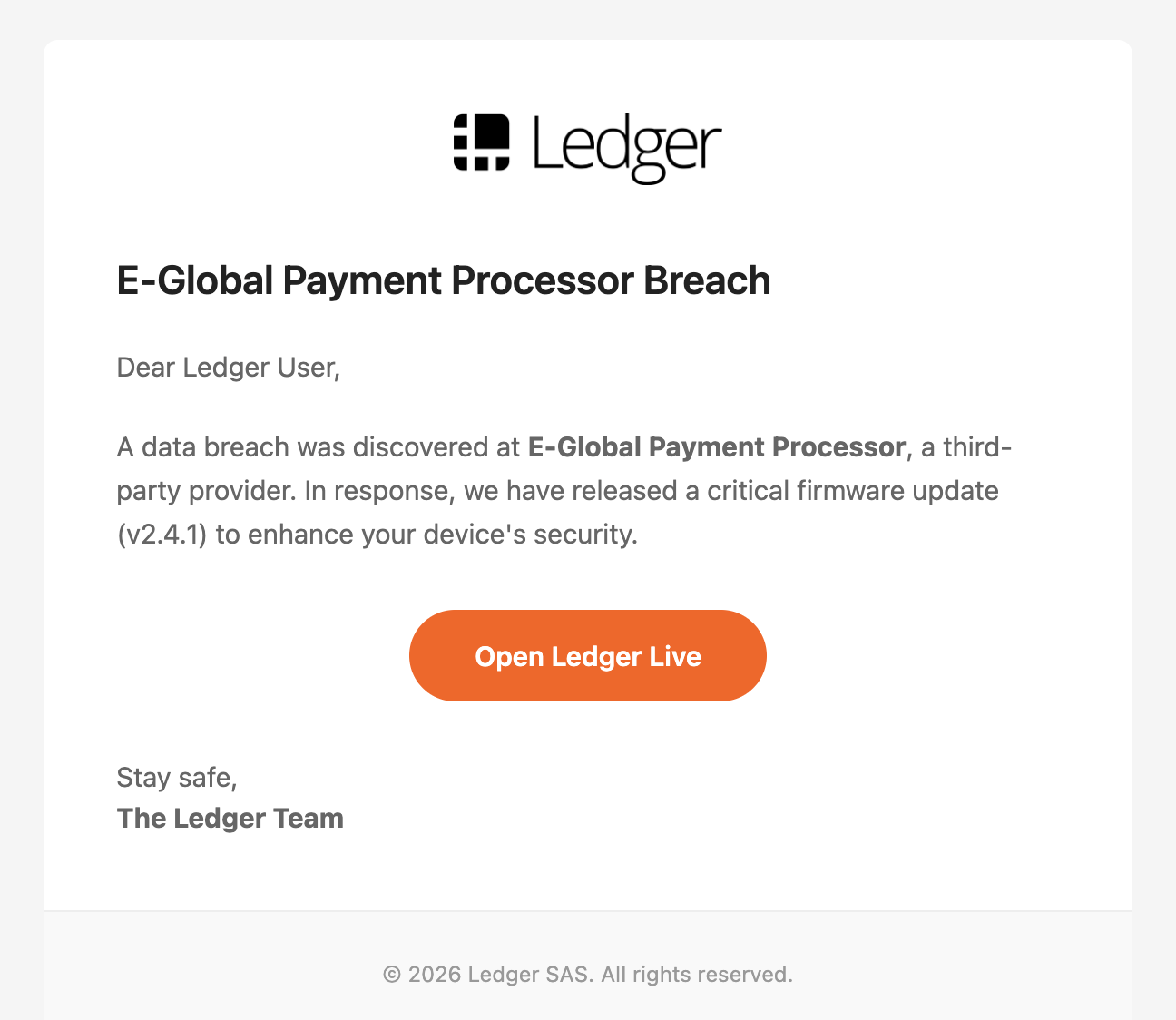
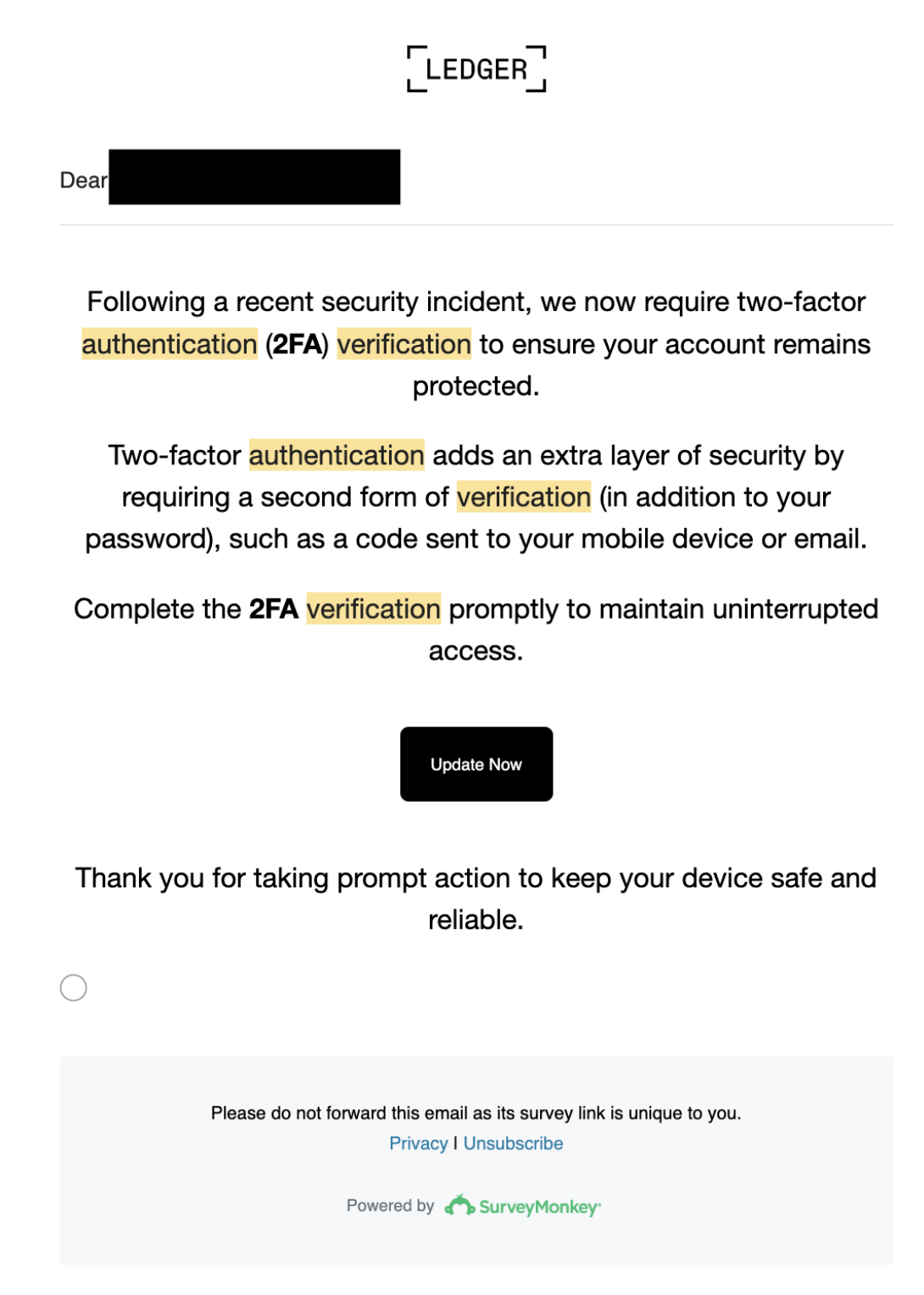
Always remember: There is never a good reason to type your phrase into a computer.
Physical mail prompting users to scan a QR code or visit a website
Users are receiving physical letters in the mail. The letters vary in format and subject matter, but they all prompt individuals to scan a QR code and/or go to the website mentioned in the letter, and follow the set of instructions. Ultimately, users are requested to enter their 24 words. Remember: Never enter your 24 words – there is no good reason to type your recovery phrase into a computer. Anyone that has your recovery phrase has full access to any account that has been created using it.
Below are a few photo examples of this scam variant:
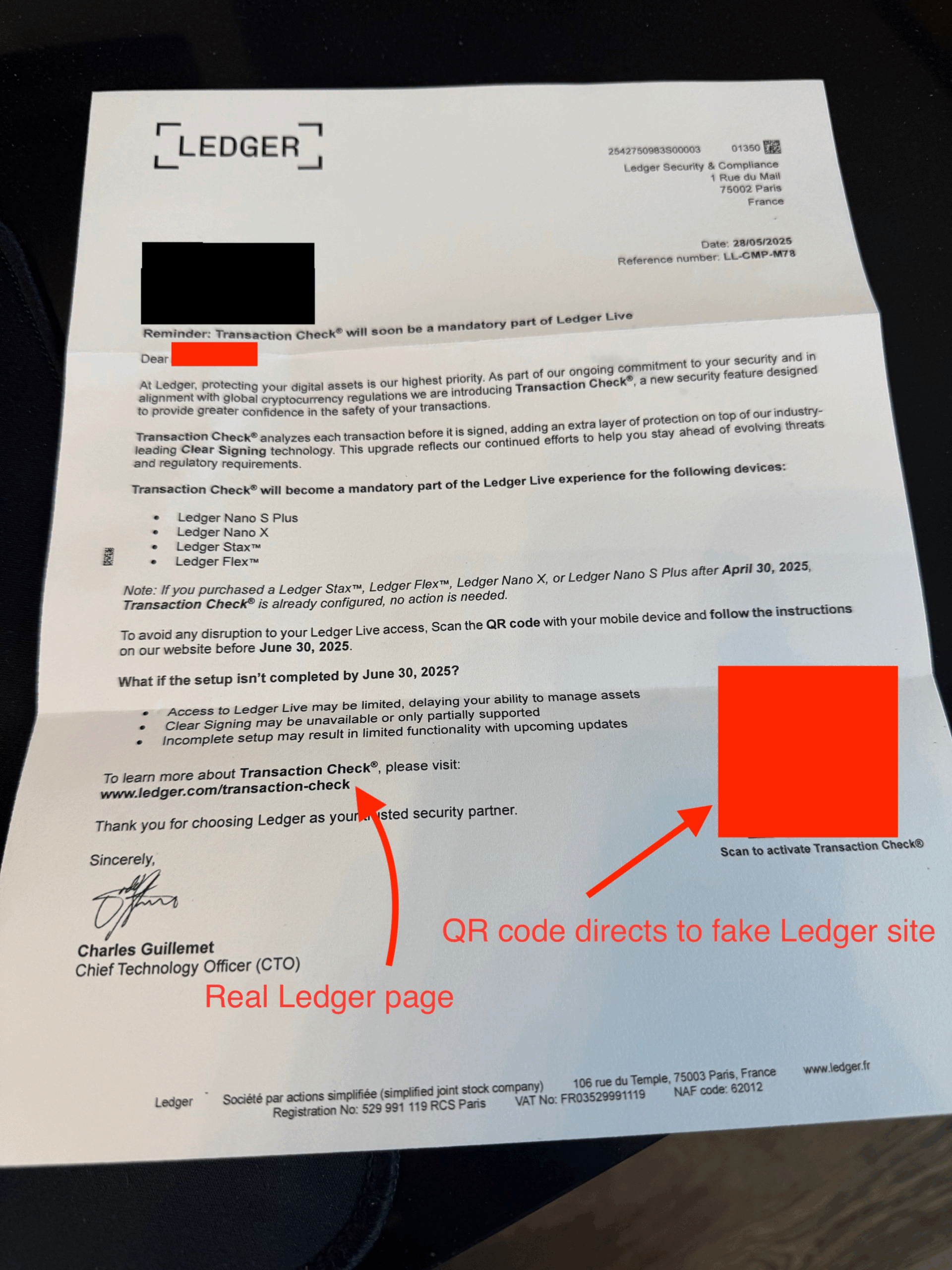
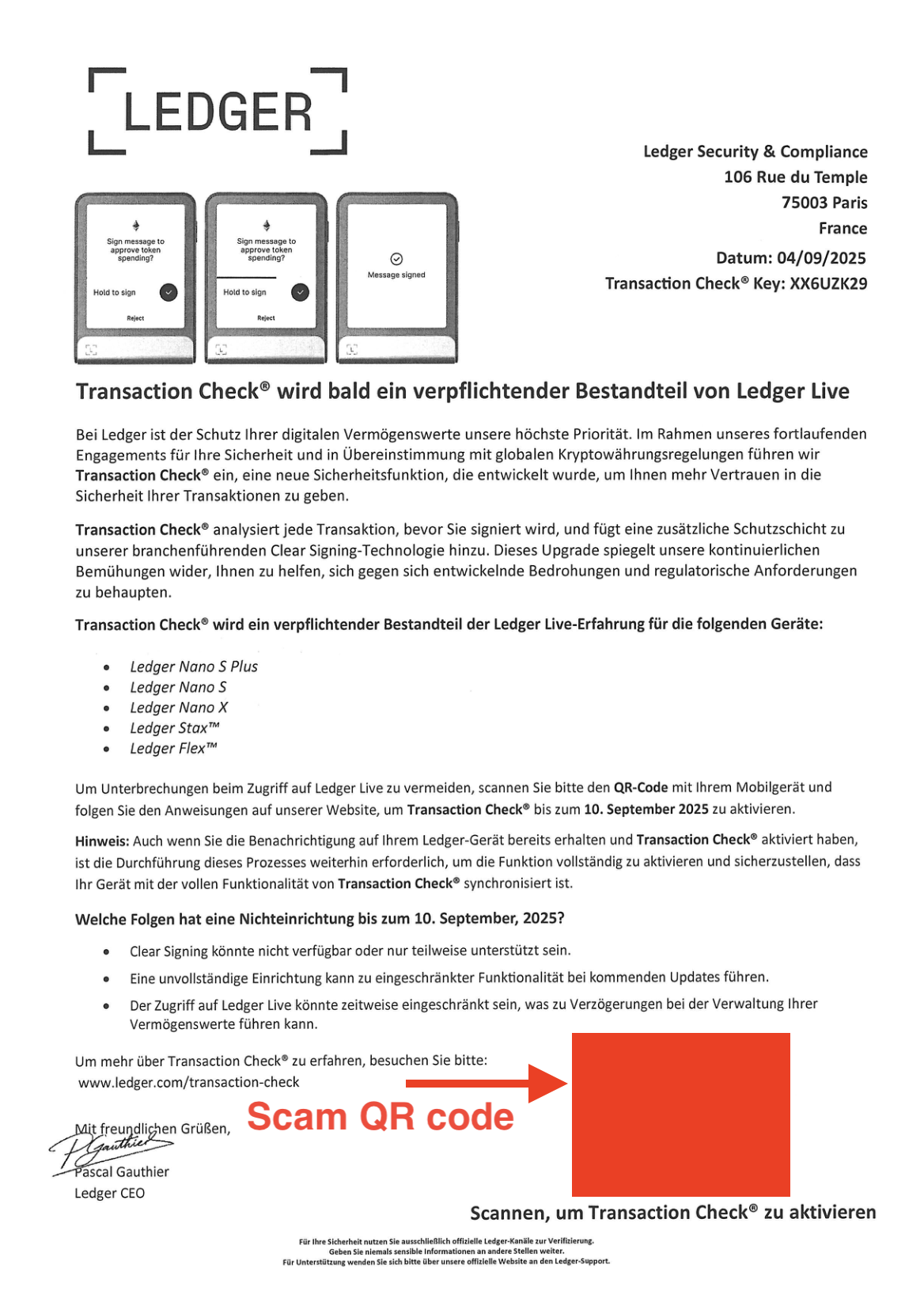
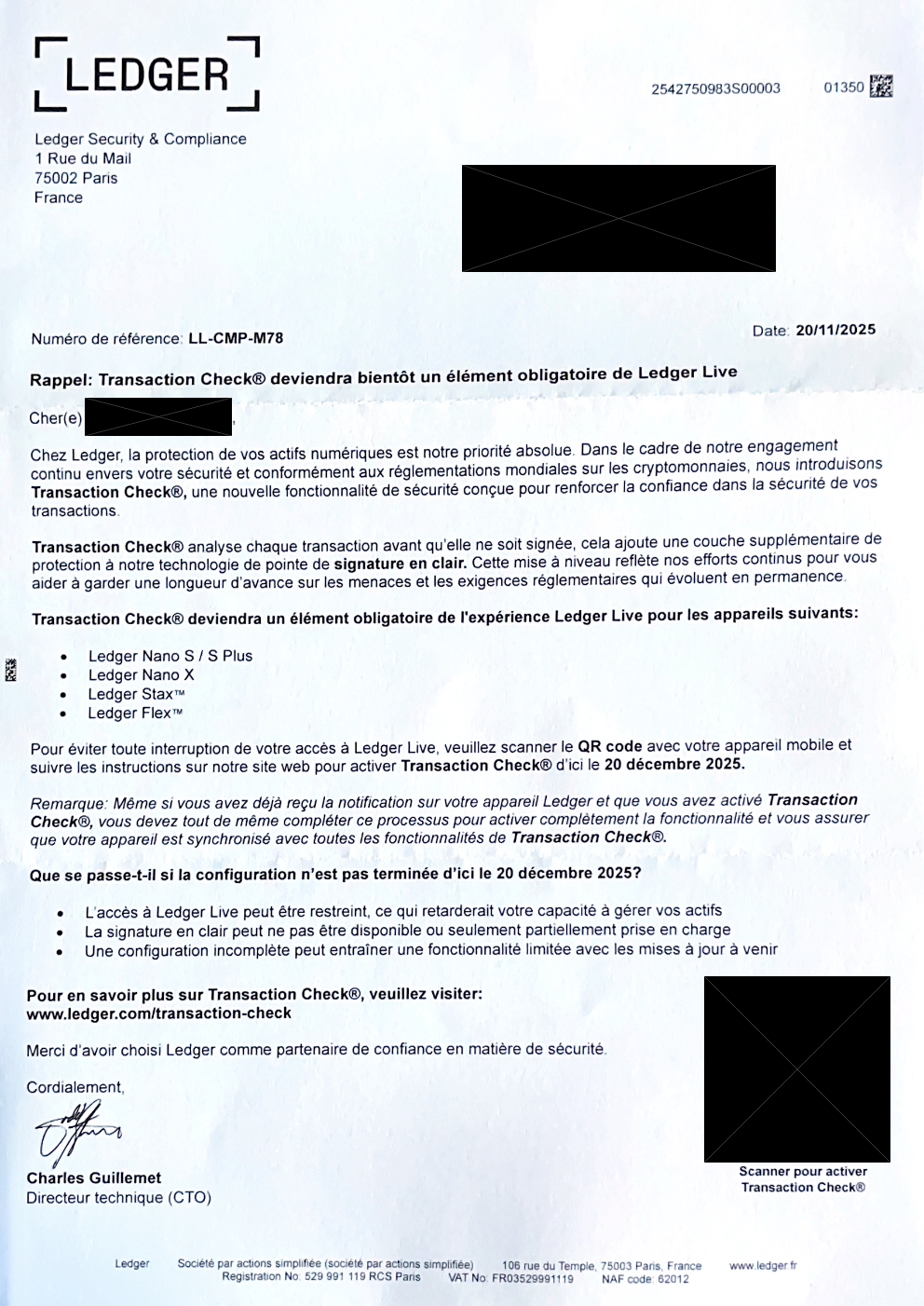
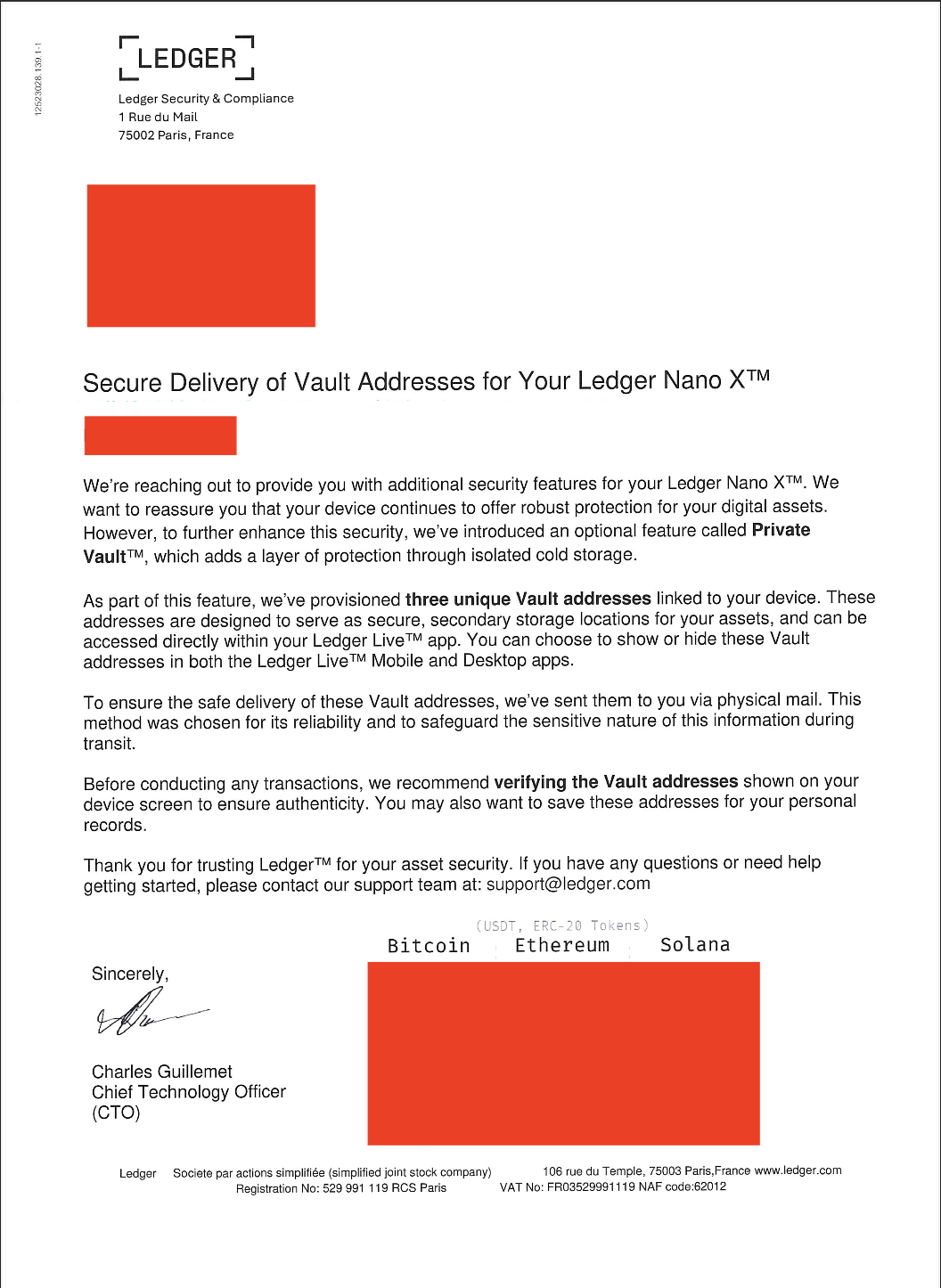
Another recent letter claims that Ledger has opened vault addresses for specific users. It implies but does not directly state that you should send funds to various wallet addresses in order to “vault” your crypto. This is of course not true, and you should never send cryptocurrency to an address you don’t know.
Malicious actors contacting Ledger users via phone calls
The key takeaway here is that Ledger will never contact users via phone call, for any reason. No matter how convincing the person may seem, always remember that there are no circumstances where it would be necessary to provide your 24 word recovery phrase. Any attempt to gain this secret information is an attempt to steal your funds.
If you ever find yourself on the phone with someone claiming to be from Ledger, immediately hang up and ignore further contact attempts.
We’ve seen three primary trends involving unsolicited phone calls:
This Ledger Support Article will provide more information about this scam tactic.
Fake Ledger Wallet (formerly Ledger Live) application or website
This remains one of the most common scam tactics we see. Fake versions of Ledger Wallet (formerly Ledger Live) can look extremely convincing at first glance. However, users who attempt to interact with one will inevitably receive a supposed “error message” accompanied by a request to input their 24 word recovery phrase. Of course, there is no real issue with the device, its memory, the firmware, etc. It is only an attempt to get the user to type their 24 word recovery phrase.
The only place to download the official Ledger Wallet application is directly from our website at https://www.ledger.com/ledger-live. Please refer to this article to see examples of some fake Ledger Wallet applications/websites we’ve encountered:
Ledger Support Article
In these examples, when the victim of the scam clicks the “Verify Now”, “Secure My Account Now”, or “Claim My Gen 5 Protection Device” button, they are taken to a site where they are prompted to enter their recovery phrase. The recovery phrase is the key to your accounts, and anyone with this phrase has full access to all accounts created using it.
Scam NFTs / Tokens
This tactic involves a scammer depositing an NFT into a user’s wallet that contains a title or description intended to trick the user into believing they have won a prize or giveaway. It will also include instructions to visit a website to claim the “reward”. NFTs of this nature should be treated the same as a spam email – don’t interact with them in any way.
This article will provide some examples of common scam NFTs that are received, as well as instructions on how to properly handle them: Ledger Support Article
If you receive an unsolicited airdropped token, ignore and hide it immediately without any interaction; these tokens are “bait” traps designed to lure you to phishing websites where “claiming” or swapping them triggers a malicious smart contract that drains your wallet.
Beware of the latest one: (Token Name: QCORE (QCORE.FINANCE)).
Fake social media accounts posing as Ledger
Scammers constantly create fake profiles on social media platforms that can be very difficult to spot as a fake. One key thing to remember is that Ledger will never send users a direct message on social media. Any request to communicate via direct message on social media platforms should be considered a scam attempt.
On top of impersonating our official support accounts, scammers will often impersonate individuals who work at Ledger or have worked at Ledger in the past. These messages can be received as responses to your posts, and they will typically request for you to send them a direct message. They may also recommend to follow up with someone on another social media platform, such as linking an Instagram or Telegram account to contact.
For your security, please treat any message directing you to contact another person on social media, or any attempt to engage via direct message, as a scam attempt. Above all, always remember to never provide your 24 word recovery phrase to any person, no matter what.
Please refer to this article for a full list of our official support profiles on social media:
Ledger Support Article

The Battleground Against Phishing Attempts
Read the article
Anatomy of a Phishing Attack
Read the article
How to keep your crypto safe against scams
Read the articleIf you think you have received a fake communication from a third party impersonating Ledger (phone call, email, or other), report it in detail to our dedicated phishing address: [email protected]
If you want to report a fake X (Twitter) account impersonating Ledger or its employees, you can use this link.
Please also consider reporting the phishing or fraud attempt to the Federal Trade Commission. This can be done here.
If you have received a phishing attempt or if you are aware of an illegal website, please report it to Google Safebrowsing. The more we report these illegal websites to Google, the more difficult it will be for scammers to deceive our Ledger users.
Thank you for taking the time to report a phishing email. It will help us identify potential new phishing campaigns. All reports are carefully reviewed by our team but please note that we don’t send individualized responses. If your inquiry requires a response from Ledger, please contact our Customer Support directly.
Privacy notice for phishing report email: Ledger has a legitimate interest in collecting and processing your data to investigate your phishing report. Your information will be available to Ledger (and its technical providers) and will be retained for no longer than 6 months. Your data may be shared with law enforcement authorities for investigation purposes. If you do not wish that we share your information, please let us know.
Your information may be transferred to non-European countries that ensure an adequate level of protection, or under the standard contractual clauses adopted by the EU Commission or the Data Privacy Framework Program for providers located in the United States.
You may access your data and request their rectification or deletion. You may also request the limitation of the processing of your data. To exercise your rights or for any question on the processing of your data, please contact Ledger’s Data Protection Officer here. If nevertheless you believe Ledger did not adequately address your concerns and mishandled your data, you may lodge a complaint with the personal data protection authority of your country.