
Perpetual Trading Explained: What Is It And How Does It Work?

| KEY TAKEAWAYS: |
| — Perpetual trading (perps) offers 24/7 leveraged exposure to digital assets – including crypto and tokenized stocks – in both directions, with no expiry date and no need to own the asset. — On-chain perps give you self-custody and transparency, but trading on these platforms also means, blind signing, browser wallet vulnerabilities, and no way to verify what you’re actually approving. — Ledger Wallet™ combines the transparency of on-chain perps with the ease of an all-in-one app, backed by hardware-grade protection at every step. |
Perpetual trading lets you speculate on whether an asset’s price will go up or down, without ever owning the asset itself. In the 24/7 world of crypto markets, that means continuous access to markets, leveraged exposure, and no need to hold the underlying asset at any point.
Demand for perpetual futures has grown considerably, and so have the options for how to trade them. You can access them on centralized exchanges, or trade them on-chain through decentralized protocols. Each comes with its own trade-offs around custody, usability, and security.
But what if you didn’t have to choose? Ledger Wallet™, now lets you trade perpetual markets with Yield.xyz directly via a single, intuitive app, with on-chain settlement, self-custody, clear transaction signing, and hardware-backed protection at every step.
This guide breaks down exactly what perpetual trading is, how it works, and what makes trading with a Ledger signer a different experience.
What Is Perpetual Trading?
A perpetual futures contract (also called a “perp”) is a financial derivative that tracks the price of an asset like Bitcoin (BTC) or Ethereum (ETH), without you ever needing to own it.
Instead of buying BTC, you open a contract predicting BTC’s future price movement. You can take a long position, predicting the price will rise, or a short position, predicting the price will fall. You profit based on the difference between the actual price and the point at which you close the contract. The underlying asset itself never changes hands. Only the gain or loss from the trade.
What makes perpetuals different from traditional futures is that they have no expiry date.
Standard futures contracts close on a fixed date. Perpetual contracts do not have an expiry date. You can hold a position for as long as you choose – minutes, days or months – provided the initial deposit you use to fund the position (known as margin) stays above the minimum required level.
Positions can be closed voluntarily at any time, or automatically liquidated if your margin falls below the required threshold, resulting in the loss of your collateral. Holding a position open also incurs an ongoing funding rate, explained below.
How Does Perpetual Trading Work?
Perpetual trading is built on four core concepts: direction, leverage, margin, and the funding rate. Understanding each one tells you how your trade performs, and what it costs to hold it.
Long vs. Short Positions
Every perpetual trade starts with a single question: do you think the price will go up or down?
- Long position: You expect the price to rise. Open a long on ETH at $2,000 and it climbs to $2,500, meaning you profit from that $500 move, without ever holding ETH.
- Short position: You expect the price to fall. Short BTC at $60,000 and it drops to $55,000, meaning you profit from the decline.
In spot trading, where you buy and hold the actual asset, you can only profit when prices rise. Perpetuals let you take a position in either direction.
But ‘opening’ a position isn’t free. To enter a perpetual trade, long or short, you have to put up collateral first by depositing funds into the platform.
That collateral acts as a security deposit: it has to be large enough to cover the maximum loss the platform expects your position could take before it would force you to close.
The smaller your deposit relative to your position size, the less room the price has to move against you before you run out of collateral. That’s why your deposit directly limits how much leverage you can take on a trade.
It is important to note that perpetual trading is highly risky and can result in losses. These losses magnify especially because you trade with leverage.
Leverage and Margin in Perpetual Trading
Leverage lets you control a position much larger than the amount you deposit. The money you put in is called your margin, which is the collateral backing your trade. You’re never buying the asset. You’re opening a leveraged position on its price movement from the start.
Example: 5x leverage on ETH
You deposit $500 as margin and open a long position on ETH at $2,000 with 5x leverage. This means that your total position size is $2,500.
- ETH rises 10% to $2,200 → your position gains $250. Your margin grows from $500 to $750, a 50% return.
- ETH falls 10% to $1,800 → your position loses $250. Your margin drops from $500 to $250, a 50% loss.
- ETH falls 20% to $1,600 → the loss is $500 ($2,500 × 0.20). Your margin is consumed entirely, and your position is liquidated, resulting in the loss of your collateral.
To clarify, when the price starts to move against you, your losses don’t immediately wipe you out.
As your margin shrinks toward the minimum level required to keep your position open, you’ll typically receive a margin call: a warning that your position is at risk and that you need to add more collateral to keep it alive. If you top up in time, the trade stays open. If you don’t, the platform automatically closes your trade in a process called liquidation.
Liquidation
Liquidation happens when your margin falls below the minimum level required to keep your position open. The platform automatically closes your trade and, in most cases, you lose the full amount deposited for that position.
However, there are four situations where some of your deposits may survive a liquidation.
First, many platforms (including protocols like Hyperliquid) try to close only the smallest part of your position needed to bring you back above the safe margin level, rather than closing it entirely. If the price recovers after that partial close, the rest of your collateral stays intact.
Second, when the platform is closing your trade for you, it has to find buyers (or sellers) on the open market, and sometimes it gets a better price than expected. When that happens, any used funds go back to you instead of being lost.
Third, if you receive a warning that your position is in danger and you act quickly, either by depositing more collateral or by closing the trade yourself, you can stop the liquidation from happening at all. Your remaining margin stays yours.
Lastly, well-designed platforms have built-in safety nets (called backstop vaults and insurance mechanisms) that prevent your account balance from going below zero. These platforms have been designed to prevent you from owing more money than your original deposit.
In fast-moving market conditions, prices can blow through your liquidation threshold before any warning is meaningful, and by the time you see the alert, the trade may already be closed.
Liquidation Cascades Explained
There’s also a second-order risk worth understanding: liquidation cascades. When prices drop sharply, many leveraged positions hit their liquidation thresholds at the same time. The exchange must sell all that collateral on the open market at once, which pushes the price of the associated asset down further, triggering a further wave of liquidations in a cascade effect.
This is a well-documented phenomenon in crypto markets. On October 11th 2025, over $10 billion in leveraged positions were wiped out in a single event – one of the largest liquidation cascades in crypto history – as cascading sell pressure drove prices sharply lower and triggered wave after wave of forced closures.
Funding Rate Mechanism
Here’s a subtlety that catches many new traders off guard.
A perpetual contract isn’t the asset itself, it’s a separate product designed to track the real-world market price of the asset you’re trading. This applies across all perpetual markets accessible via Ledger WalletTM – from major crypto assets like BTC and ETH to tokenized stocks – known as the spot price. But nothing automatically forces the contract price to stay in line with the spot price.
When demand for the contract is higher than demand for the asset, the contract can start trading above spot. When demand is lower, it can drift below. Without a correction mechanism, that gap could grow indefinitely.
The mechanism that solves this is called the funding rate.
Funding Rates Explained
Every eight hours, a small payment is exchanged between traders holding long positions and traders holding short positions. The direction of the payment depends on where the contract price sits relative to spot:
- Perp price above spot (positive rate): Longs pay Shorts. This creates a cost for holding long positions and a reward for going short, which gradually pulls the contract price back down toward the real market price.
- Perp price below spot (negative rate): Shorts pay Longs. This incentivizes buying, pushing the price back up toward the spot price.
Funding rates can provide a useful barometer of market sentiment, rising during bull markets and falling during bear markets.
The key thing to understand is funding costs accumulate. If you’re on the paying side, a small percentage of your position’s value is deducted from your margin at every interval. Even a low rate of 0.05% every eight hours compounds to roughly 54% of your position’s value over a full year. Always calculate what funding will cost you before holding a leveraged trade for days or weeks.
Note that this payment flows between traders, not to or from the exchange.
Spot Trading vs. Traditional Futures vs. Perpetuals: Comparison Table
Now that you understand how perps work, it helps to see where they sit alongside the two instruments traders most often compare them to: spot trading and traditional futures.
| Feature | Spot Trading | Traditional Futures | Perpetuals |
| Own the Asset | ✓ Yes | ✗ No (cash-settled) | ✗ No (cash-settled) |
| Expiry Date | None | Fixed date | None |
| Leverage Available | ✗ No | ✓ Limited | Up to 125x |
| Short Selling | ✗ Not natively | ✓ Yes | ✓ Yes |
| Funding Costs | None | None | Every 8 hrs |
| Rollover Required | N/A | ✓ Yes | ✗ No |
| Liquidation Risk | None | Yes | High (with leverage) |
| Trading Hours | 24/7 | Exchange hours | 24/7 |
| Price Anchoring | Real-time market | Settlement date | Funding rate mechanism |
| Self-Custody Possible | ✓ Yes | ✗ No | On-chain only |
Spot trading is the simplest of the three. You buy and hold the actual asset, face no liquidation risk or funding costs, and your Bitcoin is genuinely yours. The trade-off is that you can only profit when prices rise.
Traditional futures let you use leverage and short positions, but every contract has a fixed end date. When that date arrives, your position closes automatically. Staying in the trade means opening a new contract, which means extra fees. Perpetuals combine the flexibility of both. You get 24/7 markets, leverage, and the ability to go short, with no expiry date to manage. The funding rate is the ongoing cost of that flexibility.
Centralised Exchange Perp Trading vs. On-Chain Perp Trading
Most perpetual volume in crypto flows through centralised exchanges. For years, that’s simply where the liquidity lived. These platforms are familiar, fast, and easy to use.
The trade-off is custody. When you deposit collateral to a centralised exchange, those funds leave your control. They become a balance on the exchange’s internal ledger. You’re trusting that the platform stays solvent, that its security holds, and that nothing restricts your account or assets.
These are not hypothetical concerns. Exchange hacks and insolvencies have affected user balances across the industry for over a decade. The collapse of FTX in 2022 made the risk impossible to ignore; overnight, hundreds of thousands of users were locked out of funds they had treated as their own.
What Are On-Chain Perps?
On-chain protocols let you trade perpetual contracts directly on-chain. You keep your funds in a wallet you control and connect it to the protocol when you want to trade. Your collateral stays visible on the blockchain at all times. Trades execute through smart contracts, and the protocol never takes possession of your funds.
There’s no exchange balance sheet holding your money. No operator with the power to restrict your account. The custody risk inherent to centralized platforms are essentially removed.
The catch, until recently, was usability.
Trading on-chain typically meant bridging funds across chains, connecting a software wallet whose private keys live on an internet-connected device, navigating unfamiliar interfaces, and signing transactions displayed as unreadable strings of code. You solved the custody problem and inherited a new set: browser wallet vulnerabilities, blind signing risk, and the kind of operational friction that made active trading genuinely difficult.
Perpetual Trading via Ledger WalletTM
Perpetual trading via Ledger Wallet™ is built on one premise: if you’re going to take on the risk of leveraged trading, you should do it through a secure infrastructure.
You can now access perpetual markets directly via Ledger Wallet™ on mobile or desktop, clear signing on your Ledger signer.
How Does It Work?
Perp trading via Ledger Wallet™ is provided by Yield.xyz and built on Hyperliquid, a high-performance on-chain trading protocol built for perpetual markets. It’s fast enough to feel like a centralized exchange, but it never takes custody of your funds.
What makes it different is the secure hardware: your Ledger signer. Every signature, whether depositing collateral or withdrawing funds, goes through your Ledger signer’s secure chip. Your private keys never touch the internet.
What Can You Trade?
Provided by Yield.xyz, perpetual trading via Ledger WalletTM includes:
- Long and short positions on major assets including BTC, ETH, SOL, and more.
- Market and limit orders: open at current prices or set your entry in advance.
- Take Profit and Stop Loss: set automated exit points when you open a position.
- Built-in candlestick charts with selectable timeframes (1m, 5m, 15m, 1h, 4h, 1d).
- Edit and close positions: adjust or exit any open trade, with a clear P&L summary on close.
- Leverage on majors: with your maximum limit shown clearly in-app.
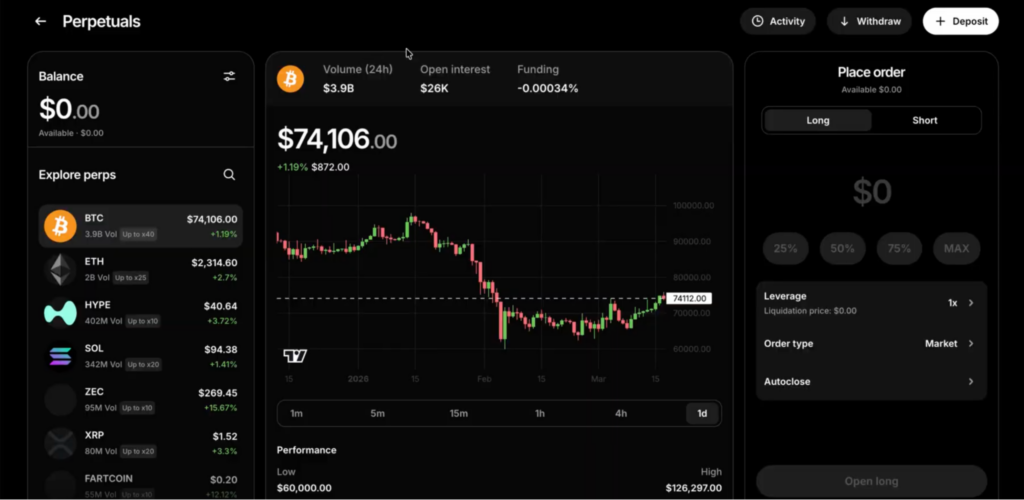
On Ledger WalletTM’s Perpetuals dashboard, you can also view live market data for any asset before you open a trade, including the 24-hour trading volume, the current open interest (the total value of active positions in the market), and the live funding rate.
Because the funding rate is displayed in real time on the asset you’re viewing, you can see at a glance which side of the market is paying (longs or shorts) and roughly how expensive it would be to hold a position open.
The dashboard turns funding from a hidden expense into something you can read in real-time before you trade.
Free from Compromise, with Ledger WalletTM
Without a hardware signer, trading perps on-chain means navigating browser wallets, blind signing, and environments where a single compromised session can cost you more than any trade. Ledger Wallet removes that friction – free from compromise. With a software wallet, the process can involve multiple steps, each can be a potential attack surface. A phishing site. A malicious browser extension. A compromised session.
Ledger WalletTM collapses all of it into one place. Perp trading lives inside the same app you already use to stake ETH, swap tokens, buy crypto, and manage your long-term holdings. No third-party wallet to install. No separate website to connect to.
Clear Signing and Transaction Check
Before you approve any transaction, you need to know exactly what you’re approving. This is where Ledger signers set a different standard.
When you deposit collateral, open a position, or withdraw funds, the full details of what you’re authorising appear on your Ledger signer’s secure screen in plain language, not hex code. You read it, verify it, and confirm it on a device whose private keys have never touched the internet.
Transaction Check goes one step further. It analyses each signing request in real-time and flags anything suspicious: malicious contracts, known scam addresses, or transactions that don’t match what the app is showing you. If something looks off, you get warned before you approve.
Together, Clear Signing and Transaction Check mean you always know two things before you confirm: exactly what you’re signing, and whether that signature is safe to give.
Secure Self-Custody
Your private keys stay isolated from the internet on your Ledger signer at all times. No exchange holds your collateral. No operator can freeze your account. Whether a centralized platform gets hacked, freezes withdrawals, or goes insolvent is no longer your concern. Your assets are yours.
Underpinning all of this is Ledger’s security architecture: a secure screen, a custom operating system, and a secure element chip. This is hardened further by Ledger Donjon, Ledger’s in-house team of security researchers who actively probe for vulnerabilities before they can reach users.
Managing Risks in Perpetual Trading
No platform or guide can eliminate the financial risk in perpetual trading. What you can control is how you approach it. Here are the practices experienced traders rely on:
- Start small. The lower the leverage, the more time you have to react when the market moves against you, and vice versa.
- Use stop loss and take profit. Volatility drives emotion. Setting clear exit points before you open a position helps you stick to your plan, not your feelings.
- Trade within your limits. Only risk what you’re willing to lose. Perpetual trading involves significant risk of financial loss and may not be suitable for everyone.
- Monitor funding rates. If you’re holding a position for days or weeks, funding costs accumulate. Check the rate before entering and factor it into your trade.
- Avoid overtrading. More positions means more exposure and more fees. Fewer, well-considered trades tend to outperform impulsive ones.
Conclusion
Perpetual trading will always carry high financial risk. Leverage, liquidation, and funding costs are inherent to these instruments, and no platform removes that.
What Ledger WalletTM removes is the additional layer of security risk that comes from trading in environments where your funds aren’t truly yours, where your signatures aren’t truly informed, and where a single compromised browser session can cost you more than any trade ever could.
You get all the exposure of leveraged crypto trading. You keep technical control through hardware-backed self-custody.
Perpetual trading is rolling out progressively across select regions. Buy a Ledger signer today and start trading perpetuals with hardware security.
DISCLAIMER: Perpetuals trading is speculative and carries substantial risk and is provided by Yield.xyz. Read full disclosure: https://docs.yield.xyz/docs/perpetuals-trading-disclaimer. This service is not intended for users in restricted jurisdictions, including the UK, US, Ontario (Canada), France, and Belgium. Always read and accept the Terms of Service of Yield.xyz before transacting. Ledger does not provide any financial advice or recommendation. Crypto transaction services are provided by third-party service providers. Ledger provides no advice or recommendations to use any of these third-party services.
