
How ETFs Are Reshaping Crypto Investment

| KEY TAKEAWAYS: |
| — Crypto’s complexity and risks tend to deter mainstream investors due to a lot of factors including lack of understanding or trust. — Crypto ETFs solve this by letting you invest in Bitcoin or Ethereum through a regular brokerage account, as easily as buying stocks, with regulatory oversight for added trust and security. — While BTC & ETH ETFs provide more mainstream access to cryptocurrencies, they don’t actually offer you ownership of those assets. Instead, you’re trusting centralized entities with your funds. |
With the rise of ETFs, getting involved in cryptocurrencies has now become as mainstream as buying stocks or precious metals. Both Bitcoin and Ether ETFs have seen huge success with over $1.2 billion in daily inflows recorded in October 2025 for U.S. Bitcoin ETFs alone, and Ethereum ETFs reaching $30 billion in assets under management (AUM) by September 2025, making them some of the most popular ETF launches in history.
However, there’s more to ETFs than just their easy access. Many people don’t realise they contradict part of crypto’s core ethos: ownership.
To explain, ETFs don’t offer you true ownership over crypto assets. Instead you’re trusting a centralized financial institution to safeguard that crypto for you, which poses some risks and limitations. So if you’re wondering what a crypto ETF is, how they work and whether you actually want to get involved with them, you’re in the right place.
Let’s dive in.
Crypto ETFs: What Are They?
Crypto ETFs are exchange-traded funds (ETFs) that hold cryptocurrencies or cryptocurrency-related assets, allowing investors exposure to crypto through a traditional investment structure.
They let you invest in crypto’s value through a regular brokerage account, skipping direct ownership of the crypto asset itself.
When you invest in a crypto ETF, you’re essentially buying shares in a professionally managed fund holding the actual crypto assets, overseen by financial institutions like BlackRock or Grayscale. In return, you pay fees and forgo control of the private keys, so your exposure can be frozen or restricted by regulators.
Like Ledger CEO Pascal Gauthier says, “ a Bitcoin ETF will never be your Bitcoin”.
How Crypto ETFs Drive Adoption (But at a Cost)
In a nutshell, ETFs make crypto accessible and liquid, letting you trade easily at market prices. They also lower the entry barrier for newcomers, allowing for less tax complexity. However, there’s a huge trade-off: ETFs are centralized, meaning you rely on others to manage your funds, which contrasts with crypto’s decentralized ethos.
As of Q1 2025, Coinshare research shows that institutional investors hold just 22.9 % of total U.S. Bitcoin ETF assets, i.e. the majority of ETF shares are still owned by everyday investors, not pension funds or banks.
Meanwhile, corporate treasuries outside ETFs increased their Bitcoin holdings from 1.68 million BTC to 1.98 million BTC by May 2025, suggesting that corporations are now opening up to Bitcoin as a hedge against inflation and economic instability.
Though this compromise promotes broader adoption and helps new entrants into crypto gain confidence in the systems in place, secure self-custody unlocks a higher level of freedom and control and puts power back in the hands of the people.
Now, let’s explore some of the types of ETFs and why they’re important.
Types of ETFs
Understanding different types of ETFs is crucial because not all crypto ETFs are created equally. Each type offers distinct advantages and risks, influencing how closely your investment matches the actual crypto asset’s price performance.
Spot ETFs
A spot ETF directly holds the underlying cryptocurrency. For example, a spot Bitcoin ETF actually holds Bitcoin. This means its performance of these ETFs are directly tied to the price movements of the actual crypto asset, offering pure price exposure.
Futures ETFs
Futures ETFs don’t hold the actual cryptocurrency; instead, they hold futures contracts that bet on the future price of the crypto asset. As a result, their returns can differ significantly from the actual crypto price due to the complexities of futures markets and contract rollovers.
Actively Managed vs. Passively Managed ETFs
Most spot crypto ETFs are passively managed, meaning they aim to track the performance of a specific cryptocurrency or index without active intervention.
Actively managed ETFs, on the other hand, have a fund manager who makes decisions on what assets to buy and sell within the fund, attempting to outperform a benchmark. For the most part, crypto ETFs are leaning towards passive, mirroring the direct asset price.
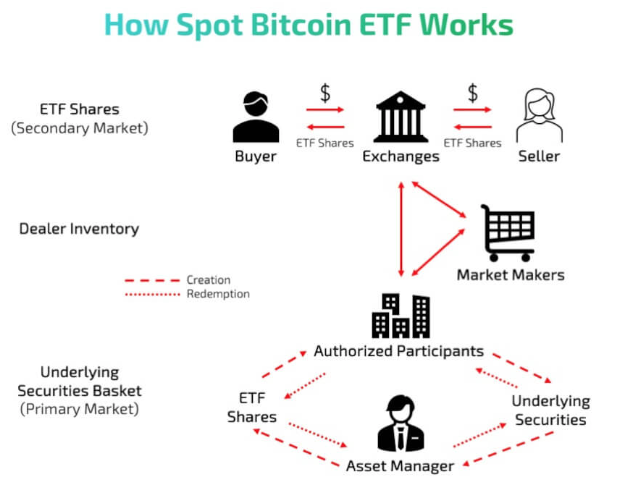
Source: Coincu
TL;DR: Spot = holds the coin. Futures = holds contracts that can drift from the coin.
Active vs passive = how the fund is run.
But most importantly, none of these ETF types actually give you ownership over your cryptocurrencies.
So why are Crypto ETFs important?
Essentially, it’s because of the broader implications of having cryptocurrencies adopted by institutions and broader markets and industries. Let’s observe how ETFs impact the market.
Crypto ETFs, Flows and Market Impact
Since their launch, spot Bitcoin ETFs have become a major force in shaping crypto prices because they prove institutional interest and easy investing for the masses. It’s important to remember that BTC ETF inflows and outflows show what investors are feeling about crypto at any given time.
When money flows into Bitcoin ETFs, funds buy more Bitcoin, which often pushes the price up. When money flows out, they sell, which can drag the price down.
For example, in January 2025 ETFs added over 38,000 BTC and prices rose, while February saw heavy withdrawals that hurt momentum. By April, BlackRock lost nearly 4,900 BTC while Fidelity gained 1,300 BTC, proving ETF flows can move prices quickly.
That’s why financial experts like Citigroup analysts now see BTC ETFs as a real-time signal of market confidence.
Institutional Adoption Beyond ETFs
By mid-2025, more than 90 public companies together held about $224 billion in Bitcoin, nearly 1.98 million BTC, up from 1.68 million just a few months earlier. Clearer regulations in the U.S. and Japan made this possible, and companies now treat Bitcoin as a strategic reserve asset, like gold or cash.
This growth shows how deeply Bitcoin has moved into corporate finance.
But it also raises a big question: Bitcoin was designed as a peer-to-peer value transfer, yet today it’s being locked up on balance sheets and treated like a corporate bond. That shift means that the tension between Bitcoin’s original vision of individual sovereignty and its growing use as a traditional financial instrument comes down to people .
Stablecoins and Tokenized Treasuries
Stablecoin growth matters for ETFs because it fuels the liquidity that makes large Bitcoin and Ether trades possible, directly supporting ETF demand. In other words, just as ETF flows now sway crypto prices, the expansion of stablecoins acts as the financial plumbing behind those flows — both showing how Wall Street is tightening its grip on crypto.
Right now, stablecoin use is booming. Stablecoin use jumped over 50% within a year, and at the same time, BlackRock’s BUIDL fund has hit $3B, turning Treasuries into tokenized, yield-bearing assets.
Together with ETFs and corporate Bitcoin reserves, these products show how traditional finance is reshaping crypto, moving it further from its peer-to-peer roots and deeper into traditional markets.
Now, let’s take a look at active Crypto ETFs and how they’re holding up.
Crypto ETFs & Status in 2025
The path to crypto ETFs has been long. The Winklevoss twins’ first U.S. Bitcoin ETF attempt in 2013 was rejected, and Canada beat the U.S. to market with the Purpose Bitcoin ETF in 2021.
America’s first futures-based product, BITO, arrived later that year, but true change came in January 2024, when the SEC finally approved a wave of spot Bitcoin ETFs.
11 ETFs launched at once, pulling in billions and helping push Bitcoin to record highs.
By mid-2025, Ethereum ETFs also went live and the first Solana ETF approved by the SEC followed in late 2025. At the time of writing, filings for Cardano, XRP, Sui, Injective and others are pending.
As the market matures, crypto ETFs are evolving past simple price tracking to give people value-added features native to the blockchain itself. Lets understand Bitcoin and other spot crypto ETFs, and their status in 2025 and beyond.
Spot Bitcoin ETFs in the US
The approval of spot Bitcoin ETFs in the United States on January 10, 2024, was a huge win for crypto. After years of rejections and delays, the U.S. Securities and Exchange Commission (SEC) finally gave the green light to 11 spot Bitcoin ETFs. Lets take a look at some of the big names on the list and how much investment they currently manage.
BlackRock (IBIT – iShares Bitcoin Trust ETF)
Launched January 2024, IBIT quickly became the leader in inflows and the fastest ETF in history to surpass $70 billion AUM.
Grayscale (GBTC – Grayscale Bitcoin Trust)
Converted from a long-standing trust into a spot ETF in January 2024. Despite high fees and outflows, it still manages about $18 billion.
Fidelity (FBTC – Fidelity Wise Origin Bitcoin Fund)
Another January 2024 launch, FBTC offers direct Bitcoin exposure and now holds over $20 billion, making it one of the top funds alongside IBIT and GBTC.
Ark Invest / 21Shares (ARKB – ARK 21Shares Bitcoin ETF)
ARKB is a joint effort between Ark and 21Shares, with assets around $5 billion.
VanEck (HODL – VanEck Bitcoin ETF)
One of the earliest advocates for a spot ETF, VanEck’s HODL fund launched in January 2024 and now manages roughly $1.6 billion around the time of writing.
These ETFs have been widely credited with helping Bitcoin go to new all-time highs, as capital previously locked out of the crypto market found an accessible and regulated entry point.
| Issuer & Fund Name | Ticker | Launch Date | Approx. AUM |
| ARK 21Shares Bitcoin ETF | ARKB | Jan 11, 2024 | ~$5.2 billion |
| Bitwise Bitcoin ETF | BITB | Jan 11, 2024 | ~$4.0 billion |
| iShares Bitcoin Trust (BlackRock) | IBIT | Jan 11, 2024 | >$70 billion |
| Fidelity Wise Origin Bitcoin Fund | FBTC | Jan 11, 2024 | ~$24 billion |
| Franklin Bitcoin ETF | EZBC | Jan 11, 2024 | ~6,148 BTC ≈ $0.6 billion |
| Invesco Galaxy Bitcoin ETF | BTCO | Jan 11, 2024 | ~6,977 BTC ≈ $0.7 billion |
| VanEck Bitcoin Trust | HODL | Jan 11, 2024 | ~$1.6 billion |
| Valkyrie Bitcoin Fund | BRRR | Jan 11, 2024 | ~8,561 BTC ≈ $0.8 billion |
| WisdomTree Bitcoin Fund | BTCW | Jan 11, 2024 | ~1,163 BTC ≈ $0.1 billion |
| Grayscale Bitcoin Trust (ETF version) | GBTC | Jan 11, 2024 | ~$18 billion |
Spot ETH ETFs in the US
On May 23, 2025, the SEC took a huge step by approving the 19b-4 applications (the official paperwork for exchanges asking the SEC for permission to list ETFs) for several spot Ethereum ETFs.
This approval means the SEC has acknowledged that the market for Ethereum is sufficient to support an ETF.
Following closely on the heels of Bitcoin’s success, Spot Ethereum (ETH) ETFs also help crypto adoption boom. Lets explore some of the institutional ETFs for Ethereum that are currently available.
Grayscale Ethereum Trust (ETHE)
Launched as a private placement in 2017, ETHE converted to a spot ETF in July 2024. Despite fee-driven outflows, it still manages about $3.5B as of the time of writing.
Fidelity Ethereum Fund (FETH)
Debuted in July 2024, FETH offers direct Ether exposure with competitive fees and now holds around $2.5B as of the time of writing.
Invesco Galaxy Ethereum ETF (QETH)
Also launched in July 2024, QETH aims to match Ethereum’s price performance but remains smaller, with roughly $36M AUM.
| Issuer & Fund Name | Ticker | Launch Date | Approx. AUM (mid-2025) |
| BlackRock – iShares Ethereum Trust | ETHA | Jul 23, 2024 | ~$10 billion (largest) |
| Fidelity (Wise Origin) Ethereum Fund | FETH (or unnamed) | Jul 23, 2024 | ~$2.5 billion |
| Grayscale Ethereum Mini Trust | ETH | Jul 23, 2024 | ~$1.27 billion |
| Grayscale Ethereum Trust | ETHE | Jul 23, 2024 | ~$3.46 billion |
| Bitwise Ethereum ETF | ETHW | Jul 23, 2024 | ~$460 million |
| Franklin Ethereum ETF | EZET | Jul 23, 2024 | ~$69 million |
| VanEck Ethereum ETF | ETHV | Jul 2024 | ~$196 million |
| ARK 21Shares, WisdomTree, others | – | Jul 2024 | AUM generally < $100 m or not disclosed; collectively minor |
SOL ETFs in the US
Solana (SOL) was the next crypto asset to get its own spot ETF in the US.
The first U.S. spot Solana ETF, REX-Osprey SOL + Staking ETF (SSK), launched in July 2025, offering direct SOL exposure plus staking rewards, with an AUM of ~100 million as of the time of writing. This actively managed fund holds at least 80% in spot SOL (mostly directly staked), up to 40% in non-U.S. SOL staking products, and some liquid staking tokens like JitoSOL. However, it did not follow the usual approval process, and is not a traditional Spot ETF. Instead, it was structured under the Investment Company Act of 1940 to bypass many of the regulatory hurdles crypto ETFs face.
The first true SOL ETF to get approval by the SEC is the 21 Shares Solana ETF, with its initial filings approved in October 2025. However, due to the US government shutdown, it’s unclear when it will actually start operating.
However, these are not the only Solana spot ETFs in the works; multiple issuers Grayscale, VanEck, Bitwise, Fidelity, Invesco Galaxy, Canary Capital, have pending applications with staking features.
Plus, it’s important to note that Solana ETPs (Exchange Traded Products) and ETNs (Exchange Traded Notes) do exist and are trading in other regions, particularly in Europe. These are similar to ETFs and often offer direct exposure to Solana, with some even incorporating staking. Examples include:
| Fund Name | Ticker | Launch Date | Approx. AUM (mid‑2025) |
| REX‑Osprey Solana + Staking ETF | SSK | Jul 2, 2025 | ~$100 million |
| 21Shares | ASOL | TBA | TBA |
ADA ETF
While the U.S. doesn’t have spot ADA ETFs yet, there are already Cardano ETPs (Exchange Traded Products) and ETNs (Exchange Traded Notes) available and trading on European exchanges. These products offer direct exposure to ADA and some even provide staking rewards. Examples include:
- 21Shares Cardano ETP (AADA)
- ETC Group Physical Cardano (RDAN)
- WisdomTree Physical Cardano
- Fineqia FTSE Cardano Enhanced Yield ETN (YADA)
Grayscale and others have requested the SEC to approve spot ADA ETFs (funds that directly hold Cardano), but the SEC keeps delaying its decision, with a final deadline for Grayscale’s ADA ETF expected around October 2025.
SUI ETF
There are no U.S. spot SUI ETFs yet, but major issuers like 21Shares, Invesco Galaxy, VanEck, and Bitwise have filed applications with the SEC. SUI ETPs already live in Europe, offering regulated exposure abroad. Despite being a newer chain, Sui has drawn interest from asset managers such as Canary Capital, which has also filed for a SUI ETF.
INJ ETF
Like Sui, Injective is a blockchain with a focus on DeFi, making it a hot contender for ETFs despite being less known than giants like Bitcoin or Ethereum.
Canary Capital is pushing the envelope by setting up a Delaware trust for a “Staked INJ ETF,” a first step toward a U.S. fund that tracks Injective’s INJ token price and offers staking rewards, extra profits from helping secure the blockchain.
XRP ETF
Despite ongoing legal battles between Ripple (the company behind XRP) and the SEC, several firms like Canary Capital and REX/Osprey have filed for spot XRP ETFs. The SEC has consistently delayed decisions on these, with most final deadlines extending into October.
Other Crypto ETFs (You Should Know)
Crypto ETFs extend beyond the major players, with various asset managers exploring opportunities across a broader spectrum of digital assets. Some other potential crypto ETFs include:
- Dogecoin (DOGE) and Litecoin (LTC) ETFs: Both Dogecoin, the popular meme coin, and Litecoin have seen ETF filings from firms like 21Shares (for DOGE) and CoinShares (for LTC).
Similar to other altcoin filings, these have faced delays from the SEC, with approvals likely to be pushed into Q3 or Q4 of 2025. - Tron (TRX) and Hedera (HBAR) ETFs: Canary Capital, in particular, has been active in filing for ETFs based on a range of altcoins, including Tron and Hedera.
The general expectation is that the SEC will take its time, often using its full 240-day review period for new and complex filings, with staggered approvals likely across different assets.
Benefits vs Risks of Crypto ETFs
Spot ETFs, corporate treasuries and tokenized treasuries show us exactly how deeply crypto has integrated with traditional finance, but they also reintroduce the very intermediaries (custodians, brokers, fund managers and regulators) that crypto was designed to remove.
So, does this mean crypto ETFs should be ignored?
At the very least, crypto ETFs democratize access, help with price discovery and bring institutional credibility to crypto. They also make crypto part of people’s retirement portfolios and pension funds, which can support even more adoption.
However, if tomorrow a fund halts redemptions, if a government freezes accounts or if a manager mismanages the underlying assets, ETF holders lose their funds in this loss. Simply, they don’t offer the same ownership rights as you’d get with self-custody.
For investors, the takeaway is clear: crypto is becoming more accessible and mainstream, but also more centralized.
The very tools making it easy to buy, ETFs, corporate funds, TradFi-backed stablecoins, shift power away from individuals and toward institutions. That’s why, while crypto ETFs may be reshaping the market, they don’t give you the decentralized future crypto was built for.
Crypto ETFs vs Self-Custody: Why Ownership Matters
Satoshi Nakamoto launched Bitcoin to give people sovereignty over their money. In that vision, holding your own keys is non‑negotiable. If you’re craving financial freedom and peace of mind, you need to retain ownership over your assets, and that relies on owning your private keys. With secure self custody, no middleman, government, or central entity has any power over your funds. You’re in the driver’s seat of your financial destiny.
Fortunately, in today’s web3 ecosystem, owning cryptocurrencies is easy—even for beginners. There’s no need to trust centralized institutions with your assets, and it’s simpler than ever to use DCA strategies to buy multiple cryptocurrencies, securely transact crypto across borders, participate in DeFi protocols for lending or liquidity provision to boost returns, and much more.
With the Ledger ecosystem, you can access all of that and more. Your Ledger signer provides secure and user-friendly access to your own crypto assets, with no device ever being hacked. Plus Ledger Wallet™ , the all-in-one app for interacting with the blockchain, offers secure access to staking services on Ethereum, Solana, or Cardano that many U.S. ETFs explicitly exclude due to regulations.
So, if you’re already interested in ETFs, why not just directly invest in crypto and retain ownership of your assets? Take your portfolio to the next level and unlock full control—with security and self-custody. Because if not self-custody, why crypto?
Want to learn more? Take a look at some of our other Ledger Academy resources to understand why decentralization is the future of all finance.
Crypto ETF FAQs
What does ETF stand for?
ETF stands for Exchange-Traded Fund. It’s a type of investment vehicle that tracks the value of an underlying asset (e.g. Bitcoin or Ethereum) and trades on traditional stock exchanges, making it easy for investors to gain exposure without directly owning crypto.
How Crypto ETFs Get Filed
To launch a crypto ETF in the U.S., a stock exchange first asks the SEC for permission to list it by filing a 19b‑4 form. If the SEC agrees, the company behind the ETF then submits an S‑1 document explaining how the fund works, what it invests in, and what risks are involved.
Once both filings are approved, the ETF can officially start trading on regular stock exchanges, letting people invest in crypto just like they buy shares or gold funds.
Which countries offer crypto ETFs?
Crypto ETFs are available in multiple regions, including the U.S., Canada, Brazil, Germany, and Switzerland. Canada and Europe were first movers, with the U.S. joining in 2024 after approving Bitcoin spot ETFs.
Is there any Bitcoin ETF in the US?
Yes. The SEC approved 11 spot Bitcoin ETFs in January 2024 from major issuers like BlackRock, Fidelity, and Grayscale, collectively managing tens of billions in assets.
Is there an Ether ETF in the US?
Yes. Spot Ethereum ETFs were approved in May 2025, marking a major milestone after Bitcoin’s ETF success. BlackRock, Fidelity, and Grayscale lead the market with billions in assets under management.
Is it better to invest in ETFs or buy crypto directly?
While ETFs offer convenience, you’re handing over control to a third party custodian, exactly what crypto was designed to avoid. If you believe in true financial freedom, buying crypto directly and holding it yourself through secure self-custody is the only way to fully own your assets and stay aligned with crypto’s original purpose: independence from centralized control.
