
How To Use ChatGPT To Predict Crypto Market Trends

| KEY TAKEAWAYS: |
| — Traditional analytical tools were designed for markets with closing bells, quarterly earnings, and regulated channels – frameworks that don’t translate to cryptocurrency’s 24/7, sentiment-driven environment. — While ChatGPT can analyze crypto market patterns, sentiment shifts, whale behavior, and on-chain anomalies, it does not predict future prices. — To get actionable insights for crypto market prediction, you need to use structured data and precise, specific prompts instead of generic questions. |
You’re staring at a Bitcoin chart at 3.00 AM. The pattern looks somewhat familiar – you’ve seen this setup before. Was it March 2024? Or that false breakout in September 2025? And social media is a frenzy of analysts and influencers with different explanations. You have 15 minutes to decide: panic sell, HODL, or buy the dip.
Welcome to crypto trading in 2026, where information overload is the default state. Traditionally, a crypto trader had to master both technical analysis (TA) and fundamental analysis (FA) in-depth to gain insight into potential patterns and trends. This would take hours and demand a high level of technical expertise that most newbies lack.
With coin prices fluctuating unpredictably and rapidly in response to shifts in investor sentiment, regulatory changes, exchange hacks, or even a simple tweet, your brain might fuzz out with exhaustion trying to decipher what indicators matter or what happens next. For both seasoned and beginner cryptocurrency traders, simply observing or evaluating these movements can be overwhelming and time-consuming.
This is where large language models (LLMs), such as ChatGPT, can come in to help filter the noise. Rather than predicting the future, the real potential of ChatGPT lies in its capacity to analyze vast amounts of historical data and real-time market sentiments to enhance your crypto trading decisions.
In this guide, Ledger Academy explores ChatGPT’s role in cryptocurrency trading, how to use it for crypto analysis, generating potential market insights, and recognizing and interpreting patterns and trends.
What Is the Role of ChatGPT in Crypto Trading?
Traditional financial analysis is not optimized for cryptocurrency trading, given that it was initially developed and intended for traditional markets. In stock markets, for instance, trading closes at the end of business hours, quarterly earnings drive valuations, and information flows through regulated channels. In contrast, the crypto market never closes, operating 24/7 across global time zones. Valuations shift based on investor sentiments, news, and protocol upgrades rather than earnings reports, and there’s no regulated channel for information flow. Traditional methods simply lack the speed, depth, and insight necessary to keep pace with and effectively anticipate crypto market trends.
Where you would usually track 10 or 30 companies in traditional markets, a crypto trader is bombarded with information flow 24/7 for over 20,000 different tokens across global time zones. Moreover, each token has its own online community, GitHub activity, on-chain metrics, and whale movements.
ChatGPT can help transform crypto analysis from reactive decision-making to proactive, not by forecasting prices but by identifying patterns faster and more comprehensively than conventional techniques. However, the model only interprets what you describe, meaning that the analysis is as good as the data you feed it.
To explain further, ChatGPT can help crypto traders with:
Interpreting Technical Patterns
When fed with structured data, the LLM can help identify and interpret technical patterns. By inputting a description of price action, such as higher lows and declining volume, ChatGPT can help classify the market formation and propose a potential range of outcomes based on historical data.
For example, imagine Bitcoin’s price has been moving up and down with a narrowing range for over three weeks, with fewer people buying and selling each day. You can describe this pattern to ChatGPT, and it can help compare it to similar situations from the past to determine whether Bitcoin’s price is more likely to continue in its current direction or reverse course. It can also help explain the likelihood of a breakout in a particular direction and estimate how far the price might move based on the size of the pattern.
Extracting Insights from Technical Indicators
Another potential use case is ChatGPT’s ability to interpret the actual meaning of your technical indicators. It assists in turning raw statistics, such as the Relative Strength Index (RSI) and Bollinger Bands, into potential actionable insights and cross-references them with historical events.
Since RSI measures whether an asset is overbought or oversold by tracking the speed and magnitude of recent price changes on a scale of 0 to 100, ChatGPT can help you understand why a particular RSI level matters more during different market phases. For instance, an RSI of 70 in a strong uptrend might signal a different trend than the same reading during distribution. Technically, ChatGPT contextualizes these metrics against broader market conditions, translating technical data into actionable insights.
Contextualizing Market Sentiments and Summarizing Social Media Buzz
Market sentiment, including social media buzz, the fear and greed index, FOMO, and negative narratives spreading through communities, is one of the most prominent factors influencing cryptocurrency market movements, with information and opinions spreading rapidly across social media platforms. In this sense, manually tracking sentiment across platforms becomes infeasible, especially during times of market volatility.
By supplying it with sample posts, trending hashtags, or discussion summaries, ChatGPT can be a useful tool for quickly determining the prevailing consensus, whether it’s optimism about institutional investment, anxiety over regulation, or excitement about a blockchain network upgrade.
Simply put, ChatGPT can be used to analyze how similar sentiment patterns historically correlate with price action. It can assist in identifying not just the emotional tone but also potential underlying catalysts when examining sentiment shifts. For example, it might help distinguish between bearish sentiment stemming from regulatory uncertainty versus one caused by a technical breakdown, providing additional context for your analysis.
Drafting and Refining Trading Strategies
The LLM can also be useful in playing the devil’s advocate by turning your gut feeling into more structured strategies. By describing your approach, the model can help you outline entry criteria, exit conditions, position sizing logic, and risk parameters.
More importantly, it can encourage you to think through edge cases and failure modes before risking your capital. Rather than telling you whether your strategy will work, it can help identify potential logical gaps and point to historical scenarios where similar approaches struggled.
Identifying Patterns Across Unrelated Factors
Lastly, crypto market movements are typically the result of several factors, not just a single one. In most cases, technical factors coincide with sentiment shifts and fundamental factors.
When analyzing whether a token’s current setup resembles conditions before previous rallies, ChatGPT can simultaneously compare trading volume patterns, holder distribution changes, social mention velocity, developer activity, and correlation with Bitcoin. This potential to instantly generate insights could save you considerable time that would otherwise be spent on research and analysis.
Step-By-Step Process: How To Use ChatGPT To Analyze Crypto Trends
The difference between generic output and actionable insights lies entirely in the data you feed into ChatGPT. Simply, the quality of the outcome relies on the quality of the input.
The steps to effectively use ChatGPT for crypto analysis include:
1. Clearly Define Your Objective
Vague objectives often produce vague results. Thus, before even interacting with ChatGPT, you must clearly formulate what you’re trying to achieve. Understand whether you’re just building a strategy, researching a token, or checking market sentiment.
A clear objective might specify:
- The asset or sector you’re analyzing.
- The time horizon, whether it is a short-term shift, medium-term position, or long-term trend.
- The decision this analysis will inform, such as entry, exit, position sizing, and portfolio allocation.
- Success metrics or what would make this analysis useful.
An example of a clearly defined objective would look like this:
“I want to identify whether Bitcoin’s current consolidation pattern shares structural characteristics with previous accumulation phases that preceded major rallies, specifically comparing on-chain metrics, sentiment trends, and technical factors.”
Rather than simply asking, “Should I buy Bitcoin now?” – which invites speculation, this prompt focuses on comparing specific current metrics against historical patterns, turning ChatGPT into an analytical tool rather than a prediction tool.
2. Collect Data for the Analysis
Once you’ve set your objective, the next step is to gather data from reliable sources, such as blockchain explorers, sentiment analysis, and verifiable market data sites. Since ChatGPT cannot access real-time market data, you’ll have to provide it with reliable, up-to-date data.
Different analysis angles determine the type of data required. For instance:
- Price analysis – Demands precise historical data on prices, trading volume, and market capitalization movements.
- Whale activity analysis – Focuses on tracking the movements and wallet behavior of large-scale investors.
- Sentiment analysis – Involves monitoring social media discussions, popular influencer mentions, and shifts in general crowd behavior.
When collecting data, consider:
- Regular tracking over one-off deep dives – Trends are best identified through regular and consistent tracking of the same metrics, whether daily or monthly.
- Time-stamped records – A metric’s relevance changes significantly based on when it was collected. For instance, data collected three days ago tells a completely different story from data collected 40 minutes ago.
- Source documentation – Another best practice is to always document your data source. This traceability allows you to easily cross-reference the inputs and verify which data points might be responsible if ChatGPT’s market analysis appears inaccurate.
3. Format the Data
ChatGPT analyzes structured data that emphasizes key events, trends, and patterns far more effectively than narrative descriptions. For instance, when formatting price data, organizing details, such as open price, close price, and volume, in chronological order helps effectively capture market movement.
Generally, how well you format information directly impacts the quality of the results. This can include:
- Filling the gaps – To ensure continuity and improve the accuracy of the analysis, fill missing entries with estimated values, such as those derived from moving averages, especially in volatile markets.
- Combining sentiment scores with key events – Sentiment data, such as social media discussions, news articles’ tone, forum discussions, and influencer commentary, is often unstructured, making its analysis difficult. A sentiment score quantifies this mood numerically (such as 75/100 bullish), but these numbers alone lack context. For accurate analysis, link these scores to specific events and dates, such as negative sentiment spiking from regulatory news or positive sentiment following a protocol upgrade.
- Cleaning the data – By standardizing date formats, removing duplicates, clearly labeling, and filling gaps through interpolation of trends, you maximize the quality and accuracy of ChatGPT’s output, thereby extracting meaningful insights.
- Use Clear, Structured Prompts
Prompt engineering separates actionable insights from generic responses. Your prompt should guide ChatGPT’s analytical framework while preventing prediction bias.
As such, for precise results, avoid ambiguity by including indicators, timeframes, historical comparison points, and desired output format. This allows ChatGPT to leverage its pattern recognition capabilities more effectively.
In summary, an effective prompt gives ChatGPT a perspective, specifies the task, structures the input data, and tells the model how to process the data and what the expected results should look like.
Example prompt:
1 – Role Assignment and Task Specification
You are a quantitative crypto market analyst specializing in pattern recognition. Your task is to identify whether Ethereum’s current market structure resembles historical pre-rally conditions.
2 – Structure Input Data
Current Ethereum Metrics (Feb 10, 2026):
- Price: $2,020
- 24-hour price change: -4%
- Active Addresses: ~970,000 daily (~substantial growth Y/Y)
- Gas Fees: ~0.5 – 4 Gwei (near all-time low)
- Staking Deposits: ~35 – 36M ETH now staked
- BTC Correlation: Still correlated with BTC downturn moves
Historical Pre-Rally Example (March 2024):
- Price: $2,890 (similar consolidation)
- Active Addresses: 518,000
- Gas Fees: 19 Gwei
- Staking Deposits: +38,000 ETH (weekly)
- BTC Correlation: 0.71
3 – Analysis Framework
Analyze across these dimensions:
- Holder Behavior (exchange flows, staking)
- Network Demand (active addresses, gas fees)
- Market Independence (BTC correlation changes)
- Structural Positioning (volume, momentum)
For each dimension, rate similarity (1-10) and identify critical differences.
4 – Output Format
Output format:
[COMPARISON SUMMARY] – One paragraph
[DIMENSION ANALYSIS] – Detailed breakdown with ratings
[KEY DIFFERENCES] – What’s different this time
[CONFIDENCE LEVEL] – How confident this comparison is valid (1-10 with reasoning)
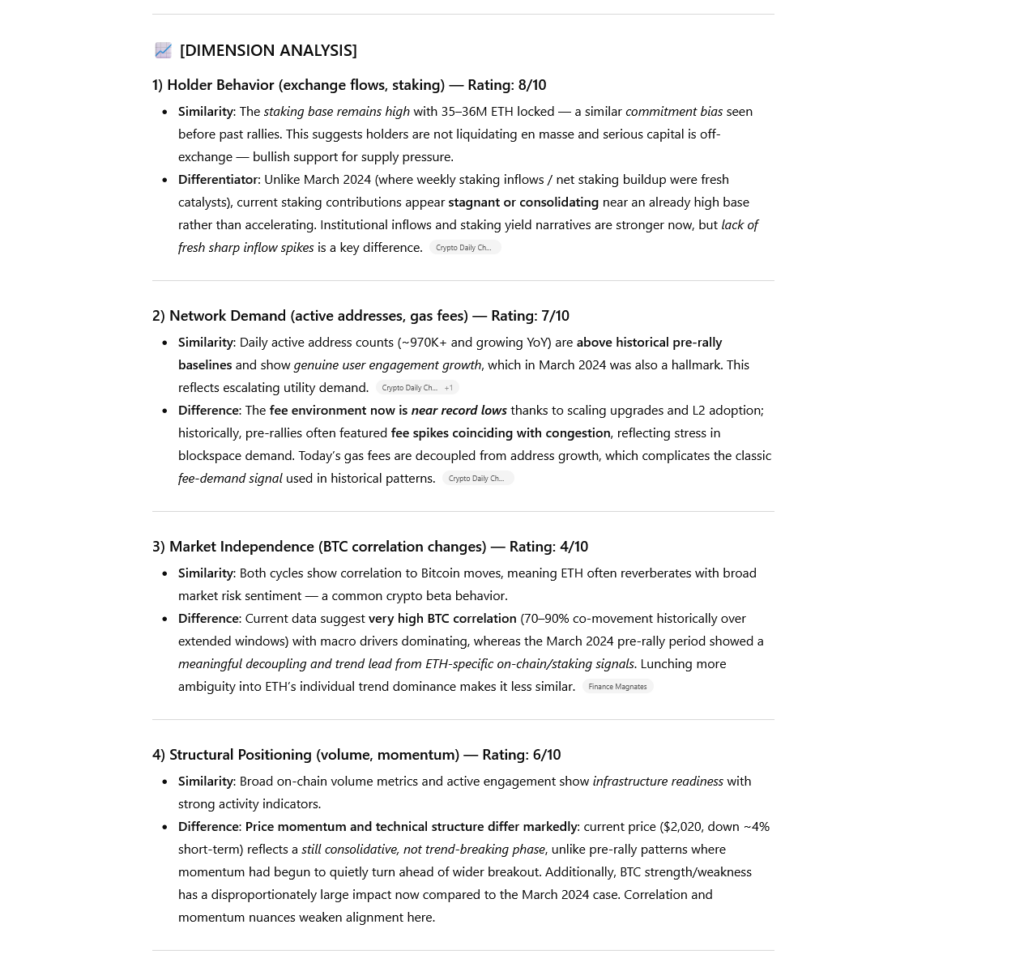
Fig.1.0: ChatGPT output result
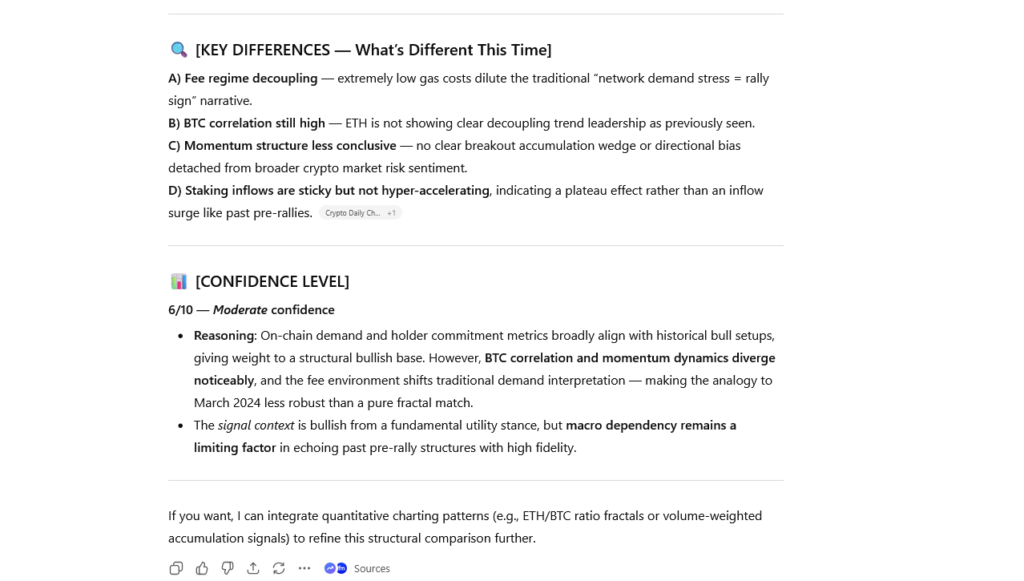
Fig. 1.1: ChatGPT output result
5 – Verify the Insights With Trusted Sources
Never make investment decisions based solely on ChatGPT-generated insights. Regardless of how compelling the analysis seems, the extreme volatility of crypto markets requires you to cross-validate with other data sources and independent research. As with any analytical tool, ChatGPT should only ever be used as a research tool and not an oracle. It should inform your process, not replace it. Use verified external platforms to confirm the suggestions.
To validate ChatGPT’s market results:
- Cross-reference with reliable sources – When ChatGPT suggests a signal, such as a bullish trend based on the RSI, immediately compare this against real-time data from established platforms, like CoinGecko, to confirm the suggestion’s authenticity.
- Evaluate against the broader market context – Market movements often respond to wider economic news, geopolitical developments, or major events. If ChatGPT identifies a market pattern, check if significant external factors align with or support the prediction.
- Backtest trading strategies – Before making an investment decision, test any trading strategy or insight suggested by ChatGPT in a risk-free environment. Utilize demo trading platforms to assess the strategy’s true effectiveness.
6 – Simulate Scenarios and Possible Outcomes
Similar to traditional financial markets, cryptocurrency markets are probabilistic rather than deterministic. This means that, even with accurate analysis, the outcome may differ due to unforeseen factors. It is also noteworthy that ChatGPT responses might be speculative insights based on dated logic and sentiment patterns rather than real-time market predictions.
Use ChatGPT to map possible outcome paths and their probability ranges. Focus on conditional setups rather than absolute predictions.
For example:
Based on this market setup and analysis, create three scenario paths with different probability estimates:
- Bullish scenario (X% probability)
- Base case scenario (X% probability)
- Bearish scenario (X% probability)
For each scenario, answer the following questions:
- What specific events or metrics would confirm this path?
- What would price action and key metrics look like in this scenario?
- Timeline expectations for the scenario to play out?
- What would invalidate this scenario early?
For each scenario, identify:
- Early warning indicators that would increase its probability
- At what point does the scenario become obvious (too late to adjust)?
- Optimal positioning for each outcome
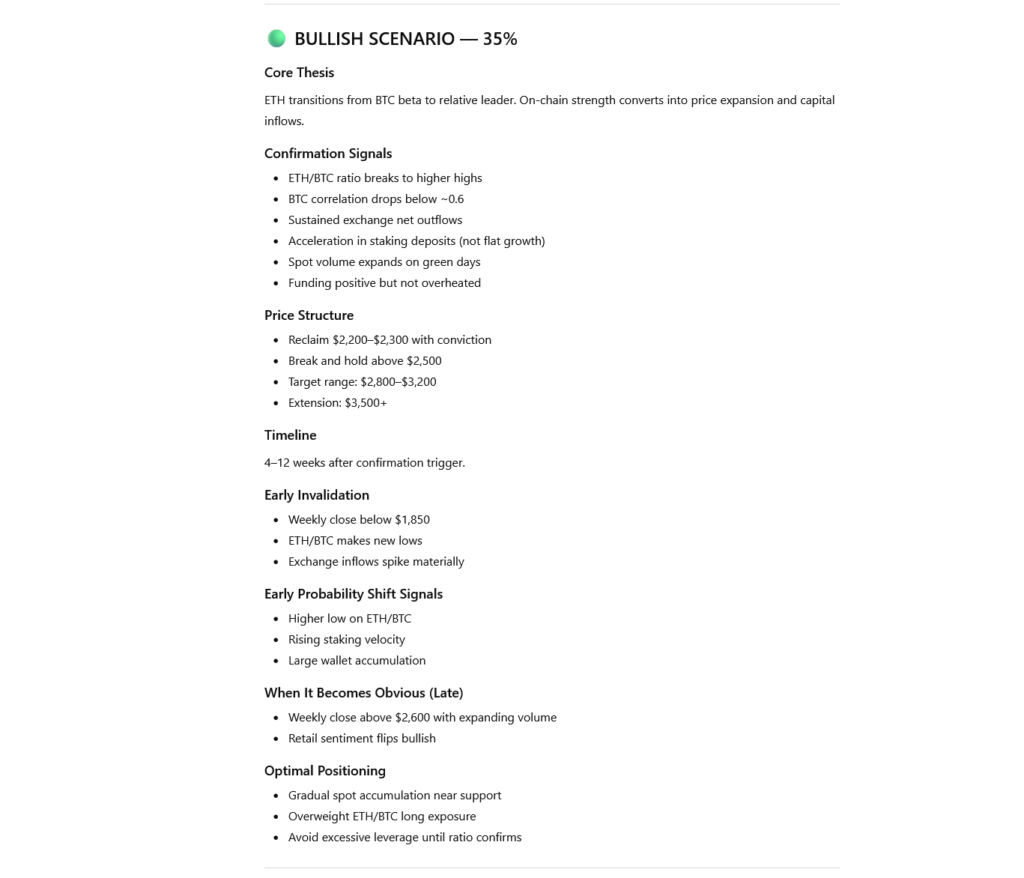
Fig. 2.0: Output for bullish scenario
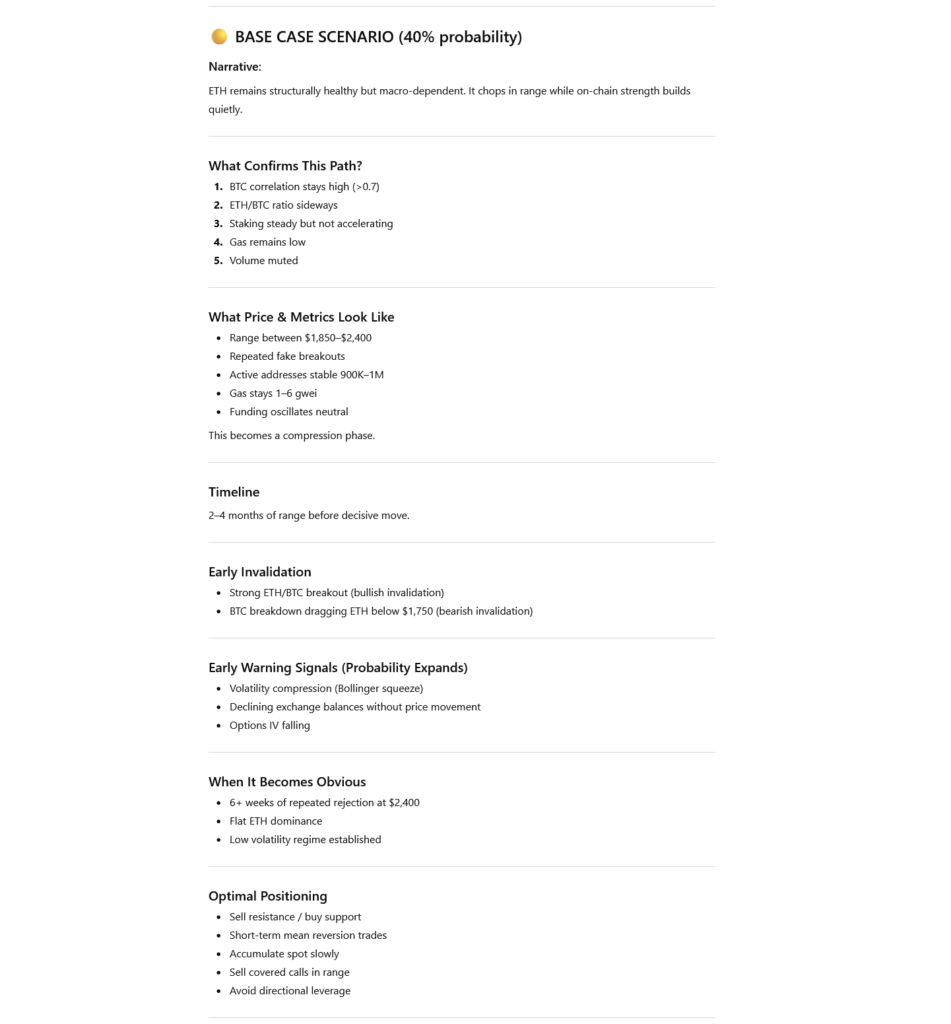
Fig. 2.1: Out for base case scenario
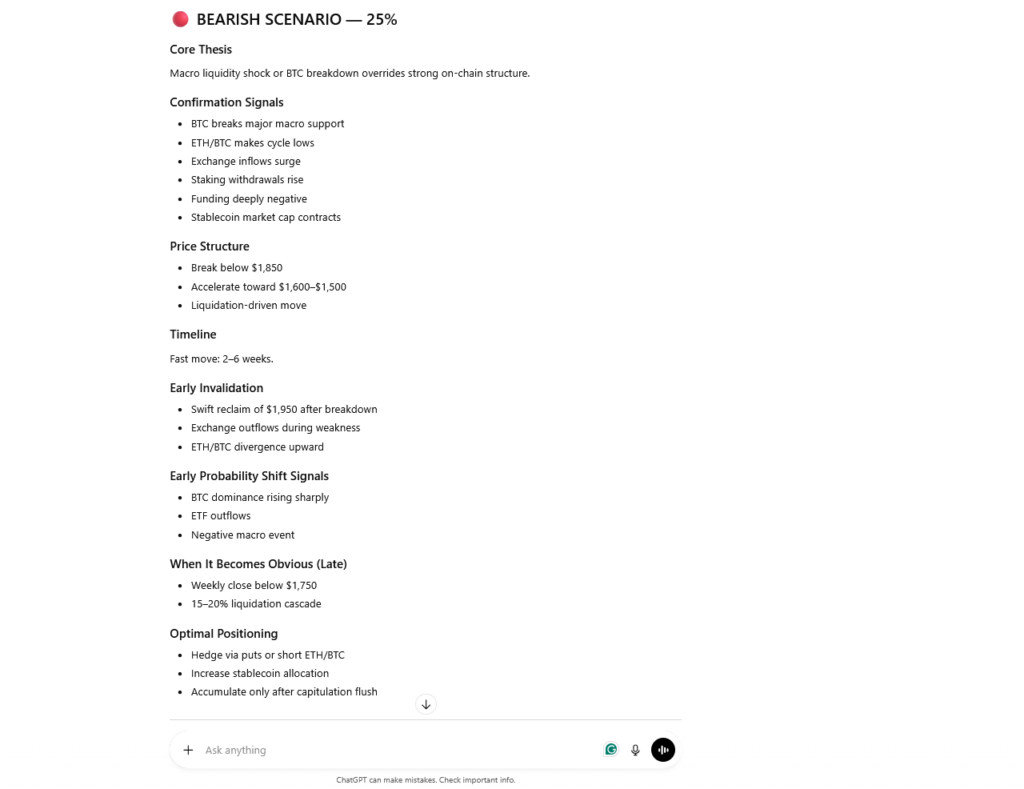
Fig. 2.2: Output for bearish scenario
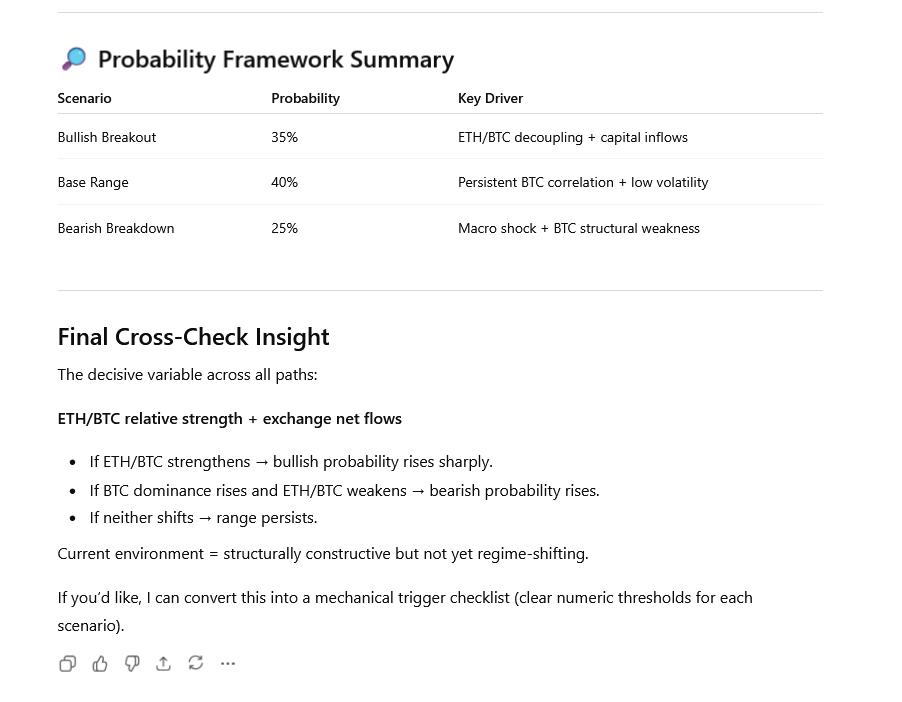
Fig. 2.3: Framework summary
ChatGPT Processing Capacity With Your Due Diligence
Combined with market knowledge, disciplined risk management, and critical thinking, ChatGPT can be a useful tool for processing information more quickly and identifying potential patterns you might otherwise miss. However, while its value in pattern recognition, when used properly, is undeniable, it is essential to utilize ChatGPT’s insights as a guide rather than a replacement for critical thinking and due diligence.
To summarize, your edge isn’t ChatGPT. It’s knowing what questions to ask it, how to verify what it tells you, and when to ignore it entirely. Use it to sharpen your own analysis, challenge your assumptions, and expand your pattern recognition abilities, rather than treating it as an oracle.
