
Bitcoin vs Solana: Proof of Work vs Proof of History Explained

| KEY TAKEAWAYS: |
| — Bitcoin prioritizes security and decentralization, which differs fundamentally from Solana’s focus on speed and scalability. — Bitcoin uses a Proof of Work (PoW) model processing around 7 Transactions Per Second (TPS), while Solana utilizes a hybrid Proof of History (PoH) and Proof of Stake (PoS) model to achieve 3,000–5,000 TPS. — Bitcoin scales through Layer-2 solutions like the Lightning Network for fast payments, while Solana’s Layer-1 architecture supports complex smart contracts natively. |
Not all blockchains are created equal. Some function like fortresses: slow, deliberate, and virtually impenetrable. Others operate like racetracks: fast, efficient, and designed for constant motion. Bitcoin and Solana represent these two distinct philosophies.
Since 2009, Bitcoin (the world’s biggest cryptocurrency) has served as the foundation of digital asset innovation. Its conservative design created what many call “digital gold“—a store of value you can trust, prioritizing security and decentralization over speed.
Solana, launched in 2020, was designed for a world that demands instant results: traders executing thousands of transactions per second, gamers requiring real-time interactions, and applications that feel as responsive as the apps on your phone.
The choice between them depends on what you are trying to accomplish. This article explores the fundamental differences between Bitcoin and Solana to help you decide which approach aligns with your goals.
Bitcoin vs Solana
What is Bitcoin?
Bitcoin is the first and most established cryptocurrency, launched in 2009 by the pseudonymous Satoshi Nakamoto. It operates as a decentralized peer-to-peer electronic cash system secured by Proof of Work (PoW) consensus, where miners expend computational power to validate transactions and secure the network, prioritizing security, decentralization, and censorship resistance over transaction speed.
With a fixed supply cap of 21 million coins and an issuance schedule controlled by halving events, Bitcoin has established itself as a store of value and hedge against inflation. The network processes approximately 7 TPS on its base layer with 10-minute block times.
For faster payments, Bitcoin utilizes the Lightning Network, a layer-2 solution that recently reached a record liquidity of over 5,600 BTC locked in payment channels.
What is the Bitcoin Lightning Network?
The Lightning Network operates through bidirectional payment channels: private ledgers between two parties that track unlimited transactions without touching Bitcoin’s main blockchain. When you open a channel, both parties commit Bitcoin to a multi-signature address, creating a shared balance sheet. Each transaction updates this ledger through cryptographic signatures from both parties. Only two transactions ever reach Bitcoin’s base layer: opening and closing the channel.
The network’s power lies in its routing capability. You do not need a direct channel with everyone you pay. If you have a channel with Party B, and Party B has a channel with Party C, you can route a payment through Party B.
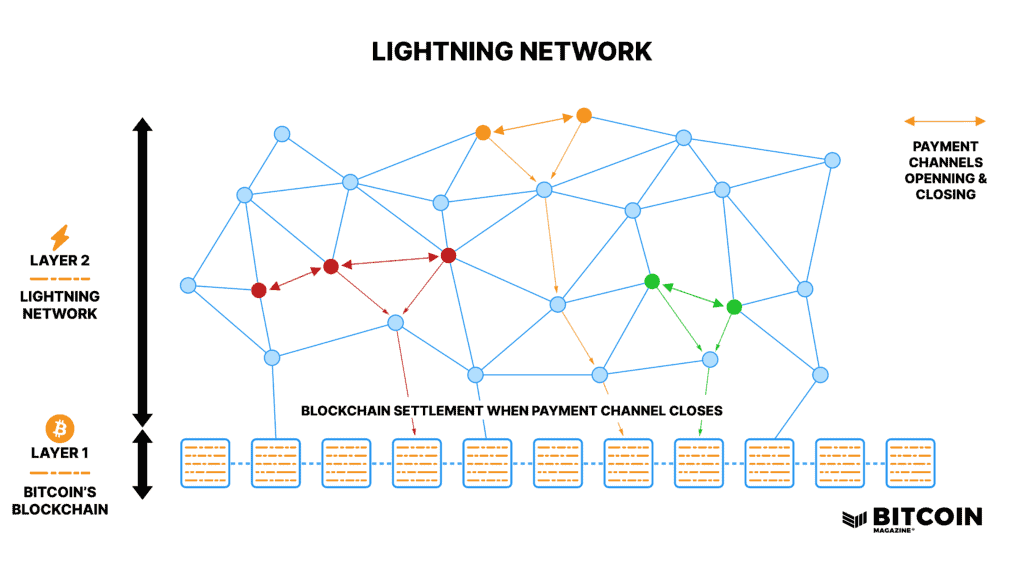
The Layer-2 network (top) processes transactions off-chain through interconnected payment channels (blue lines), with only channel openings and closings settled on Bitcoin’s Layer-1 blockchain (bottom). Colored routes show multi-hop payments routing through intermediary nodes. Source: Bitcoin Magazine
The network automatically finds the most efficient route across thousands of interconnected channels, splitting payments if necessary to optimize for speed and fees. With nearly 15,000 active nodes and 48,000+ payment channels as of the time of writing, Lightning has become Bitcoin’s answer to delivering instant, scalable payments.
Beyond simple payments, Lightning now supports stablecoins through Taproot Assets. Since early 2025, Tether (USDT) transfers on Lightning combine Bitcoin’s security with dollar stability, addressing volatility concerns for merchants and everyday transactions.
This makes it real competition against traditional payment processors: companies like Square are deploying Lightning to 4 million merchants in 2026, with early adopters reporting 50% lower payment processing fees than credit cards.
What is Solana?
Solana is a high-performing layer-1 blockchain designed for scalability and speed. Launched in 2020 by Anatoly Yakovenko, it employs a hybrid consensus mechanism combining Proof of History (PoH) and Proof of Stake (PoS) models, achieving high throughput without sharding or layer-2 scaling solutions.
The Solana blockchain hosts high-frequency applications such as gaming, decentralized exchanges (DEXs), and consumer-facing apps requiring instant finality and low costs. The Firedancer validator client, launched in December 2025, enhanced network diversity and laid the groundwork for processing up to 1 million TPS in controlled environments.
Two Different Blockchain Philosophies, Two Different Approaches
Bitcoin and Solana emerged from different eras and design priorities. Bitcoin pioneered decentralized money with an uncompromising focus on security, while Solana tackles the scalability challenges that limit blockchain adoption. Let’s examine how their architectural choices reflect these distinct philosophies.
Bitcoin as Store of Value vs. Solana as World Computer
Bitcoin and Solana solve fundamentally different problems. Bitcoin was designed as a store of value—digital gold that preserves purchasing power through scarcity and decentralization. Its primary function is to function as sound money, with security and censorship resistance as non-negotiable features.
Solana operates as a world computer—a programmable platform capable of hosting entire economies of decentralized applications (dApps). Its architecture prioritizes throughput and user experience, enabling developers to build applications rivaling traditional web2 services in speed and responsiveness.
This philosophical divide shapes every technical decision these networks make. Understanding this difference is essential for evaluating which blockchain aligns with your goals.
Bitcoin’s Proof of Work vs Solana’s Proof of Stake
Bitcoin uses Proof of Work (PoW), a secure but energy-intensive consensus mechanism. Miners compete to solve cryptographic puzzles using the SHA-256 algorithm. This creates a “51% attack” threshold; an attacker would need more than half the network’s total computational power to compromise security. Given Bitcoin’s hash rate scale and globally distributed mining operations, such an attack remains economically impractical.
Solana uses a hybrid approach. Proof of History (PoH) acts as a cryptographic clock, timestamping transactions to create a verifiable sequence. This allows validators to process transactions in parallel rather than waiting for network-wide agreement on timing. The PoS component then secures the network based on the amount of SOL tokens validators have staked.
Bitcoin’s UTXO Model vs Solana’s Account Model
Bitcoin uses an Unspent Transaction Output (UTXO) model, where each transaction consumes previous outputs and creates new ones. Unlike account-based systems, Bitcoin doesn’t track balances directly—your wallet balance represents the sum of all UTXOs you control. This model enhances privacy and enables parallel transaction validation, though it adds complexity for developers building applications on Bitcoin.
Solana employs an account model centered around wallets and account balances. The network maintains a global state where each account stores its balance and associated data. Transactions modify the state of one or more accounts, requiring developers to declare which accounts a transaction will access. This enables the runtime to determine which transactions can execute in parallel, though transactions affecting the same account must execute sequentially.
Scalability of Bitcoin vs Solana
Bitcoin tackles scalability (a blockchain’s ability to handle growing transaction volumes) through a layered approach. The base layer’s architecture prioritizes security and decentralization—every node validates every transaction and stores the complete blockchain history—limiting throughput to approximately 7 TPS with 10-minute block times.
This design ensures anyone can run a node without specialized hardware, maintaining Bitcoin’s censorship resistance. Upgrades like SegWit (Segregated Witness) increased effective block capacity by separating signature data from transaction data, while Taproot enhanced privacy and enabled more complex smart contracts through Schnorr signatures. However, these optimizations couldn’t overcome Bitcoin’s fundamental architectural constraints.
For high-frequency payments, Bitcoin uses the Lightning Network, a layer-2 solution that processes transactions off-chain through payment channels. These channels enable near-instant settlements at minimal fees, with final settlement to Bitcoin’s base layer occurring only when channels close. As of late 2025, Lightning Network capacity, the total Bitcoin locked in channels enabling instant transactions, surpassed 5,600 BTC (approximately $490 million), driven largely by institutional adoption from major exchanges.
Solana pursues vertical scalability through a single high-performance chain. Rather than offloading transactions to layer-2s, Solana processes everything in parallel directly on its base layer. This monolithic approach requires validators to run powerful servers with high-speed processors, substantial RAM, and fast network connections to keep pace with transaction throughput, creating higher entry barriers but eliminating the complexity of managing multiple layers.
The Firedancer validator client (deployed December 2025) demonstrated over 600,000 TPS in tests with a theoretical ceiling of 1 million TPS. The upcoming Alpenglow upgrade aims to reduce block finality from 12.8 seconds to approximately 100-150 milliseconds, further enhancing Solana’s performance.
Programming Language
Bitcoin’s scripting language is intentionally limited, prioritizing security over flexibility. Bitcoin Script is a stack-based, non-Turing-complete language that restricts the types of operations possible on the network. This design minimizes attack surfaces and ensures predictable behavior, though it limits the complexity of applications that can be built directly on Bitcoin’s base layer.
Recent upgrades like Taproot have expanded Bitcoin’s smart contract capabilities through Merkelized Abstract Syntax Trees (MAST) and Schnorr signatures. These improvements enable more sophisticated applications while maintaining Bitcoin’s security-first philosophy. Additionally, the Lightning Network’s Taproot Assets upgrade to version 0.7 introduced reusable addresses and support for larger transactions.
Solana utilizes Rust, a programming language renowned for its performance and memory safety, for creating complex smart contracts and decentralized applications with very low latency. Rust’s widespread adoption outside blockchain development allows Solana to tap into a broader developer pool. The network also supports C, C++, and TypeScript, providing flexibility for developers from various backgrounds.
Transaction Speed and Performance
Bitcoin’s base layer finality typically requires 1-6 block confirmations (10-60 minutes) depending on transaction value and security requirements. This conservative approach ensures maximum security and decentralization, with every full node independently verifying each transaction.
Transactions on Lightning settle in seconds, making Bitcoin viable for everyday purchases and microtransactions while final settlement remains secured by Bitcoin’s base layer.
Solana achieves significantly higher throughput on its base layer, with a theoretical maximum of 65,000 TPS and real-world performance around 4,000 TPS. Block times average 0.4 seconds, with finality typically reached in under 13 seconds under current network conditions.
Network stability presents another consideration. Bitcoin has maintained 99.98% uptime since its 2009 launch, with no significant network-wide outages. Solana has experienced several notable outages since its 2020 inception, though the Firedancer client diversity upgrade aims to improve resilience by reducing reliance on a single validator implementation
Network Fees
Bitcoin transaction fees vary with network congestion and transaction size in bytes. During high demand, fees rise significantly as users compete for limited block space. As of the time of writing, fees range from a few dollars to over $10 during peak congestion, though Lightning Network transactions settle for fractions of a cent.
Bitcoin’s fee market operates on a priority basis—users can pay higher fees to expedite confirmation. Half of each transaction fee goes to miners who secure the network, incentivizing continued participation in Bitcoin’s PoW consensus.
Solana maintains low transaction fees, typically fractions of a cent. The fee structure consists of a base fee of 0.000005 SOL per transaction signature (approximately $0.0007 at current prices), with half burned and half paid to validators. Users can add priority fees during congestion to increase processing likelihood, though these typically remain below $0.01 even during peak activity.
This consistent low-cost structure makes Solana particularly suited for applications requiring frequent transactions, such as gaming, decentralized exchanges, and high-frequency trading—use cases where Bitcoin’s base layer fees would be prohibitive.
Bitcoin vs Solana Comparison
| Feature | Bitcoin | Solana |
| Launch Year | 2009 | 2020 |
| Consensus Mechanism | Proof of Work (PoW) | PoH + PoS |
| Transaction Speed | ~7 TPS (base layer) | 4,000+ TPS (real-world) |
| Theoretical Max TPS | ~7 TPS | 65,000 TPS (1M+ with Firedancer) |
| Block Time | ~10 minutes | 0.4 seconds |
| Finality | 10-60 minutes | 12.8 seconds (improving to ~150ms) |
| Programming Language | Bitcoin Script (limited), Rust for Lightning | Rust, C, C++, TypeScript |
| Data Model | UTXO-based | Account-based |
| Scalability Approach | Layer-2 (Lightning Network) | Vertical (high-performance L1) |
| Energy Consumption | High (91-150 TWh annually) | Low (PoS-based) |
| Primary Use Case | Store of value, digital gold | DeFi, gaming, high-frequency dApps |
| Network Hash Rate/Security | ~950 EH/s | Validator stake-based |
| Supply Cap | 21 million BTC (fixed) | Inflationary (decreasing rate) |
Future Prospects and Potential
Bitcoin’s development roadmap focuses on enhancing privacy, programmability, and user experience while maintaining its core security guarantees. Proposed upgrades include BIP-324 for encrypted peer-to-peer communications, OP_CAT for advanced scripting capabilities, and Lightning Network improvements.
The Lightning Network’s capacity surge to over 5,600 BTC signals growing institutional adoption. The Taproot Assets v0.7 upgrade positions Bitcoin to compete with Ethereum-based stablecoin networks through enhanced asset issuance capabilities.
Bitcoin has also expanded its institutional footprint through spot Bitcoin ETFs, attracting billions and bringing cryptocurrency exposure to traditional portfolios. This institutional adoption reinforces Bitcoin’s position as digital gold and a long-term store of value.
Solana’s near-term trajectory centers on the Alpenglow upgrade, expected in early 2026. This update will replace Solana’s current consensus components with Votor (off-chain voting protocol) and Rotor (optimized data propagation), targeting finality reduction from 12.8 seconds to 100-150 milliseconds.
The Firedancer validator client launched in December 2025, representing a critical step toward client diversity and network resilience. With approximately 20.9% of stake across 207 validators as of October 2025, Firedancer adoption continues to grow. Full deployment of Firedancer’s 1 million+ TPS capability could position Solana as infrastructure for internet-scale capital markets.
Solana is pursuing institutional adoption through proposed Solana ETFs and expanding partnerships with traditional finance. The network’s focus on low latency and high throughput makes it particularly attractive for applications requiring real-time execution, such as trading platforms and payment processors.
Conclusion: Bitcoin vs Solana
Bitcoin and Solana represent distinct evolutionary branches in blockchain technology. Bitcoin offers unmatched security, decentralization, and proven resilience as the foundation of digital value storage. Its conservative design choices prioritize censorship resistance and long-term reliability over raw performance metrics.
Both blockchains allow users to participate in network security through different mechanisms. To interact with either ecosystem, you need a Bitcoin wallet or a Solana wallet. Using a Ledger signer offers industry-leading hardware security while integrating with Ledger Wallet™ for seamless digital asset management and ownership.
Solana delivers cutting-edge performance for applications requiring speed and scalability. Its innovative architecture enables use cases that would be economically unfeasible on Bitcoin’s base layer, from decentralized exchanges to blockchain gaming and real-time financial applications.
Rather than competing directly, these blockchains serve complementary roles in the broader crypto ecosystem. Bitcoin anchors the industry as sound money and a settlement layer, while Solana pushes the boundaries of what’s possible for decentralized applications.
Regardless of which network you choose, security remains essential. Whether holding BTC, SOL, or assets across multiple chains, protecting your crypto wallet is critical. Using a Ledger signer paired with Ledger Wallet™ is the most seamless and secure option for experiencing true digital ownership while interacting with these groundbreaking networks.
Frequently Asked Questions
Is Solana faster than Bitcoin?
Yes, Solana is significantly faster than Bitcoin, processing ~4,000 transactions per second (TPS) with 0.4-second blocks, compared to Bitcoin’s 7 TPS with 10-minute blocks. While Bitcoin’s Lightning Network improves payment speed, the core difference remains: Bitcoin prioritizes maximum security and decentralization, whereas Solana focuses on high throughput and minimal latency.
Can Solana replace Bitcoin?
No, Solana cannot ‘replace’ Bitcoin as they serve different purposes. Bitcoin is “digital gold”—a scarce, censorship-resistant store of value with a 21 million coin cap, secured by proof-of-work. Solana is a fast, programmable platform for decentralized applications, enabling use cases unfeasible on slower networks. Investors often hold both for distinct portfolio goals.
What is better, Bitcoin or Solana?
Neither is objectively “better” – the choice depends on your goals. Bitcoin is a low-volatility inflation hedge, superior for long-term value storage, offering security, decentralization, and institutional trust (ETFs). Solana is better for high-frequency apps (DeFi, gaming, real-time trading) due to its low fees and fast finality.
Will Solana outperform Bitcoin?
Bitcoin is digital gold with lower volatility and institutional support. Solana offers higher risk and return, being a newer network with a history of outages and competition from other high-performance blockchains. Bitcoin’s fixed supply creates scarcity, while Solana’s value relies on the growth of its ecosystem.
