
What is Kalshi Prediction Market?

| KEY TAKEAWAYS: |
| — Kalshi is the first U.S.-regulated platform for event contracts, letting users trade yes/no outcomes on sports, politics, economic data, and more. — Unlike offshore betting sites, Kalshi operates under federal commodities law, making insider trading a criminal offense and subjecting funds to futures-style protections. — Despite capturing 60% of global prediction-market volume, Kalshi faces legal challenges in over ten states that claim its sports contracts violate state gambling laws. |
Prediction markets transform the endless forecasts flying around social media, group chats, and TV panels into real trades where people back their beliefs with actual money.
When predictions carry real financial consequences, weak guesses fade and informed views rise to the top. To understand what’s causing this gold rush, it helps to start by getting to know these markets better.
What Are Prediction Markets?
Prediction markets are platforms that let people trade on what they think will happen in the future, turning opinion into priced commodities. Instead of buying shares in a company, participants trade binary contracts tied to outcomes like:
- Will the Fed cut rates this quarter?
- Will Bitcoin trade above $150,000 by January?
With real money at stake, prediction markets become live forecasts driven by financial incentives, where traders with information or conviction put capital behind their views.
This concept exploded from crypto curiosity to Wall Street legitimacy: The Wall Street Journal now displays prediction market odds alongside stock tickers. In fact, prediction platforms like Kalshi and Polymarket logged a combined $9.5 billion in November 2025 alone, with contracts on everything from Federal Reserve rate decisions, NFL playoff outcomes, to Jake Paul vs Anthony Joshua: trading in real time as news breaks.
Crypto-native prediction platforms like Polymarket showed just how powerful this idea can be – moving billions of dollars on a single event and pricing Donald Trump as an overwhelming favorite to win the U.S. Presidential election 2024, hours before most poll-based forecasts caught up. But, the Kalshi prediction market took a different approach.
Kalshi has captured over 60% of global prediction‑market volume in 2025, regularly out‑trading Polymarket by more than $2 billion a month, despite operating only in the U.S.
To understand how that happened, it helps to look at what Kalshi actually is and how it works.
What Is Kalshi Prediction Market?
Kalshi is a government-compliant prediction market platform and the first fully regulated U.S. exchange for event contracts. Founded in 2018 by MIT graduates Tarek Mansour (CEO) and Luana Lopes Lara (COO), who brought backgrounds in computer science and quantitative finance to build the platform.
Think of it as a stock exchange, but instead of trading company shares, you’re trading contracts on whether specific events will happen. As news and data break (jobs numbers, inflation reports, or injury news), prices update in real time, letting you act on new information with clear risk and a fixed payoff.
Why Kalshi Isn’t Like a Betting App
On Kalshi, you’re trading on sports, politics, and pop‑culture outcomes, so people may think of it as a betting app. The difference is that Kalshi is registered with the U.S. Commodity Futures Trading Commission (CFTC) as a designated contract market under U.S. law, placing it in the same regulatory category as futures exchanges, not sportsbooks.
That matters because CFTC rules ban trading on material, non-public information, a.k.a insider trading. On gambling sites, the worst consequence is usually account suspension; on Kalshi, it’s the same federal penalties as manipulating stock or commodity markets.
Why Kalshi Matters
For years, U.S. traders had no legal prediction market access—forced to choose offshore platforms, complex crypto tools, or sitting out entirely—until Kalshi secured the first‑ever CFTC license in November 2020, creating a federally supervised venue where Americans could trade without legal risk.
This transformed prediction markets from a regulatory gray zone into a federally supervised platform with direct U.S. access—no VPNs or workarounds required.
On Kalshi, markets are carefully designed, so:
- Outcomes must be objectively verifiable.
- Contracts can be pulled or voided if manipulation risk is detected.
- Markets follow strict rulebooks; resolution criteria and data sources are spelled out in advance.
- Customer funds sit in segregated accounts and are subject to futures‑style protections.
For everyday users, this means your orders execute instantly, you get better prices (smaller gaps between buy and sell), payouts in dollars, and predictable rules. There is no platform token to farm, no gamified staking tiers, etc., just markets that behave more like a traditional exchange than a betting app.
How Does Kalshi Prediction Market Work?
1. Markets as Yes/No Event Contracts
Each Kalshi market is a yes/no question with a clear end date. Contracts trade between 1¢ and 99¢, where the price reflects implied probability. A “Yes” at 62¢ suggests the crowd sees roughly a 62% chance the event will occur.
If the event settles to “Yes,” each “Yes” contract pays $1 and each “No” pays $0. If it settles to “No,” the reverse is true. Your profit is simply what you receive at settlement minus what you paid (and fees).
For Example: You buy 10 “yes” contracts (for any particular event) at $0.62 each)
- You pay $6.20 total
If the event does not happen:
- Each contract pays $0
- You receive nothing
- You lose the $6.20 you paid
If the event happens:
- Each contract pays $1
- You receive $10
- Your profit is $3.80 (minus fees)
Risk: If the event settles against you, you can lose 100% of the amount you paid for those contracts.
2. Central Order Book and Price Formation
Kalshi uses a central limit order book (CLOB), similar to a stock exchange, not an automated market maker.
- You place limit orders (you choose the price) or market orders (you accept the best available price).
- Other traders do the same on the opposite side.
- The system matches compatible orders based on price and time priority.
There is no bookmaker deciding odds. Supply and demand drive the price in real time: when buyers outnumber sellers, bids rise; when sellers dominate, offers drop. Each trade shifts the odds, creating a live forecast that responds instantly to breaking news, data releases, or sentiment swings.
In busy markets (NFL games, big economic events), so many people are trading that the gap between what buyers will pay and what sellers want is razor-thin, often just a penny. You can jump in or out instantly without losing much.
Risk: In obscure markets, it’s like a garage sale with only a few browsers. Your order might sit there lonely, or you might have to drop your price just to make a deal happen.
3. Collateral, Offsetting Positions, and Risk
Kalshi asks you to post collateral (cash set aside to cover potential losses), similar to a brokerage account.
When you buy a simple “Yes” or “No” contract outright, your maximum loss is capped at what you paid. But Kalshi gets smarter when you hold multiple related positions:
- Instead of adding up the maximum loss of each bet separately, it uses portfolio margining to calculate your worst-case combined outcome.
- If one position tends to gain when another loses, the platform recognizes that your total exposure is smaller than the sum of the parts and requires less collateral accordingly.
If markets move sharply against you and your available cash no longer covers the risk, Kalshi can:
- Ask you to add more funds (a margin call), or
- Automatically reduce or close some positions at current market prices.
This protects the exchange and other participants but can lock in losses if volatility is high.
Risk: If prices move sharply against you and you don’t add collateral, Kalshi can close positions automatically at unfavorable levels, locking in losses.
4. Resolution, Settlement, and Data Sources
Kalshi defines, in advance, exactly how each market will be judged:
- Economic data: specific government releases (e.g., BLS unemployment, CPI).
- Elections: official certified results or seat counts.
- Sports: league‑verified scores and statistics.
When the event concludes and the reference source is final, Kalshi determines the outcome – sports settle within hours, economic data on release day, political markets after certification.
Risk: Edge‑case events may trigger disputes; if rules or data sources are unclear, the outcome may differ from what you expected, even if you ‘felt right’ about the real‑world result.
5. Earning While You Wait + Event‑Driven “Parking”
Kalshi pays interest on idle cash and certain low-risk hedged positions, functioning like a savings account for your trading capital. Rates fluctuate with market conditions, so you earn more when rates rise.
6. On‑ and Off‑Ramps: Fiat First, Crypto Optional
Kalshi is fiat-native: you link a U.S. bank account, deposit dollars via ACH or wire (withdrawals take 1–3 days), and trade entirely in USD. Third-party services offer crypto on-ramps for USDC conversion.
Some third‑party services act as crypto on‑ramps, letting you deposit stablecoins like USDC and convert them into dollars.
Kalshi vs Polymarket
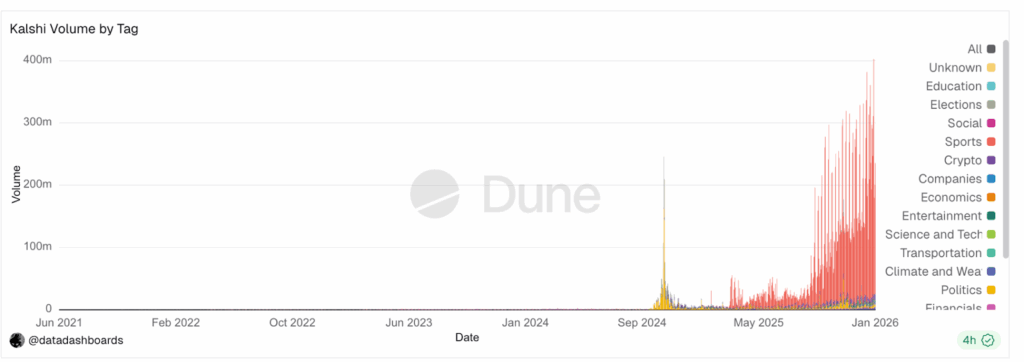
Kalshi focuses on sports betting more than any other platform, and that focus has made it the king of regulated American prediction markets. Sports contracts generated 89% of Kalshi’s $263.5 million in 2025 fee revenue, with December 2025 alone processing $6.38 billion in volume, largely driven by NFL and NBA markets. The platform secured mainstream legitimacy through December 2025 partnerships with CNN and CNBC that display Kalshi’s live prediction odds across their programming and digital platforms.
Polymarket, launched in 2020 as a blockchain-based protocol on Polygon, operates as a permissionless global crypto marketplace where anyone can create contracts on anything from crypto ETF approvals, to tweets, to Ukraine ceasefire odds, even to viral bets like “Will Elon Musk tweet on X more than 50 times this week?“. This transparency fueled a $9 billion volume surge during the 2024 election but also invited a $7 million governance attack in 2025, when a whale voter drained trader funds by falsely settling a Ukraine mineral deal market.
Access & Geography
Kalshi operates exclusively in the U.S. across all 50 states (though facing legal challenges in 10+ states). Polymarket geoblocks U.S. users but serves the rest of the world, currently testing a regulated U.S. re-entry.
Funding & Currency
Kalshi is fiat-native: you deposit dollars via bank account (ACH/wire), trade in USD, and withdraw to U.S. banks. Some third-party crypto on-ramps exist. Polymarket requires USDC on Polygon—you need a crypto wallet and stablecoins to participate.
Volume & Market Focus
As of November 2025, Kalshi processed $5.8B in monthly volume (90% sports), while Polymarket hit $3.74B focusing on crypto, geopolitics, and entertainment markets.
Fees & Yield
Kalshi charges 0.01–0.05% per trade and pays 3.25% APY on idle cash. Polymarket charges 0.75% plus Polygon gas fees (minimal) with no yield program.
Regulatory Framework
Kalshi is CFTC-licensed with deposit insurance and legal recourse if disputes arise. Polymarket operates offshore with smart contracts as the final arbiter—no customer service can reverse transactions.
Forecasting Accuracy
Both platforms outperformed traditional polling averages in the 2024 election, with Kalshi’s institutionally-traded markets tracking macro outcomes closely and Polymarket’s permissionless markets capturing faster moves on niche events
Kalshi vs Polymarket Comparison Chart
| Aspect | Kalshi | Polymarket |
| Geographic Access | U.S. only (all 50 states) | Global except U.S. (geoblocked); testing regulated U.S. re-entry |
| Funding | Dollars (bank/card), some crypto | USDC on Polygon only |
| Monthly Volume (Nov 2025) | $5.8B | $3.74B |
| Key Markets | Sports, politics, economy | Crypto, global events, entertainment |
| Fees | 0.01‑0.05% | 0.75% + gas |
| Yield/Perks | 3.25% APY on balances | None |
| Custody Model | Custodial; FDIC‑insured USD, Coinbase Custody USDC | Non‑custodial; user holds private keys |
| Regulatory Framework | CFTC-licensed (U.S.); deposit insurance & legal recourse | Offshore; smart contract is final arbiter |
Several studies on recent elections suggest that both Kalshi and Polymarket often outperformed major polling averages on high‑profile races, with Kalshi’s more curated, institutionally traded markets tending to track macro outcomes closely, while Polymarket’s permissionless markets captured faster moves in niche or crypto‑adjacent events.
Crypto Vs. Traditional Prediction Markets: What Should You Choose?
Choose Kalshi if you want to trade in dollars, have regulatory protections, and are comfortable sharing your ID and bank account. It’s built for both everyday users and professionals who want legal certainty and dollar payouts.
If you value privacy, global access, and individual sovereignty, Polymarket lets you trade anything from crypto ETF approvals to viral memes without permission, but you’re on your own if a smart contract bug or governance attack drains funds.
Custody Trade‑Offs
Prediction markets make custody trade-offs impossible to ignore.
- On Kalshi, cash sits in segregated accounts, rules are enforced by regulators, and users have legal recourse. But you are still trusting an intermediary. If accounts are frozen, markets halted, or withdrawals delayed, your funds are immediately at risk.
- On Polymarket, you control your wallet and private keys—funds stay in your wallet until you trade, then move into Polygon smart contracts. This eliminates company-insolvency risk: if Polymarket shuts down, your funds and positions remain accessible on-chain. You can withdraw, view positions, or redeem winnings via the UMA oracle using tools like PolygonScan.
- However, you now face smart contract risk (code bugs, oracle failures, governance attacks) and full responsibility for wallet security.
Neither model is risk-free. Kalshi gives you regulatory oversight and legal recourse but requires you to trust a custodian. Polymarket gives you full control of your keys but leaves you exposed to smart contract bugs and governance attacks with no regulator to appeal to.
This is why using hardware-based secure signers matters when you use Polymarket.
How to Use Ledger Signer with Polymarket
Ledger signers work with Polygon-compatible wallets (like MetaMask) to access Polymarket and other dApps, shielding against keyloggers and clipboard hijacks by keeping your private keys offline.
- For Polymarket users, connecting a Ledger through MetaMask routes every transaction to the device for signing – meaning, you must physically approve each action on the signer’s secure screen before it executes.
- However, most Polygon dApps including Polymarket require “blind signing,” meaning you’ll see contract addresses and transaction data in hexadecimal format rather than plain-language summaries. While this doesn’t provide human-readable transaction details, it still protects your private keys from being exposed to your browser or any malware, and prevents automatic approval of transactions without your physical confirmation.
Broader features like a four-digit PIN (with wipe-after-3-fails), a 24-word recovery seed generated offline, battery life that fits all lifestyles, seamless backup and recovery options, and constant firmware updates via secure channels make it future-proof.
Downsides of Kalshi Prediction Market
In December 2025, Kalshi raised $1 billion at an $11 billion valuation, but that milestone arrived with legal pressures.
Sports trading accounts for roughly 90% of Kalshi’s volume, and a nationwide class action filed in late 2025 alleges that the platform functions primarily as an illegal sportsbook operating under the cover of federal regulation.
With lawsuits in over 10 states, if courts side with the states, Kalshi faces limited options: secure gambling licenses state by state, exit sports markets entirely, or heavily geo-fence access.
Any of those outcomes would undermine the growth engine behind its valuation.
Conclusion
As of the time of writing, Kalshi is expanding aggressively into 140+ countries with unified global liquidity, launching Kalshi Research to reposition as a forecasting data platform.
Whether Kalshi evolves into a next-generation derivatives exchange or is constrained by state-by-state enforcement will likely be decided in U.S. courts in the near future.
Frequently Asked Questions
1. Is Kalshi legal?
Although Kalshi is currently legal and regulated as a prediction market by the CFTC, as of late 2025, the platform faces cease-and-desist orders, enforcement actions, or lawsuits in over ten states—including Nevada, Connecticut, Massachusetts, New York, and New Jersey—all arguing that its sports contracts constitute illegal gambling under state law, regardless of CFTC oversight.
2. Do people make money on Kalshi?
While some people are able to profit from Kalshi, as with all prediction markets, there’s a catch: research reveals Kalshi markets have a favorite-longshot bias: crowds systematically misprice contracts, letting informed traders exploit predictable patterns. Like poker, sharp players profit while casual participants fund both their winnings and the house. Some make money; most subsidize the system. The real winners? Kalshi’s founders (now on-paper billionaires) and the platform itself, on pace for $600-700 million annual revenue from transaction fees alone.
