
Bitcoin UTXOs Explained: How to Save Thousands in Transaction Fees

| KEY TAKEAWAYS: |
| — Your BTC balance isn’t a single number like a bank account; it’s the total of distinct, indivisible “chunks” called UTXOs, created every time you receive BTC. — If you receive BTC frequently, UTXOs start to pile up, making later transactions much larger (and dramatically more expensive) than they need to be. — Ledger signers help you verify critical transaction details directly on their secure screens), and Ledger Wallet™’s coin control lets you view and manually select UTXOs so you can manage them more efficiently. |
Buying BTC regularly and practicing self-custody is the right approach. But there’s a structural issue with how Bitcoin works that most people discover too late, usually when they’re staring at a $500 fee quote to send $1,000 worth of BTC.
The problem isn’t the BTC you bought. It’s how you received it. Bitcoin uses something called UTXOs (Unspent Transaction Outputs) as fundamental building blocks to address several tradFi problems.
In this model, individual pieces (chunks) of BTC are created every time you receive a BTC payment. Over time, if you stack up too many UTXOs, you could end up paying 10-20x more in transaction fees than someone sending the same amount of BTC from fewer, larger pieces.
So how does this happen, and how can you manage your BTC to avoid it? In this article, we explain what UTXOs are, why they determine your transaction costs, and how to manage UTXOs properly to avoid paying more fees than necessary.
What Is a UTXO?
A UTXO (Unspent Transaction Output) represents the unspent portion of a cryptocurrency that remains after a transaction completes. Think of it as the digital version of the change you receive after buying something with cash.
With a bank account, you deposit cash and it immediately mixes with everyone else’s money. If you deposit five $20 bills totaling $100, the bank just records “+$100” to your account. In contrast, Bitcoin transactions are more like money in a piggy bank – each deposit (like five $20 bills) stays separate.
Each UTXO is distinct, holds a different amount, and remains a separate, independent piece until you spend it. These individual pieces collectively form your Bitcoin wallet balance, serving as the foundational components of Bitcoin’s transaction system. For instance, a Bitcoin wallet balance of 0.52 BTC might actually be three separate UTXOs: 0.20 BTC + 0.15 BTC + 0.17 BTC.
The crucial detail is that a UTXO is either fully unspent or fully spent – you can’t use just a part of it. When you spend it, the old UTXO is destroyed and new ones are created: for the recipient and your change.
How UTXOs Work
Every Bitcoin transaction follows this pattern:
- Inputs: Refers to UTXOs you’re spending
- Outputs: New UTXOs being created for recipients
This is just like physical cash. If you need to pay someone $30 but only have a $50 bill, you can’t tear the bill in half. You hand over the whole $50 and receive $20 in change.
BTC UTXO Transaction Example
Let’s say you have these UTXOs in your wallet:
- One worth 0.5 BTC
- One worth 1.0 BTC
- Two worth 0.01 BTC each
Total: 1.52 BTC
You want to send someone 0.9 BTC. So, your wallet evaluates its options:
- The 0.5 BTC piece is too small,
- The 0.01 BTC pieces are way too small,
- The full 1.0 BTC piece is enough to cover the transaction.
If you have a 1.0 BTC UTXO but only need to send 0.9 BTC, you can’t just send 0.9 and leave 0.1 behind. Instead, your wallet sends 0.9 BTC to the recipient and automatically creates a change output of 0.1 BTC that goes back to you.
Your wallet now holds:
Total: 0.62 BTC
- 0.5 BTC (unchanged)
- 0.1 BTC (newly created change)
- 0.01 BTC (unchanged)
- 0.01 BTC (unchanged)
The original 1.0 BTC UTXO is ‘destroyed’ as an input and ceases to exist, replaced by the two new UTXO outputs (0.90 BTC to the recipient, 0.0995… BTC to your change address).
- Input: the single 1.0 BTC UTXO your wallet chooses to spend.
- Outputs:
- 0.9 BTC sent to the recipient (payment output)
- ~0.0995 BTC sent back to a new address you control (change output)
This ‘change’ doesn’t return to the same address it came from. Your wallet generates a brand new change address from your own pool of addresses and sends the leftover ~0.0995… BTC there.
The leftover amount that goes neither to outputs nor change?
That becomes a miner fee, a small payment to the network for validating your transaction and permanently recording it on the blockchain.
- To clarify, the miner fee isn’t a third output; it’s the unclaimed difference between your input (1.0 BTC) and your outputs (0.9 + 0.0995 BTC). That leftover 0.0005 BTC is what miners earn for validating your transaction.
Hence, every time your wallet BTC or breaks one UTXO into multiple new ones, you also increase the number of pieces you may need to spend later. Let’s understand what this has to do with the BTC fees you could eventually end up paying.
How Do UTXOs Make BTC Fees Expensive?
Bitcoin transaction fees don’t depend on the value of BTC you send. They depend on the size of the data that each transaction uses.
Sending $10 or $10,000 of Bitcoin can cost the exact same fee if the data footprint is similar.
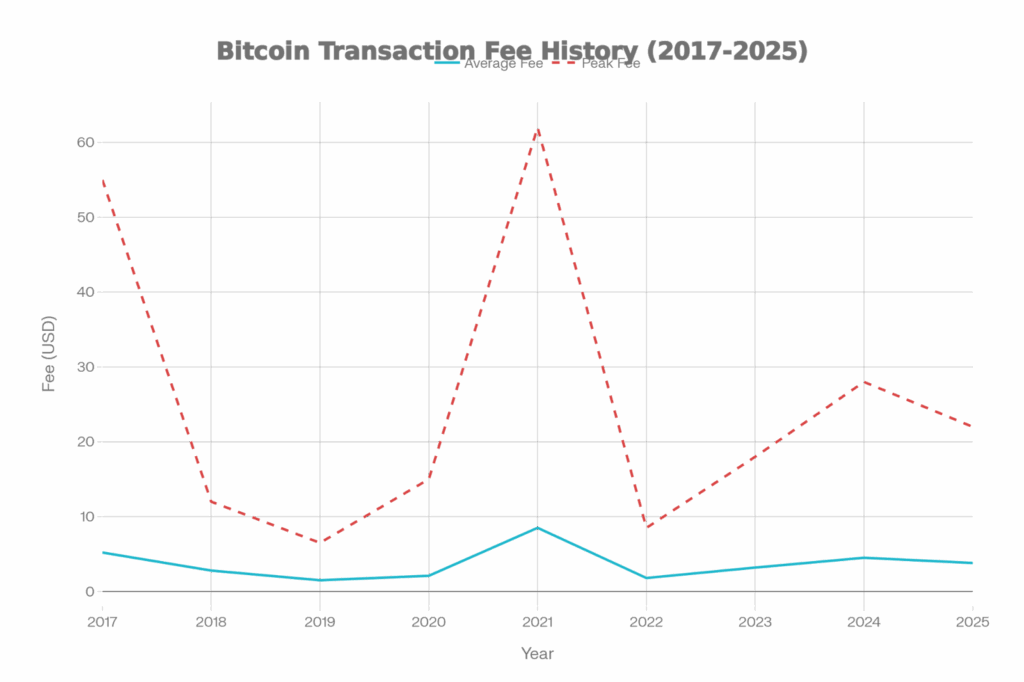
Bitcoin transaction fees have varied significantly over time, with notable spikes during periods of high network demand. This chart illustrates both average and peak transaction fees from 2017 to 2025.
For context, someone once sent over $2,000,000,000 in BTC for a fee of just eighty cents.
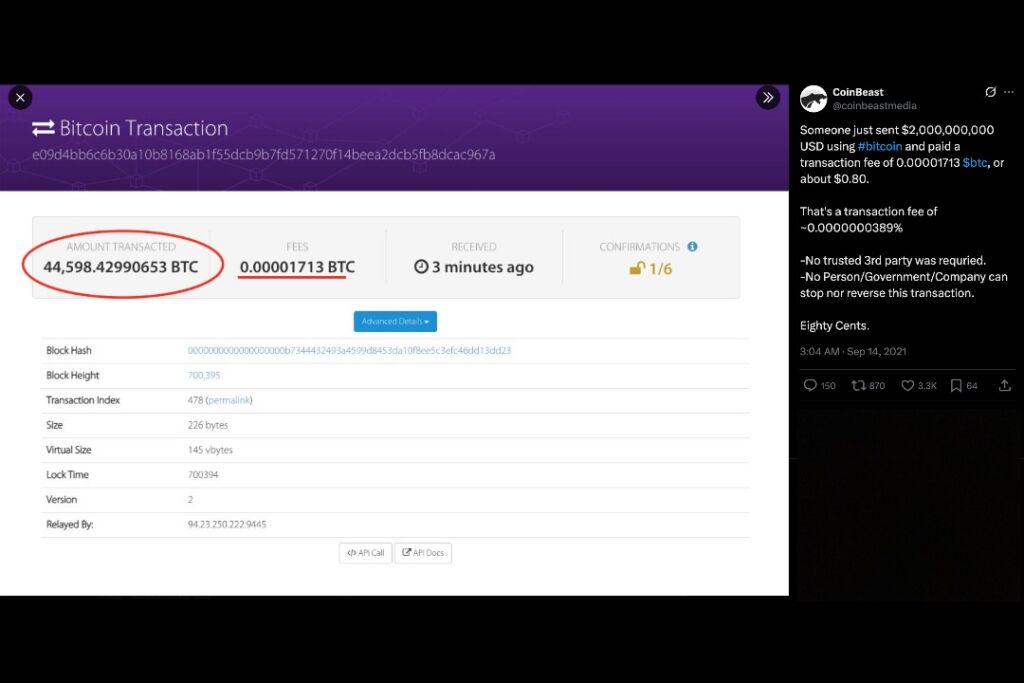
Source: CoinBeast on X
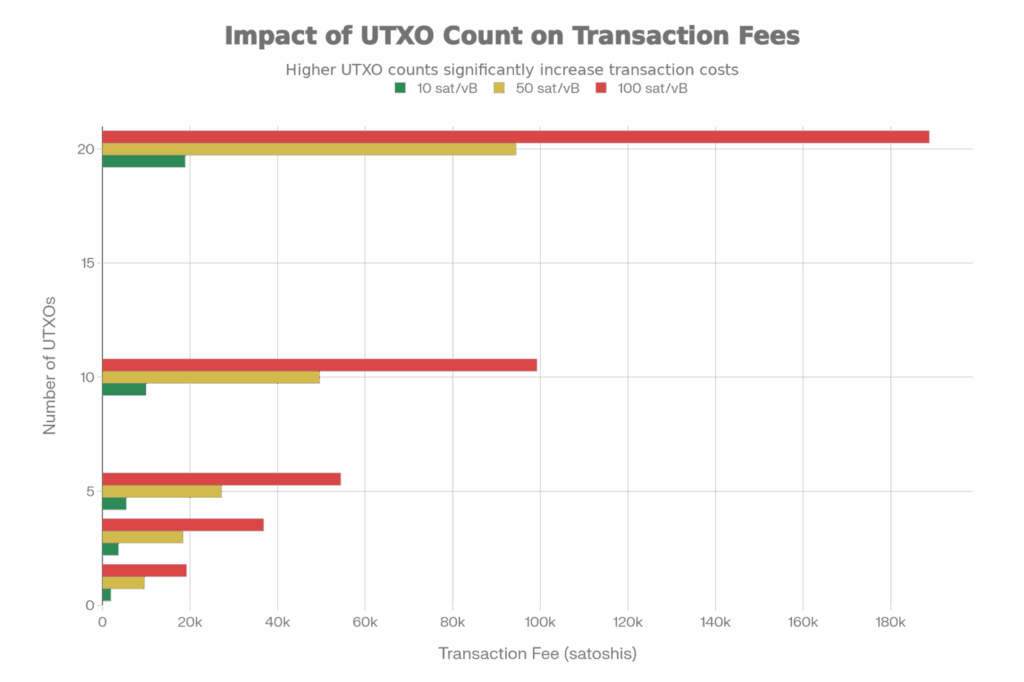
Bitcoin transaction fees don’t depend on how much BTC you send but on how big your transaction is in data terms, and every extra UTXO you spend makes that transaction bigger.
This means a payment that uses 20 tiny UTXOs can cost roughly 20 times more in fees than a payment that uses one large UTXO, even if both send the same amount of BTC.
Over years of small withdrawals, payments, and change outputs, those extra pieces quietly pile up—so when you finally want to move a larger amount, you discover that simply spending your own coins has become unexpectedly expensive.
Benefits of UTXO: Why Bitcoin Uses The UTXO Model
The UTXO architecture provides Bitcoin with properties that account-based systems cannot match:
Complete Auditability
Every single satoshi traces back through an unbroken chain to its creation. This traceability is impossible in traditional finance; you simply can’t audit the complete history of a dollar bill.
Because each UTXO is a separate piece of bitcoin with its own history, different parts of the network can check different UTXOs in parallel, instead of updating one big shared account balance step by step. This means anyone can independently verify that the supply is fixed and that your coins are real, without needing to trust a bank, exchange, or government audit.
Double-spend Prevention
Once a UTXO is consumed, it’s marked as spent and removed from the active set. Nodes can instantly verify whether someone is trying to spend the same UTXO twice. When your wallet shows that a transaction has been recorded in several new blocks (multiple confirmations), you can treat the BTC you received as final—it can’t be reversed or double‑spent behind your back.
Provable Reserves
Anyone holding UTXOs can cryptographically prove ownership by signing messages with their private keys. Individuals, exchanges, custodians, or treasuries can prove they really control the coins they claim, letting you demand evidence instead of trusting a PDF statement.
Privacy Options
Because each UTXO can be sent to a brand-new address, Bitcoin lets you spread your holdings across many addresses instead of tying everything to a single public account balance. Used carefully, this makes it harder for casual observers to see your total holdings or track all of your spending from one identifier.
Limitations of UTXO
The same properties that make Bitcoin revolutionary also create genuine constraints that shape how you must manage your wealth:
Limited Smart Contract Capabilities
Bitcoin’s UTXO‑based, stateless scripting model makes complex smart contracts difficult: it is excellent for simple, secure spends, but far less flexible than account‑based platforms built for general‑purpose DeFi.
UTXO Privacy Tradeoffs
While UTXOs enable privacy through fresh addresses, poor management creates the opposite effect.
Every time you combine multiple UTXOs in one transaction, you permanently link them on-chain. A single careless consolidation can undo years of careful address separation, making blockchain analysis trivial.
The model gives you privacy tools but punishes you severely for using them incorrectly.
UTXO Set Growth Burden
Every full Bitcoin node keeps a live database of all currently spendable UTXOs, called the UTXO set. As more people use Bitcoin, more UTXOs exist at the same time, so this database grows and needs more disk space and more RAM for fast lookups (verifying something quickly in a database).
Very small UTXOs (“dust”) that nobody will ever spend still have to sit in that database, so they waste resources on every node and slowly make it harder (and more expensive) for ordinary users to run their own node.
Dust: When Bitcoin Becomes Unspendable
Imagine owning BTC you cannot spend.
“Dust” refers to UTXOs so small that the cost to spend them exceeds their value. You still own these coins on the blockchain, but using them would mean paying more in transaction fees than the BTC value itself is worth.
Dust isn’t a protocol error or a bug; it’s an economic outcome of holding many tiny UTXOs in a system where fees are based on transaction data size, not value.
How Does Bitcoin Dust Accumulate?
Dust usually accumulates unintentionally. Frequent small withdrawals, tiny payments, and repeated change outputs leave wallets cluttered with fragments that are impractical to spend during high-fee periods.
For instance, you withdraw small amounts of BTC regularly (say ~$20 at a time) into your own wallet. Each withdrawal creates a small UTXO, and over time, these pieces pile up until spending one of them can cost as much as, or more than, the BTC it contains.
At that point, the UTXO is economically unspendable: you still own it on the blockchain, but using it would mean losing money.
UTXO Management: Why It’s Important
Managing UTXOs separates efficient Bitcoin users from those who pay 10x more than necessary.
1) Prevention (Before UTXOs Accumulate):
- Make each withdrawal count: let BTC build up on the exchange and withdraw larger amounts less often, instead of lots of tiny withdrawals.
- Aim for reasonably sized UTXOs: avoid creating very small pieces (for example, below 0.01 BTC) because they are the first to become uneconomical dust when fees spike.
- Use Layer 2 networks for small payments: send frequent coffee‑sized payments over Lightning or other Layer 2s, and only settle bigger, less frequent totals on the Bitcoin base layer.
2) Ongoing Management (While UTXOs Exist):
- Use coin control: when you send BTC, choose which UTXOs to spend so you can balance privacy and fees instead of letting the wallet pick randomly.
- Label your UTXOs: note where each piece came from (KYC exchange, mining, income, etc.) so you don’t accidentally mix coins you’d rather keep separate.
- Spend consciously: before each transaction, ask “What does combining these pieces reveal about me?” and pick UTXOs that reveal as little as possible.
Even with perfect prevention, you’ll eventually need to clean up accumulated fragments. That’s where consolidation, i.e. periodic maintenance during low-fee windows, comes in.
What is UTXO Consolidation?
UTXO consolidation means deliberately combining your small UTXOs into larger ones before you need to spend them. You do this by sending a transaction to yourself that uses many UTXOs as inputs and creates one (or a few) large UTXOs as outputs.
Consolidation is worth considering when your wallet has accumulated many UTXOs.
If you’re thinking “I get that too many UTXOs are expensive… but isn’t fixing the problem also expensive?” You’re right, but consolidating is like paying $10 for insurance that saves you $500 in fees later.
When you consolidate, try to only combine coins that come from similar places (for example, keep coins bought on exchanges separate from coins you received privately). If you mix everything into one big UTXO and someone links that UTXO to your identity, they can estimate your whole balance, not just that one payment
Optimal management requires sophisticated wallets with coin control. Basic wallets hide UTXOs, creating a two-tier system: advanced users manage fees while beginners pay massive fees through no fault of their own.
Ledger signers’ battle‑tested security model keeps your BTC safe over time, and Ledger Wallet’s coin control options turn BTC consolidation from a risky manual chore into a guided, secure step‑by‑step workflow.
How to Consolidate Bitcoin UTXOs Using Ledger Wallet
Ledger Wallet’s Coin Control lets you see and manually select the individual BTC pieces (UTXOs) that will be used in a transaction. Coin Control exposes each spendable piece so you can identify smaller or fragmented amounts.
Ledger Wallet automatically creates a fresh change address for every transaction and manages it internally. You don’t need to track change addresses yourself, and Ledger Wallet does not display which specific address is a change address: your total account balance simply reflects all spendable UTXOs you control.
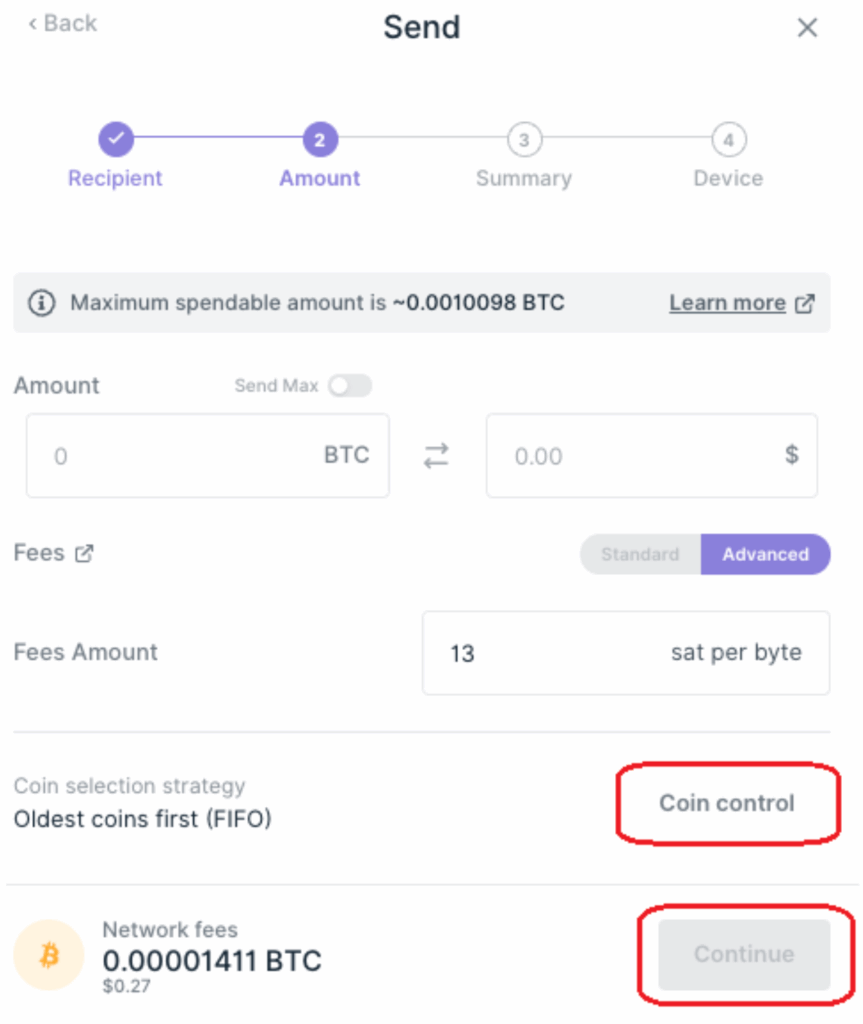
You can learn more about how to consolidate BTC using your Ledger signer and Coin Control here.
Consolidation transactions are not time-sensitive and are designed to settle when the network is quiet.
Once you consolidate:
- the selected small UTXOs are marked as spent,
- new, larger UTXOs are created in your wallet, and
- your overall balance remains the same, but structured more efficiently.
Conclusion
Over time, poor UTXO management can cost you a ton in unnecessary feesthousands of dollars in unnecessary fees that go to miners – careful management lets you keep that money instead.
When BTC sits on an exchange, UTXO management and security are the exchange’s problem; in self‑custody, they become yours. And in the real world, self‑custody usually fails not because people forget their seed phrase, but because they end up signing the wrong transaction on non-secure screen, or storing keys on internet-connected devices that can be hacked.
Your 12/24‑word secret recovery phrase is the master key that can recreate all the private keys controlling your UTXOs on any compatible wallet; anyone who gets it can spend your coins. A Ledger signer keeps that key inside a secure element chip and lets you verify the address and fee on its own screen before you approve, so malware on your computer or phone can’t silently redirect your BTC.
With over 8 million signers sold, Ledger’s security model plus Clear Signing, backup and recovery options, and coin control (via Ledger Wallet) give you both sides of real self‑custody: keys that stay offline, and UTXOs you can manage efficiently instead of bleeding fees.
Invest in a Ledger signer today and take control of your Bitcoin the right way!
Frequently Asked Questions About Bitcoin UTXOs
What is a UTXO for Bitcoin?
A Bitcoin UTXO (Unspent Transaction Output) is a specific chunk of Bitcoin left over from a previous transaction that has not yet been spent and can be used as input to a new transaction.
What is the UTXO fee for Bitcoin?
There is no fixed “UTXO fee” in Bitcoin; you pay a transaction fee based on the transaction’s size in vBytes (which depends heavily on how many UTXO inputs you spend) multiplied by the chosen fee rate in sats per vByte.
What is the minimum Bitcoin size for UTXO?
Bitcoin has no universal minimum UTXO size, but outputs below the dust threshold (around a few hundred satoshis for typical output types) are treated as uneconomical to spend and many wallets refuse to create them.
