
5 Years of Solana: From Scalable Blockchain to Global Settlement Layer

| KEY TAKEAWAYS: |
| — Solana launched in 2020 as a solution to the Blockchain Trilemma, using a unique mechanism called Proof of History to help achieve high throughput and low-latency transactions. — The network has shown considerable resilience through rapid ecosystem growth, technical roadblocks, and high-profile periods of network outages. — Five years after its mainnet launch, Solana has emerged as one of the most-used blockchains, with millions of monthly active users and adoption by global financial institutions and payment giants like Visa and Western Union. |
The history of blockchain technology is often a story of competing priorities. For much of the industry’s existence, the “Blockchain Trilemma” has suggested that a network can only optimize for two of three qualities: decentralization, security, or scalability.
When Solana entered the blockchain landscape, it did so with a clear focus on the latter, aiming to provide a high-throughput, low-cost environment that could rival centralized financial databases without sacrificing the transparency of a public ledger.
Centered around a novel pre-consensus mechanism called Proof of History (PoH), Solana has achieved transaction speeds and costs that were once seen as out of reach for a public blockchain.
However, this journey has not been without its setbacks. The network has faced significant technical hurdles, high-profile periods of downtime, and ongoing concerns around its level of centralization. Indeed, Solana is a blockchain that has been shaped as much by its failures and recoveries as by its technical milestones over its first five years.
In this article, we’ll dive into the five-year history of the Solana blockchain, from its initial design through to its current-day status as a potential base layer for the developing digital economy.
2017-2019: The Solana Blueprint
The story of Solana begins in November 2017, when former Qualcomm and Dropbox engineer, Anatoly Yakovenko, published a whitepaper describing a new method of “verifying order and passage of time between events”. To explain, Yakovenko identified the time it took nodes to agree on the order of transactions as a primary bottleneck for existing blockchains like Bitcoin and Ethereum. Thus, the whitepaper was his attempt to lay out his idea for a solution – Proof of History (PoH).
The Innovation of Proof of History
Despite what its name may suggest, Proof of History (PoH) is not actually a consensus mechanism in and of itself. Rather, it’s a mechanism designed to aid the efficiency of a consensus mechanism (Proof of Stake, in the case of Solana).
Unlike with traditional Proof of Stake (PoS) or Proof of Work (PoW), where nodes must constantly communicate to agree on a timestamp, PoH acts as a decentralized clock. In simple terms, it enables the network to create a historical record that proves a transaction occurred at a specific moment in time. This allows validators to process transactions as they arrive, rather than waiting for a block to be filled, drastically increasing efficiency.
Solana’s Hardware-First Approach
Solana’s founding team, which also included Raj Gokal, Greg Fitzgerald, and Stephen Akridge, brought a “hardware-first” mindset to blockchain development. In other words, they approached blockchain as a distributed system that would scale alongside the growth of modern hardware (CPUs, GPUs, and network bandwidth). This philosophy led to the development of “Sealevel,” a parallel runtime that allows the network to process thousands of smart contracts simultaneously, rather than one by one.
Between 2018 and 2019, the team refined these concepts through a series of testnets. The transition from early prototypes to a multi-node testnet demonstrated that the “web-scale” performance envisioned in the whitepaper (i.e., performance comparable to Web2 applications) was technically feasible.
2020: Solana Mainnet Beta and the Stateless Model
Solana officially launched its Mainnet Beta in March 2020. This was a pivotal year that saw the birth of the Solana Program Library (SPL) and the introduction of a unique architectural approach that separated code and network states.
Programs vs. Accounts
Unlike Ethereum, where smart contracts store both the code and the current state (like balances) in the same location, Solana separates them.
“Programs” (Solana’s version of smart contracts) contain immutable code, while “Accounts” store the data. This separation is what enables parallel processing; if two transactions aren’t trying to access the same data account, they can be processed simultaneously rather than sequentially.
The Birth of the SPL Ecosystem
At the center of this new ecosystem were Solana-based tokens created using the Solana Program Library (SPL). Much like Ethereum’s ERC-20 standard, the SPL provided a collection of pre-compiled programs that allowed developers to launch tokens and decentralized applications (dApps) with ease. The goal of this building-block approach was to enable different elements of the network to work together seamlessly from day one.
2021: “Solana Summer” and the Scaling Crisis
2021 was a pivotal year for Solana’s growth. Fueled by a massive surge in Decentralized Finance (DeFi) and the explosion of Non-Fungible Tokens (NFTs), Solana became widely known as the primary competitor to the pioneering smart contract chain, Ethereum.
Solana’s Ecosystem Explosion
DeFi protocols like Raydium and Serum, alongside NFT marketplaces like Magic Eden, drew millions of users attracted by sub-penny transaction fees and near-instant confirmation times. This period, often called “Solana Summer,” saw the network’s total value locked (TVL) skyrocket from around $100M in early 2021 to over $11B by December, supported by a $314 million funding round led by a16z and Polychain Capital in June 2021.
The Limits of Success
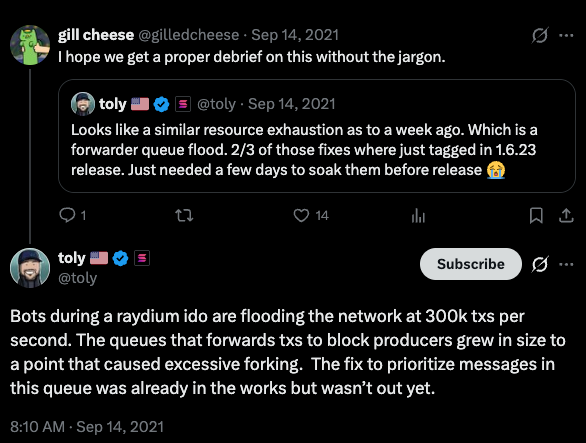
However, this rapid growth exposed the network’s early vulnerabilities. In September 2021, Solana suffered a high-profile, multi-hour outage caused by “resource exhaustion.” Essentially, a massive flood of transaction requests driven by Grape Protocol’s onchain Initial Dex Offering (IDO) overwhelmed the network’s ability to process and prioritize transactions.
This outage highlighted the tradeoff stressed by the blockchain trilemma, highlighting the fact that extreme performance comes with stability challenges and that the network needed more robust ways to handle congestion.
It also raised questions about network centralization, as the fix required coordinated action from the validator set to restart the chain—a process that involved validators manually upgrading their software and restarting in unison.
2022: Contagion and the Mobile Pivot
If 2021 was about Solana’s growth, 2022 was about resilience. The year was marked by broader market volatility, technical and reputational crises, and technical exploits resulting in over half a billion dollars being stolen.
The Wormhole Exploit
In February 2022, a critical link between Solana and other chains, the Wormhole bridge, was exploited for $320 million in what was the second-largest DeFi hack up to that point. While the network itself remained secure and Wormhole’s team quickly stepped in to restore the stolen funds, the hack illustrated a core principle of blockchain security: assets are only as secure as the most vulnerable component in their custody chain. Cross-chain bridges, by their nature, represent concentrated points of risk.
The SMS and Saga Announcement
Predicting that the future of crypto adoption would be heavily influenced by mobile devices, Solana Labs announced the Solana Mobile Stack (SMS) and the Saga phone in June 2022. This was an attempt to integrate hardware-backed security directly into a smartphone by using a secure enclave within the phone’s hardware called a “Seed Vault” to protect private keys.
The Saga would eventually launch in 2023 with lower-than-expected sales, though it eventually sold out and commanded high values on the resale market, due to a rising demand for BONK tokens that came bundled with the phone. Ultimately, Solana Labs announced in 2025 that it was ending support for the Saga, a mere two years after its initial release, and two months after announcing its predecessor, the Solana Seeker.
The FTX Collapse
The most significant blow to the network came in November 2022 with the collapse of the FTX exchange. FTX and its sister firm, Alameda Research, were major proponents and backers of the Solana ecosystem, with significant SOL holdings and deep involvement in multiple Solana projects. When they filed for bankruptcy, the fear that massive amounts of SOL would be liquidated, as well as negative sentiment due to its connection to FTX, caused the token price to plummet in value.
2023: Solana’s “Comeback” and Technical Development
Despite the major setbacks of 2022, the Solana ecosystem was eventually able to rally in 2023, staving off the troubled fate that many spectators had assigned it.
State Compression and Protocol Upgrades
On the technical side of things, 2023 was a year of significant network optimization. The introduction of State Compression in April 2023 allowed developers to mint millions of compressed NFTs for a fraction of the previous cost, enabling new use cases in DePIN (Decentralized Physical Infrastructure Networks) and gaming. The network’s TVL, which had fallen to around $200 million in the wake of FTX, rebounded to nearly $1.5 billion by year-end.
2024: Increasing Retail Adoption
By 2024, Solana had solidified its position as one of the most popular blockchains for high-frequency retail activity. Its combination of speed and low cost made it a suitable playground for trading and 2024’s memecoin craze.
Memecoins and High-Speed Activity
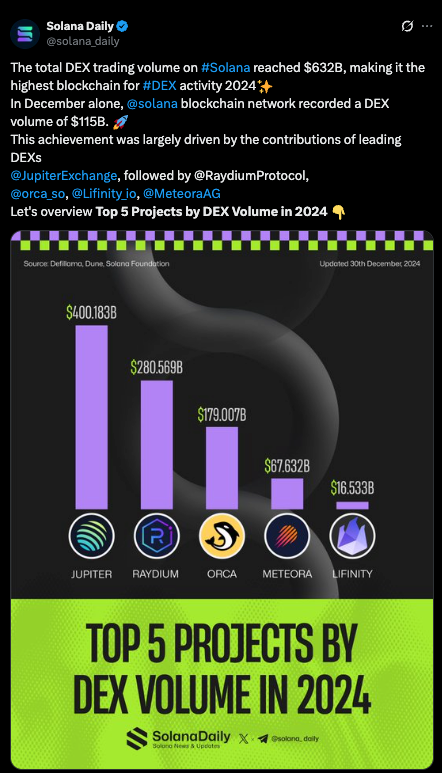
Solana’s technical architecture and low barriers to entry led to its arrival as the primary arena for the memecoin mania of 2024. This phenomenon was largely led by the emergence of the no-code memecoin platform pump.fun, along with the dominance of DEX protocols like Raydium and Jupiter.
All of these factors contributed to a high-velocity trading culture favored by risk-tolerant traders, who could regularly catapult memes to multi-million dollar market caps in a matter of hours.
Irrespective of the lack of utility or general inability of most memecoins to hold their value, this phenomenon made clear that Solana was gaining acceptance among retail users. The chain recorded lofty daily transaction values, hitting 66.9M daily transactions by the end of 2024. The network’s monthly DEX volume even surpassed that of Ethereum’s by year’s end, and exceeded $100B in both November and December.
DePIN and New Use Cases
Beyond memecoins, 2024 saw significant growth in Decentralized Physical Infrastructure Networks (DePIN). Projects like Helium (which migrated to Solana in 2023) and Render Network demonstrated that Solana’s performance characteristics made it ideal for real-world coordination problems—from wireless hotspot networks to distributed GPU rendering.
2025: The Institutional Emergence
In 2025, Solana transitioned from an experimental high-performance network into a foundational piece of global financial infrastructure. However, while the year was defined by landmark institutional integrations and technical milestones, it also served as a reminder of the inherent volatility that the network continues to navigate.
ETF Approval and Market Access
The regulatory landscape shifted dramatically in late October 2025. Following extensive filings throughout the year, spot Solana ETFs began trading in the United States after receiving SEC approval. Major financial institutions, including 21Shares, VanEck, Franklin Templeton, and Fidelity, began offering these products, providing regulated exposure to the SOL ecosystem and normalizing Solana as an asset utilized by wealth managers.
Visa Adopts Solana for USDC Settlement
December 2025 marked a watershed moment when Visa launched USDC settlement for U.S. banks using the Solana blockchain. Starting with Cross River Bank and Lead Bank, this service enables financial institutions to settle Visa network obligations seven days a week rather than the traditional five-day business cycle, achieving near-instant settlement at a fraction of legacy costs. Notably, Visa’s program had already reached a $3.5 billion annualized run rate globally before the U.S. launch, demonstrating significant institutional demand for blockchain-based settlement.
Firedancer Launch
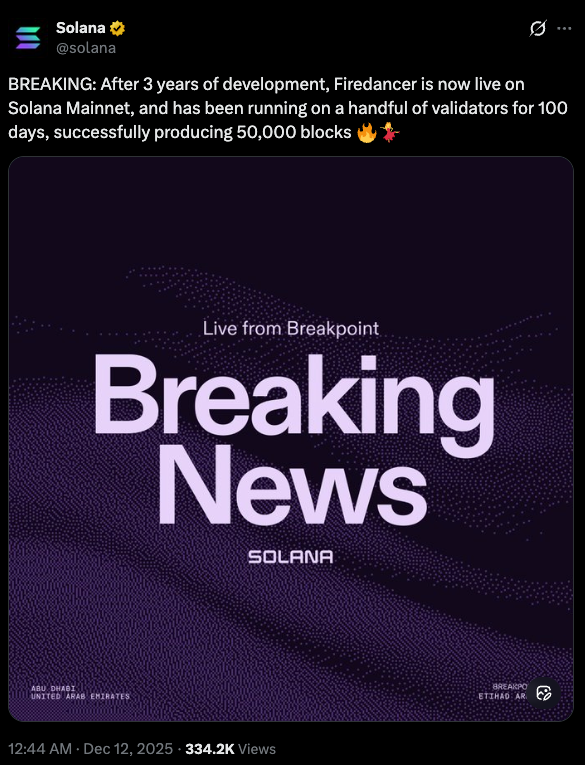
In 2025, the Solana network reached a major resilience milestone with the mainnet launch of Firedancer, a completely independent validator client developed by Jump Crypto. Built from the ground up, Firedancer seeks to prevent network crashes by giving network node operators another choice of software to use.
Network Performance
Despite the technical and institutional successes of 2025, the price of SOL faced a challenging fourth quarter. The year began on a high note, with SOL reaching an all-time high of $295 on January 19th. After a mid-year rally saw the price reach $263 in September, a bearish Q4 reversed these gains. By late December, SOL was trading down 35% on a yearly basis at approximately $122.
However, price performance does not necessarily tell the full story of the network’s underlying fundamentals. For one thing, Solana sustained daily non-vote transactions hovering around 100M for much of the year. The network also maintained 100% uptime for much of the year, which was a significant improvement from its early growing pains.
The Roadmap Ahead
Looking forward, the network is focusing on resilience and future-proofing. Firedancer’s mainnet deployment is targeting a capacity of up to one million transactions per second, while research into quantum-resistant cryptography aims to ensure the network stays secure for the next decade and beyond.
Is Solana Centralized?
While Solana has made significant strides in decentralization, concerns persist. As of December 2025, the network was just shy of 800 validators, down dramatically from its high mark of 2500 in 2023. The largest driver of this decline has been a higher bar of hardware requirements for validators, which has created barriers to entry that favor wealthier and institutional participants. Although network proponents argue that validator entry barriers, while higher than some chains, are necessary trade-offs for the network’s performance characteristics.
The debate reflects a fundamental tension: Solana’s design philosophy assumes that hardware capabilities will improve over time, allowing gradual decentralization as consumer hardware becomes more powerful. Whether this thesis proves correct will significantly impact the network’s long-term positioning as a truly decentralized blockchain.
Conclusion
Solana has evolved from being a specialized blockchain built for speed to a versatile settlement layer for use cases ranging from memecoins and gaming to institutional payments and tokenized treasuries.
Yet significant questions remain. Can the network continue to decentralize while maintaining its performance advantages? More specifically, has Solana truly solved the scalability side of the trilemma without unacceptable compromises on security and decentralization, or are these trade-offs still unfolding?
Ultimately, the network’s next chapter will be defined both by its appeal to retail and institutional users, and by how it navigates the delicate balance between performance, decentralization, and security that every blockchain ultimately must strike.
