
The Complete Guide to Monad Blockchain

| KEY TAKEAWAYS: |
| — Every blockchain has to choose between high decentralization, strong security, and high scalability (speed + low fees). Historically, no Layer-1 delivered all three without compromise. — Developers and users have lived with the trade-offs: congestion, high costs or faster chains built on expensive hardware. — Monad is a high-speed Layer-1 chain that re-engineers the EVM to eliminate the typical compromises via parallel execution, achieving ~10,000 transactions per second (TPS) potential, sub-second finality, and near-zero fees. |
All blockchains struggle to balance decentralization, security, and scalability at the same time in what’s called a ‘blockchain trilemma’. When many independent participants (a.k.a validators) verify transactions, the network becomes more decentralized and secure, but coordinating all of them takes time and slows throughput. On the other hand, reduce the number of validators to speed things up, and decentralization is the trade-off.
Enter Monad – a Layer-1 blockchain that’s essentially trying to overcome this trilemma at scale. To achieve its speed without sacrificing decentralization, Monad treats the trilemma as an architectural problem, redesigning how the EVM (Ethereum Virtual Machine) itself executes transactions.
Networks like Ethereum prioritize decentralization and security, but that comes with congestion and high fees during heavy demand, a problem the ecosystem is working on but hasn’t fully solved yet even with Layer 2s and upgrades. On the other hand, the Solana network optimizes for speed and performance with fewer validators, but that comes with trade-offs like network outages.
Monad’s premise is simple: run Ethereum-level decentralization at Solana-level speed, without changing how developers build or deploy smart contracts.
So what is Monad, and what exactly makes it interesting? Let’s dive in.
What is Monad Blockchain?
Monad is a high-performance Layer-1 blockchain with full EVM compatibility, meaning that you can build, port, or run all Ethereum dApps and smart contracts on it just as-is, without the need for any code modification.
Its key breakthrough is parallel execution, which means Monad can handle many transactions simultaneously instead of lining them up one after another, so the network stays fast even when lots of people are using it. It is currently the only L1 that keeps full Ethereum bytecode compatibility while executing transactions in parallel and pipelining block production, scaling the EVM itself rather than scaling around it.
Designed as a faster Ethereum “state-replication machine” and built from scratch using C++ and Rust, it is engineered to solve the blockchain trilemma by delivering Ethereum-grade decentralization and security together with 10,000 TPS, sub-second finality, and near-zero fees.
Let’s take a look under the hood to understand exactly how Monad’s parallel execution works, the other parts of the network’s architecture that support it, and how this makes sense for anyone interested in using it.
How Does Monad Network Work?
Every blockchain does two things:
- Consensus — agree on the order of transactions (the ledger)
- Execution — apply those transactions to update balances and contracts (the state)
On Ethereum, once consensus is decided, the EVM executes transactions one-by-one, even if the computer running the node has many CPU cores available. Only a single transaction ever runs at any given moment, which is why the network slows down during busy periods.
Monad changes only the execution stage: once the network has agreed on the order of transactions, it runs many of them in parallel across all available CPU cores and then applies the results in that exact agreed order, so the blockchain reaches the same final state without running everything sequentially.
The result is familiar Ethereum-level security and decentralization, but with dramatically higher throughput.
A simple way to visualize this:
Transactions on Ethereum:
- Consensus → Execution → Consensus → Execution (serial, single-threaded order)
Transactions on Monad:
- Consensus ⇄ Execution ⇄ Consensus ⇄ Execution (fully overlapping + multi-core parallel execution)
To dive a little deeper, let’s understand a little more about how parallel execution works on Monad.
Parallel Execution Explained
There are two ways to speed up an EVM chain:
- Sharding — Sharding splits a blockchain network into smaller pieces (shards) that process transactions independently, increasing speed and scalability, but at the cost of fragmenting blockspace (the network’s shared transaction capacity) and adding complexity.
- Parallel execution — This process keeps one unified blockspace and processes many transactions in parallel, boosting throughput while keeping the same final result.
Monad executes transactions simultaneously and if any of them get stuck or outdated, it simply re-executes, eliminating conflicts without reducing validator participation or requiring high-end hardware. Smart-contract code is also compiled on the fly using JIT (just-in-time) compilation, which speeds up execution even further.
Moreover, the Monad network also pipelines block production, so while block N is executing, block N+1 is already reaching consensus.
With parallel execution inside each block and pipelining between blocks, Monad reduces finality time and boosts transaction throughput while preserving decentralization.
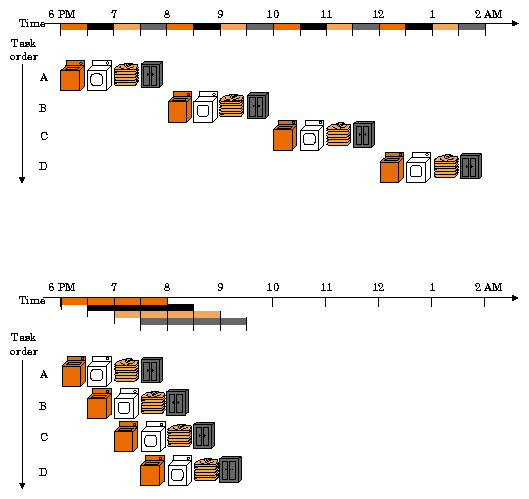
Comparison of linear vs parallel task processing: Top shows chores done one-by-one, bottom shows multiple chores running simultaneously without changing order.
Monad’s Other Architectural Components
Monad’s performance also draws from the combination of several systems working together, namely:
- MonadBFT: A fast and fork-resistant consensus design that finalizes blocks in under a second, even with many validators spread around the world.
- RaptorCast: A networking system that broadcasts new blocks across validators quickly so the whole network stays in sync without needing servers to be located in the same data centers.
- Asynchronous Execution: The network agrees on the order of transactions first, then executes them afterward; so execution never slows down block finalization.
- MonadDb: A storage engine built for quick reads and writes as the chain grows, ensuring performance stays high even as more apps and users join.
Monad Tokenomics: Explained
Monad has a fixed total supply of 100 billion $MON, distributed across key groups that support network growth:
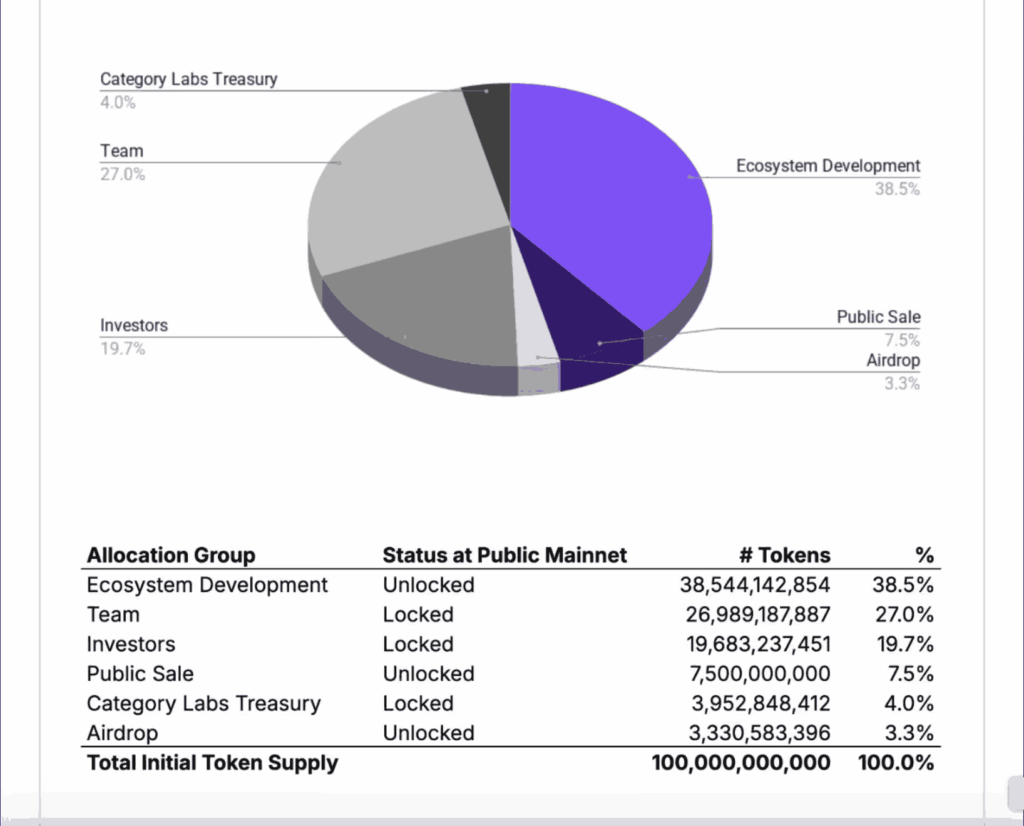
Source: Monad docs
Unlike many token launches, Monad did not conduct a traditional ICO. It instead released $MON during its mainnet Token Generation Event (TGE) in November 2025. A big driver of early excitement came from the Coinbase Monad sale and active Monad pre-market trading, which sparked speculation well before mainnet usage began.
As of the time of writing, the Monad crypto price (or simply MON price) sits around the $0.03 range, below its peak, as the market waits to see whether usage continues to grow after early incentives fade.
Monad Crypto Native Token: $MON
The Monad network’s native crypto token $MON is required for all activity on the chain, serving three roles:
- Gas fees: $MON is used to pay for transactions and smart-contract execution, and fees remain extremely low due to Monad’s efficiency.
- Staking and security: Monad uses Proof-of-Stake, so holders can stake or delegate $MON to secure the network and earn rewards.
- Ecosystem currency: As the base asset of the chain, $MON is the primary liquidity pair and settlement token across DeFi, NFTs, lending, and other apps.
$MON uses a dual issuance and burn model: new MON is issued as rewards to validators and delegators, while the base transaction fee on the network is permanently burned. Locked allocations, assigned to team members, investors, and the treasury, are excluded from staking rewards to prevent insiders from earning passive yield on unvested tokens.
In Monad, new tokens are mainly rewarded to people who stake and help secure the network. So if you’re staking, you’re earning at the same rate new tokens are being created, protecting you from dilution.
Over time, as the network grows and users pay more transaction fees, the plan is for fewer new tokens to be created so the system can run on fees instead of inflation.
The Monad network is powered by its native token, $MON, which is required for all activity on the chain.
Benefits & Use Cases of Monad
The key advantages of Monad arise from its architecture design choices:
Scalability Without Fragmentation
DeFi apps like DEXs, lending markets, perps, and liquid staking protocols can live in the same shared ecosystem without fragmented liquidity or cloning contracts across shards. Trades, liquidations, and lending markets can run as fast as centralized exchanges or web2 trading apps without gas spikes or failed transactions.
That same speed makes onchain gaming feel real-time – players can explore rich virtual worlds, interact with each other, and trade their in-game items instantly without lag or high fees.
Monad also potentially allows more efficiency for large-scale digital economies, and for institutions to settle tokenized real-world assets, like stocks and bonds, onchain immediately.
High Performance Without Specialty Hardware
With Monad, anyone with consumer-grade hardware can run a node and participate in securing the network, rather than only institutions with data-center–grade servers. As of early mainnet, validators currently run on significantly lower specs than Solana or Sui require.
Developer Familiarity
Full EVM compatibility means existing Solidity contracts, dev tooling, and wallet infrastructure carry over easily.
Fast Finality
Blocks finalize in under a second because execution never slows down consensus, so apps feel instant for users. Your trades settle immediately, your NFT mints don’t get stuck or cost you major gas fees during busy periods.
For institutions, tokenized real-world assets like stocks and bonds to settle onchain without long confirmation delays.
Future-Proof Execution Model
Legacy apps that would overwhelm today’s L1’s like real-time gaming worlds, social apps with millions of messages onchain, high-frequency DeFi, etc. can continue scaling without changing how developers build.
Is Monad The Future of L1s in Crypto?
On paper, Monad targets around 10,000 transactions per second, with ~400 ms block times and ~800 ms finality, putting it far ahead of typical EVM chains in raw throughput and latency.
Pre-market launch, Monad secured a valuation near $3B. It officially launched its public mainnet in November 2025 alongside its Token Generation Event (TGE) for its native crypto token $MON with a total supply of 100 billion.
Monad is already handling real traffic at scale, and its performance profile lines up with the ‘high-speed EVM’ story the architecture promises. It has already handled 3.7 million transactions on launch day, memecoin launches spiking to 350+ TPS, and DeFi TVL rocketing past $245 M in under two weeks.
Monad vs Other Major Chains: Comparison Chart
| Chain | Type | Approx TPS (base L1) | Block Time | Finality (settled) | Execution / Design Highlights |
| Monad | L1, EVM | ~10,000 TPS (potential) | ~0.4s | ~0.8s | Parallel EVM execution + pipelined MonadBFT consensus |
| Ethereum | L1, EVM | ~15–30 TPS | ~12s | ~5–12 min (finality) | Single-threaded EVM; security + decentralization first |
| Solana | L1 | ~2,000–4,000 TPS (real-world) | ~0.4s | ~2–13s | High-throughput, parallel runtime; higher hardware bar |
| XRP Ledger | L1 | Up to ~1,500 TPS (routine) | ~3–5s | ~3–5s | Optimized for cross-border payments, not general EVM |
| Sui | L1 (Move) | ~1,000–5,000 TPS (benchmarked) | ~0.4–0.5s | >1s | Object-centric parallel execution, Move VM |
But how does all this performance stack up in the real world? Let’s understand the potential drawbacks of Monad.
Risks of Monad
Monad’s biggest risk is that it’s still a newer Layer-1, meaning long-term decentralization, validator distribution, and economic security are not proven yet. The architecture is designed to scale without reducing the total number of validators, but whether that holds in practice depends on how many participants join and whether the network maintains resilience under high load phases.
There is also ecosystem risk: Monad’s performance advantage only matters if developers continue to build real products and users continue to transact on it once incentives cool off. A network driven mostly by short-term incentives rather than real demand can see participants drop.
Monad’s architecture is strong, but its long-term success depends on sustained adoption and durability under real economic pressure, not just technical promise. Finally, as with any new network, forecasts and Monad crypto price predictions mean little unless usage continues once incentives fade.
How to Use the Monad Blockchain Securely
If you’d like to get in early on Monad’s innovative approach to scaling blockchain, you can purchase and transact $MON from the security of the Ledger ecosystem, with a Ledger signer along with the all-in-one crypto app Ledger Wallet™.
With a Ledger signer, you’ll sign every transaction physically on a secure touchscreen with clear signing – human-readable information that shows you exactly what you’re approving. Additionally, Ledger’s transaction check feature will warn you if a smart contract or token transfer looks suspicious or doesn’t match what the connected dApp is displaying.
Even if a wallet, dApp, or block explorer shows misleading token activity or routes you toward a malicious contract, nothing can move without your explicit approval via the Ledger signer. This removes the risk of blind signing through a hacked or spoofed interface; one of the most common ways users lose funds on new networks.
With the Ledger ecosystem, you can benefit from the same level of security and protection that secures 20% of the world’s crypto. A full step-by-step guide to managing MON and ERC-20 tokens on the Monad network is available here.
Monad Today and Into the Future
Monad is already handling real traffic at scale, and its performance profile lines up with the ‘high-speed EVM’ story the architecture promises.
While it’s not the only parallelized EVM chain (Sei v2 and the upcoming MegaETH are contenders), Monad currently delivers the purest combination of full Ethereum bytecode compatibility, aggressive pipelining, and sub-second finality on a true independent L1.
The real test will be whether Monad sustains long-term adoption once incentives fade and real economic activity takes over.
FAQ
1. Is Monad built on Ethereum?
No, Monad is not built on Ethereum. It is an independent Layer-1 blockchain that supports the Ethereum Virtual Machine (EVM), meaning Ethereum smart contracts run on Monad without modification.
2. Can you invest in Monad ($MON)?
Yes, $MON is available to purchase right now. The safest, most secure way to buy and hold it is directly on a Ledger signer via Ledger wallet, keeping you in full control of your keys without compromise.
3. How secure is Monad crypto?
Monad is designed to maintain Ethereum-level decentralization and security by supporting a large, globally distributed validator set without requiring high-end hardware or reducing participation. Because the network is still early, its long-term security will ultimately depend on real-world validator distribution, stake concentration, and continued resilience of its consensus mechanism over time.
