
What is Crypto Lending?

| KEY TAKEAWAYS: |
| — Crypto lending lets you borrow funds by pledging your crypto as collateral, so you keep exposure to the asset instead of selling it. — A loan-to-value (LTV) ratio sets your borrowing limit, and if your collateral falls below the platform’s threshold, the protocol sells it automatically. — Where you borrow decides who holds your collateral: a centralized exchange, a DeFi protocol, or a self-custodial setup like Ledger Wallet™, where only your keys can move it. |
Spending your crypto usually means parting with it entirely. You sell your Bitcoin to cover an expense, and you lose any future gains if its value rises afterward. Crypto lending solves this problem. It lets you unlock liquidity from your digital assets without selling them.
This guide explains how crypto lending works, the main participants involved, the risks, and how it functions when it is designed around complete self-custody.
What Is Crypto Lending?
Crypto lending is the process of lending & borrowing funds using digital assets as collateral, rather than through a bank.
It involves two key parties: a lender & a borrower. Lenders supply the liquidity that makes loans possible, earning interest in return. Borrowers pledge their crypto as collateral to secure a loan, often disbursed in fiat or a stablecoin such as USDC or USDT, without selling the underlying asset.
A crypto loan is the onchain equivalent of a secured loan in traditional finance: you pledge an asset, borrow against it, keep the upside, and repay the balance later. What is different onchain is how the agreement is enforced. Instead of a bank underwriting the deal, a smart contract holds the collateral, tracks the loan in real time, and automatically liquidates the position if the market moves against the borrower.
How Does a Crypto Loan Work?
A crypto loan usually follows five steps.
- Deposit collateral. You lock a digital asset, such as Bitcoin, Ethereum, or another supported asset, into a lending platform or protocol.
- Borrow against it. Based on your collateral’s value and the platform’s rules, you draw a loan, often in stablecoins.
- Interest accrues. Rates are usually variable. They move with supply and demand for that asset on the lending market.
- You repay. Most onchain loans have no fixed term. You repay whenever it suits you, as long as your position stays above the platform’s threshold.
- Collateral is released. Once the loan is repaid, your collateral is returned in full.
In practice, this process is governed by two things: the loan-to-value (LTV) ratio and liquidation. LTV is the ratio between what you have borrowed and what you have deposited as collateral. For example, if you deposit $10,000 in BTC and borrow $4,000, your LTV is 40%.
Liquidation is what happens if your collateral’s value drops far enough that your LTV crosses the platform’s threshold. At that point, the protocol automatically sells enough of your collateral to repay the loan.
| Collateral value | Amount borrowed | Starting LTV | If collateral drops 30% |
| $10,000 | $3,000 | 30% | LTV rises to about 43% (still safe on most platforms) |
| $10,000 | $5,000 | 50% | LTV rises to about 71% (approaching most liquidation thresholds) |
| $10,000 | $7,000 | 70% | LTV rises to about 100% (collateral is likely liquidated) |
The lower your starting LTV, the more room your position has to absorb a price drop before liquidation becomes a risk. Each platform sets its own maximum LTV and liquidation threshold, so the same starting point can carry a different amount of risk depending on where you borrow.
Why Borrow Against Your Crypto Instead of Selling It?
Selling solves a short-term need for cash, but it comes with two lasting costs. You lose exposure to any future price gains, and in most jurisdictions, you trigger a capital gains event. Borrowing sidesteps both, with trade-offs of its own.
- You keep your exposure. Your collateral is still yours. If its price climbs while the loan is outstanding, that gain is still yours to capture once you repay and reclaim it.
- You may avoid a taxable disposal. In most jurisdictions, taking out a loan is not treated as a sale. Tax treatment varies by country and by how the loan and collateral are structured. This is not tax advice, and it is worth checking with a professional before assuming a specific outcome.
- You get liquidity to actually use. Spending, reinvesting, or covering a shortfall: the loan gives you cash flow without touching your underlying position.
Like any other loan, a crypto loan still incurs interest. And if your collateral’s value falls below the platform’s threshold, you can lose more than you intended through liquidation.
Centralized vs Decentralized Crypto Lending
Where you borrow changes who controls your collateral while the loan is outstanding. Broadly, the market splits two ways.
Centralized (CEX) lending runs through a centralized exchange or lending platform. You send your crypto to their custody, they set the terms, and they hold your collateral for the duration of the loan. It is typically the most user-friendly option, but it comes with counterparty risk. Your funds are subject to that platform’s solvency, policies, and, in rare cases, account-level actions like freezes.
Decentralized (onchain) lending runs through smart contracts on protocols like Morpho or Aave, without a company sitting in the middle. In principle, you never hand custody to a counterparty. The contract itself holds the collateral, and its logic is public and auditable. In practice, most people access these protocols through non-custodial hot wallets, which keep private keys on an internet-connected device, and the interfaces are often more jargon-heavy for newcomers.
| Centralized (CEX) | Decentralized (onchain) | |
| Who holds collateral | The platform | A smart contract |
| Main risk | Counterparty / platform risk | Smart contract risk |
| User experience | Generally simpler | Intuitive |
| Transparency | Limited to what the platform discloses | Public, auditable code |
What Are the Risks of Crypto Lending?
Some of the risks worth considering before taking a crypto loan include the following.
- Liquidation risk. Crypto markets move fast. A sharp drop can push a previously healthy LTV into liquidation territory within minutes or hours, and once triggered, liquidation does not wait for a recovery.
- Smart contract risk. Onchain loans depend on the underlying protocol’s code. Bugs, oracle failures, or exploits can affect your collateral even if you have done everything right.
- Custodial risk. On centralized platforms, your collateral is held by someone else for the duration of the loan, often subject to that platform’s operational and financial health.
- Interest rate volatility. Most onchain rates are variable and can rise sharply when demand for that asset spikes.
- Losing more than anticipated. Liquidation can cost you more collateral than you expected if the market moves against you.
Despite these risks, crypto lending can reward careful position sizing and active monitoring, much like any leveraged financial product.
How Does Crypto Lending Work With Ledger Wallet?
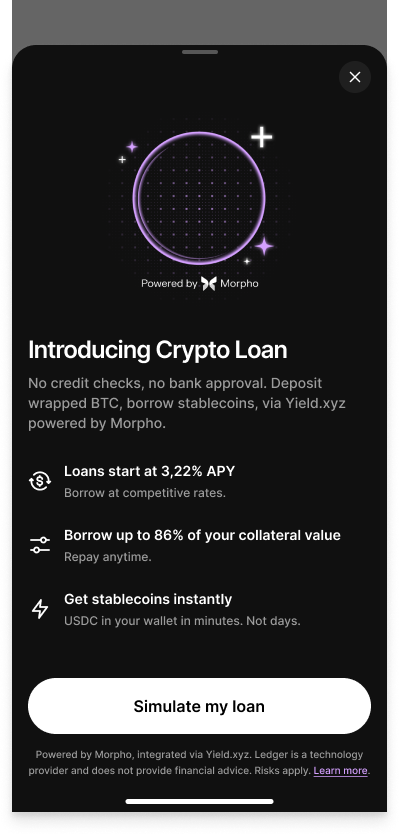
Ledger WalletTM integrated crypto-backed borrowing directly into the same app you already use to manage your portfolio, through Crypto Loan, allowing you to borrow up to 85% of your collateral value. The underlying liquidity comes from the isolated lending markets on Morpho, one of the largest decentralized lending protocols, via Yield.xyz.
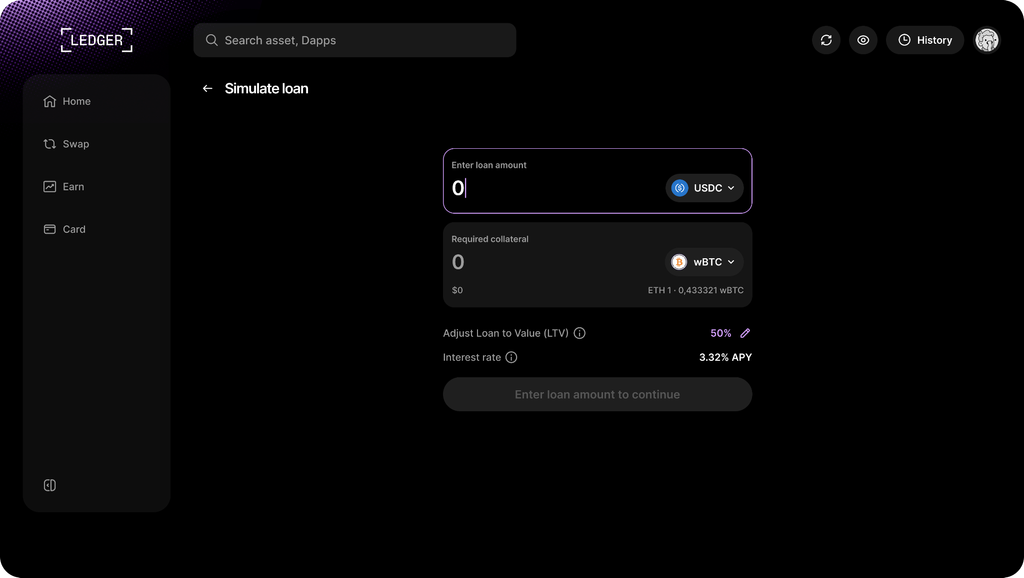
Eligible users can deposit cbBTC or wBTC as collateral to borrow USDC or USDT, initiating and managing the loan natively inside Ledger Wallet. Throughout the process, you can monitor your position’s LTV and health, and, more importantly, every key action (approving, supplying collateral, borrowing) is Clear Signed on your Ledger signer before it’s confirmed. You see exactly what you’re approving, in human-readable format, before it happens.
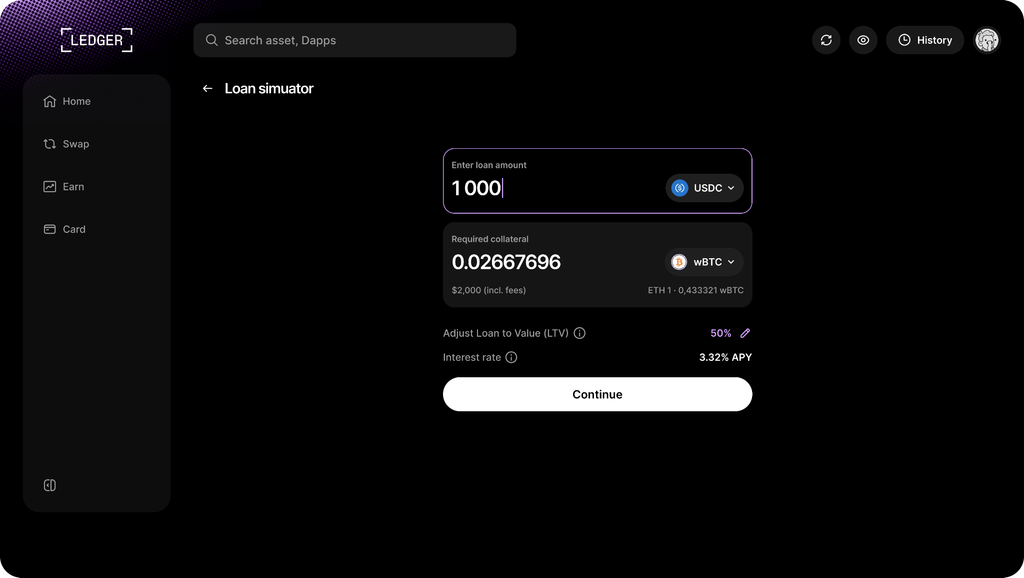
** Availability for Crypto Loans may vary by jurisdiction. Check in-app eligibility for your region. This is not financial or tax advice.
Advantages of Crypto Loan Via Ledger Wallet
Keep your Bitcoin, unlock the liquidity. Borrowing against your wBTC or cbBTC lets you raise stablecoin liquidity without selling. You keep full exposure to Bitcoin’s price, and because you are not selling, you generally avoid a taxable disposal. Tax treatment varies by jurisdiction, so confirm your own situation. That liquidity is then yours to reinvest, redeploy into other strategies, or spend on real-life expenses while your Bitcoin stays intact.
Self-custody, not someone else’s balance sheet. On a centralized platform, your collateral sits in that company’s custody for the life of the loan, exposed to its solvency and to account-level actions like freezes. With Ledger Wallet, your collateral stays onchain and your keys stay offline on your Ledger signer. There is no counterparty holding your assets, and no account for anyone to freeze.
Manage the position without leaving the app. You can monitor your LTV and position health at a glance, then supply more collateral, repay, borrow more, or withdraw directly in-app as your plan changes. This matters because liquidation is automatic. Staying ahead of your threshold is how you avoid it, and the tools to do that sit in the same place as the loan.
See what you sign, every step. Every key action, from approval and supplying collateral to borrowing, repayment, and withdrawal, is Clear Signed on your Ledger signer’s Secure Screen. The transaction is shown in human-readable form before you confirm, so you are not blind signing at the moments when a malicious or malformed transaction would cost you the most.
Is Crypto Lending Right for You?
Most users take a crypto loan to fund real-world spending without giving up their underlying asset. Others redeploy the borrowed liquidity into other positions or strategies. Both approaches carry the same underlying risk: if your collateral’s value moves against you and you are not managing the position, liquidation is automatic, and that means losses. Ultimately, the choice to take a crypto loan depends on you.
A secure way of engaging with crypto lending is one where you keep custody of your collateral and can see exactly what you are signing before you approve it. That is exactly what Ledger Wallet and a dedicated Ledger signer are built for.
Disclaimer:
Crypto Loan is powered by Morpho and integrated via Yield.xyz. Subject to country availability. Ledger is a technology provider and does not provide financial advice. Interest rates are variable and determined by the utilization of underlying isolated lending markets. Liquidation risks apply.
