
Bitcoin Halving: What It Is and When It Will Happen

| KEY TAKEAWAYS: |
| — The Bitcoin halving is an automatic event that cuts the production of new Bitcoins in half, acting like a built-in brake on inflation to ensure the total supply of BTC remains limited and scarce. — Every 210,000 blocks, roughly every four years, the reward miners receive for validating transactions is cut in half, reducing the rate at which new Bitcoin enters circulation. — The most recent Bitcoin halving took place on April 20, 2024, reducing the mining reward from 6.25 BTC to 3.125 BTC. The next halving is projected for April 2028, when the reward drops to 1.5625 BTC. |
Every four years, the Bitcoin network does something no central bank ever will: it voluntarily cuts its own money supply in half.
That event is the Bitcoin halving, and understanding it is foundational to understanding what Bitcoin is. Satoshi Nakamoto, the pseudonymous founder of Bitcoin, published a whitepaper in 2008 that had one central premise: electronic, peer-to-peer, inflation-resistant cash that needed no bank and no government. The halving is how that founding philosophy gets enforced in code. It is the mechanism that makes Bitcoin’s fixed supply of 21 million BTC a mathematical certainty.
This article will help you understand exactly what Bitcoin halving is, how it works, and how it plays out Satoshi Nakamoto’s vision for sound money.
What is the Bitcoin Halving?
The Bitcoin halving is the event where the Bitcoin network’s mining block reward is cut in half. This occurs every 210,000 blocks or roughly every 4 years, with the next halving scheduled for 2028.
The halving is hard-coded into Bitcoin’s core protocol, which means no authority approves it and no institution schedules it. It simply executes when the block counter reaches its target.
Bitcoin’s halving event is always a highly anticipated moment in the network. Primarily because of the unique nature of the public network’s supply and emission schedule, the Bitcoin halving events draw all kinds of speculation on how it will impact Bitcoin’s market price.
Understanding the Bitcoin Halving: How Does it Work
To understand the halving, you first need to understand miners: the participants who validate transactions, maintain the blockchain, and earn block rewards in return.
As a Proof-of-Work network, Bitcoin relies on miners to validate transactions and include them in blocks. To do so, they must run specialized mining hardware to participate in a lottery-like race to find the solution to the puzzle.
In simple terms, this puzzle is about creating a hash; a unique digital fingerprint made of letters and numbers that is generated from the block’s data, until it meets the network’s strict difficulty rules.
When a miner successfully solves the puzzle, they broadcast the new block to the network of crypto nodes (computers around the world running Bitcoin software that independently check every transaction).
These nodes then apply Bitcoin’s consensus mechanism; a set of rules everyone on the network follows to agree on what is valid, to verify and approve the block. Once approved, the block is permanently added to the blockchain.
The winning miner then receives a fixed number of newly created BTC, called the block reward. This reward, paid on a per-block basis, determines the rate at which new Bitcoin enters circulation (the emission rate).
| Halving | Year | Block Height | Reward Before | Reward After |
| 1st | 2012 | 210,000 | 50 BTC | 25 BTC |
| 2nd | 2016 | 420,000 | 25 BTC | 12.5 BTC |
| 3rd | 2020 | 630,000 | 12.5 BTC | 6.25 BTC |
| 4th | 2024 | 840,000 | 6.25 BTC | 3.125 BTC |
| 5th (projected) | ~April 2028 | 1,050,000 | 3.125 BTC | 1.5625 BTC |
Block rewards started at 50 BTC per block in 2009, with Bitcoin halving events permanently reducing that reward by half. The most recent Bitcoin halving took place on April 20, 2024, dropping the block reward from 6.25 BTC to 3.125 BTC. The next is projected for April 2028, when it will drop again to 1.5625 BTC.
This makes the Bitcoin halving unlike any monetary event in traditional finance.
There is no vote, no committee, no discretion involved. The supply schedule was set in 2009 and has run without interruption ever since, through market crashes, regulatory uncertainty, and global economic upheaval.
Why Was the BTC Halving Created?
The halving isn’t a feature bolted on after the fact. It is Bitcoin’s monetary policy designed by Satoshi Nakamoto, the pseudonymous creator of Bitcoin, as a direct response to the flaw at the heart of every fiat currency ever issued.
Governments and central banks can print money whenever they choose: there is no mechanism preventing them from expanding the supply, and historically, they have done exactly that, especially in times of economic stress.
This leads to inflation, with the value of your fiat currency eroding over time as more money is introduced into the system.
Bitcoin was engineered to do the opposite. Its supply is fixed at 21 million, new coins enter circulation only through mining, and that rate decreases on a predictable, immutable schedule.
Bitcoin Halving: How Does It Impact BTC’s Price?
Bitcoin’s scarcity is built into the code in a way that no political decision or outside power can change it. This is why Bitcoin is often referred to as digital gold, a finite asset whose value is that nobody can simply make more of it at will.
That scheduled supply cut creates what economists call a supply shock: the amount of new Bitcoins hitting the market gets cut overnight, but demand does not. When supply drops, and demand holds steady, basic economics says prices tend to rise. That’s the core mechanism behind every halving cycle.
For example, after the 2012 halving, Bitcoin rose from roughly $11 to over $1,000 within a year. After the 2016 halving, it climbed from approximately $650 to nearly $20,000 by the end of 2017. After the 2020 halving, it moved from around $8,700 to over $60,000 by April 2021.
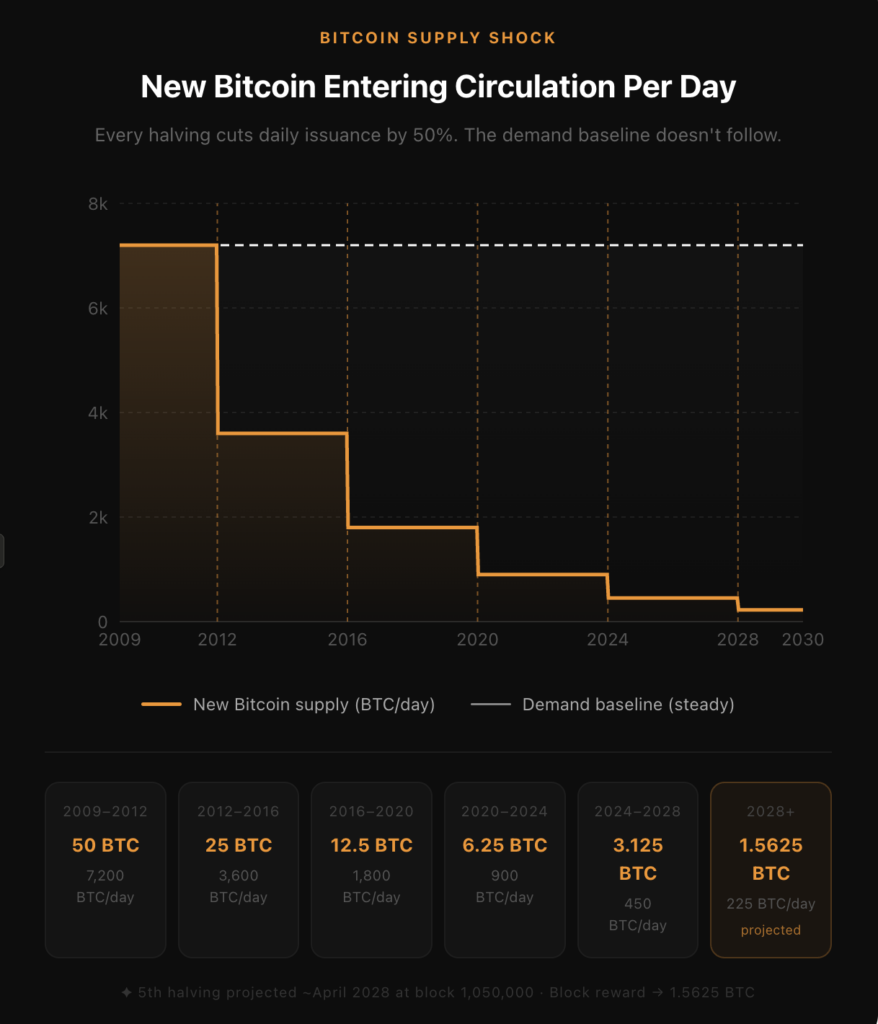
The 2024 cycle was different in one critical respect, namely, the approval of spot Bitcoin ETFs in the U.S. Launched in January 2024, these exchange-traded funds let institutional investors buy Bitcoin without holding it directly, creating institutional demand at a scale that previous halvings had never encountered. As a result, Bitcoin surpassed $108,000 within months of the April halving.
Ultimately, while halvings have historically followed this pattern of supply shock and increasing price, each cycle introduces new variables – regulatory shifts, macroeconomic conditions, the degree of institutional participation, and broader market maturity. The 2024 cycle played out differently from 2020’s precisely because the ETF dynamic was new.
How Does The Bitcoin Halving Impact BTC Miners?
The halving is, in a sense, a pay cut for BTC miners.
Miners fund their operations by selling the BTC they earn. That revenue covers hardware (specialized ASIC machines), electricity, and infrastructure. When the block reward halves, a miner’s revenue per block drops by 50% overnight, while electricity, hardware, and infrastructure costs remain the same.
Miners who were marginally profitable before the halving may find their margins wiped out entirely.
The result is a natural culling. Less efficient operations shut down, and their hash rate leaves the network. This adjusts mining difficulty downward, making it slightly easier for the remaining miners to find blocks and thus, the network rebalances. This is all by design, ensuring that even as miner participation fluctuates, blocks are found approximately every ten minutes.
For miners who survive the transition, profitability hinges on a single variable: the Bitcoin price rising enough after the halving to compensate for the reward reduction. So far, in every completed cycle, it has. But miners preparing for 2028 will need to invest in more energy-efficient hardware well in advance, as the economics will not forgive aging rigs running at high electricity costs once the reward drops to 1.5625 BTC.
If you’re curious what the hardware, setup, and electricity costs look like in practice, our guide to Bitcoin mining at home walks through it step by step.
How to Prepare for the Next BTC Halving
Halving cycles have a well-earned reputation for turbulence. In the months surrounding these events, Bitcoin’s price can swing dramatically (often within days) as supply dynamics collide with shifting sentiment.
While this volatility creates opportunity, it also exposes the risk most holders face by keeping their Bitcoin on centralized exchanges.
When bear markets hit, centralized platforms have frozen withdrawals, restricted access, or simply folded under pressure. Using a centralized exchange means trusting the platform to let you withdraw when you want, and that trust has failed repeatedly during past panics. Simply put, Bitcoin kept on an exchange is not in your control.
Secure self-custody solves this because it removes the middleman entirely.
Secure Digital Ownership Through Self-Custody
Your Bitcoin lives on the blockchain, not inside a wallet. What a signer (also referred to as a hardware wallet) actually holds are your private keys, the cryptographic passwords that control access to your coins. As long as you control those keys, no exchange, government, or platform can stop you from accessing your funds. The coins are verifiably yours because only you can authorize a transaction.
A touchscreen signer like the Ledger Nano™ Gen5, Ledger Flex™, or Ledger Stax™ are some of the best bitcoin wallets that you can trust to protect your funds in the long term. These signers keep your private keys offline and fully under your control while also making your BTC portfolio effortless to manage.
If you’re serious about securing your assets during halving-driven volatility, you’ll take these decisive steps before the next halving arrives:
- Move your long-term holdings off exchanges and into self-custody while the window is still calm.
- Select a hardware wallet with a proven, battle-tested security track record.
- Store your private keys (in the form of a secret recovery phrase) offline, and store copies in multiple secure physical locations.
- Avoid basing major allocation decisions solely on the halving date.
- Stay disciplined: volatility breeds panic, and panic-driven choices almost always destroy long-term value.
Secure Your Bitcoin Before the Next Halving with Ledger
By the next halving, over 96% of all Bitcoin will already be in circulation, and the network’s inflation rate will sit below 0.4%.
That scarcity is even more concentrated than the numbers alone suggest. Satoshi Nakamoto’s estimated 1.1 million BTC (mined in Bitcoin’s earliest days) haven’t moved in over 15 years, effectively taking them out of circulation.
In March 2025, the United States went further, signing an executive order to establish a Strategic Bitcoin Reserve: roughly 328,000 government-held BTC, locked by law and not for sale. Other governments are following this model: El Salvador holds over 6,000 BTC as a national reserve asset, and the Czech National Bank has formally proposed allocating up to 5% of its €140 billion reserves to Bitcoin.
The total BTC available to the market narrows further with every passing cycle. But the fundamental proposition remains unchanged: Bitcoin is the only monetary asset whose supply no government can print more of.
When the block reward falls to 1.5625 BTC in 2028, the network will keep producing blocks every ten minutes, just as it has for nearly two decades.
The only question is whether you’ll be in control of your share when it does. Investing in a Ledger signer allows you to actively participate in this monetary revolution and experience true digital ownership—where no one but you has the power to access, move, or manage your wealth.

Frequently Asked Questions (FAQ)
When is the next Bitcoin halving?
The next Bitcoin halving is expected in April 2028 at block 1,050,000. It will cut the mining reward from 3.125 BTC to 1.5625 BTC, though the exact date may shift by a few weeks depending on network speed.
What happens when all 21 million Bitcoins are mined?
The last Bitcoin is expected to be mined around the year 2140. After that, miners will earn only transaction fees instead of new Bitcoin rewards.
Does every halving cause a Bitcoin price increase?
No. Halvings reduce new supply and have often led to price rises in the past when demand stays strong, but other factors like regulations and market conditions also play a big role.
