
Crypto in the USA: The Ultimate Guide

| KEY TAKEAWAYS: |
| — The US is the world’s leading crypto market, with $1.3 trillion in on-chain transactions between July 2023 and June 2024. — Recent political changes are making America an increasingly crypto-friendly nation, with improvements in regulatory clarity. — Lessons learned from the collapse of the FTX exchange highlight why secure self-custody solutions are the best way to preserve your wealth. |
The crypto industry in the United States is arguably the most wide market in the world. As the world’s largest economy, the US plays a pivotal role in the trajectory of global trade and cutting-edge technologies including cryptocurrencies.
The US market was responsible for $1.3 trillion in on-chain transaction volume between July 2023 and June 2024, making it the world’s largest market according to Chainalysis.
Key players including the Coinbase and Kraken exchanges are based in the US, as is the stablecoin issuer Circle, and the cryptocurrency firm Ripple (XRP). The US is home to major Bitcoin mining operators including Marathon Digital Holdings, CleanSpark, and Riot.
US dominance is supported by institutional involvement that outshines any other region globally. Approximately 70% of the region’s on-chain activity consists of transfers in excess of $1 million dollars.
Caption: The US crypto market far outstrips all rivals.
Source: https://www.chainalysis.com/blog/north-america-crypto-adoption-2024/
While 2023 was a challenging year for US markets owing to the collapse of both the FTX exchange and Silicon Valley Bank, the 2024 US elections reshaped the political landscape as a slew of crypto-friendly legislators came to power on both sides of the political aisle.
Lawmakers are actively working to implement clear, crypto-friendly legislation consigning years of murky policymaking to the trash can of history.
The result is a wave of optimism in the US crypto market and a Bitcoin all-time price high of $124,000 in August 2025.
If you’re currently considering how to buy Bitcoin in the US in 2025, or want to learn how to safely store it, this ultimate guide to crypto in the USA has all the answers you need. We also cover a range of other topics including crypto taxes and crypto mining in the US as well as the changes American legislators are bringing forward to grow the US market.
How to Buy Crypto and Bitcoin in the USA
Read on to learn to discover how to buy Bitcoin in the USA. We’ll uncover the best app to buy crypto in the US in 2025.
Buy Crypto in the USA: Step-by-Step Guide
One way to acquire cryptocurrency in the US is by signing up to a centralized exchange (CEX). Here’s how to turn your dollars into crypto with the help of an exchange.
Step 1: Choose a Crypto Exchange
One way to buy Bitcoin with dollars is to sign up to a centralized exchange. US customers have a range of options to choose from with Coinbase, Kraken and Gemini all headquartered stateside.
There are other international options available too. For instance, Binance has a US division called Binance.US.
Step 2: Register and Complete the KYC Process
Once you’ve selected the crypto exchange you intend to sign-up for you’ll need to provide personal identifying information as part of their Know Your Customer (KYC) processes.
This information includes:
- Full name
- Date of birth
- Social Security Number (SSN) or Taxpayer Identification Number (TIN)
- Home address (Possibly with photographic corroboration such as a utility bill or bank statement)
- Photo ID (passport, driver’s license)
- Facial recognition (selfie or video clip)
The exchange will then check the information provided to ensure correctness and validity.
Depending on the exchange you may also be asked some additional anti-money laundering questions to establish the source of your funds.
Step 3: Deposit Funds
Next up, deposit some funds into your crypto exchange. You can usually do this with a number of methods including bank account transfer (ACH), wire transfer, debit or credit card, and even PayPal.
Once you’ve completed these requirements, you can choose to buy digital assets available on the CEX through U.S Dollars ($).
Securely Store Your Crypto and Bitcoin in the USA
Exchanges are a common way of acquiring crypto assets, but they’re not the safest or most secure option for storage.
Every crypto wallet has two sets of keys; the public and private keys. The public key is similar to your email address, while the private keys control and secure the wallet much like a password.
When you hold the private keys you retain ultimate control of the funds stored on that wallet. When you don’t, that control rests with whatever third party holds the private keys. In the case of exchanges the private keys are retained by them.
If the exchange you use is hacked or goes bankrupt, you could lose access to all your money with little recourse.
Why Store Your Crypto in a Self-custody Wallet?
November 11, 2022, marked one of the darkest days for global crypto investors when the FTX exchange collapsed leaving customers high and dry.
FTX was based in the Bahamas, but its founder and much of its team hailed from the US, including its CEO Sam Bankman-Fried and co-founder Gary Wang. FTX maintained a high-profile presence in the US market and through its tactics of press coverage, a raft of sponsorship deals, celebrity endorsements, and advertising during major sporting events including the Super Bowl.
FTX was a hugely successful enterprise, with over 1 million registered users and trading volumes placing it as third largest in the world. At its peak the valuation of FTX was $32 billion.
Under this veneer of success, FTX was a ticking time bomb of bad management and outright fraud. Bankman-Fried misappropriated around $10 billion in customer funds for his own ends, co-mingingling funds from supposedly separate business entities, spending the money on risky trades, investments, and a host of frivolous high-ticket items.
With little to no risk control FTX was a house of cards. In early November FTX customers began withdrawing their funds, fearing the worst when reports of FTX’s mismanagement broke.
A total of $6 billion exited the exchange before the company suspended customer withdrawals on November 8. On November 11, FTX filed for Chapter 11 bankruptcy in the US, and the house of FTX fell.
The financial post-mortem was a horror show of massive proportions, uncovering billions in lost and missing assets. Legal action followed as lawmakers brought Bankman-Fried to justice, and investors sought to recover their missing money.
For Bankman-Fried the punishment was a 25 year jail sentence, but innocent FTX customers were also punished, suffering years of financial purgatory. The price of trusting FTX with their private keys was very costly indeed.
Store your Crypto on a self-custody Wallet
The case of FTX is one of the most dramatic in crypto history, but sadly, it is not the only example of exchange malfeasance.
To avoid losses of this nature, it is always beneficial to retain control of your private keys.This is possible with any Ledger hardware wallet, including the Ledger Stax or Ledger Flex.
How to Securely Buy Ledger in the USA
Ledger signers are available through two official channels in the US. Online, you can purchase directly through Amazon US, where Ledger operates under the seller name “Ledger Official” — always verify this before completing your purchase, as Amazon’s marketplace allows third-party sellers to list against the same product page.
In-store, Best Buy is Ledger’s primary authorized US retail partner, stocking Ledger signers across 325 locations nationwide.
Whichever channel you choose, the same rule applies: only buy from sellers listed on Ledger’s official authorized resellers page, and always run the Ledger Genuine Check during setup.
Verifying your device cryptographically before moving any funds is the first act of true self-custody.
The Alternative Way to Buy Crypto in the USA with Direct Self-Custody
Ledger devices offer a safe and secure solution for crypto custodianship where control rests with you. And the Ledger Live app allows you to conveniently buy, sell, swap, stake, and manage your crypto assets too.
Step 1: Set Up Your Ledger Self-Custodian Wallet
First, get a Ledger device such as the Ledger Stax or Ledger Flex. Install Ledger Live supported on Windows, Mac, Linux, Apple or Android.
Connect your Ledger to your laptop or desktop. Click Get Started and Initialize As New Device. For security, set a PIN on your account and record your 24 word recovery phrase.
Step 2: Install Apps and Create Accounts
To hold any cryptocurrency you first need to create the appropriate account for that coin.
In Ledger Live click Portfolio, click Add Account. If you’re buying Bitcoin, install the Bitcoin app. For Solana (SOL) or memecoins on the Solana blockchain create a Solana account.
Step 3: Buy Crypto via Ledger Live Providers
Ledger Live partners with a range of third-party providers empowering you to buy cryptocurrency with US dollars.
First select a provider that appeals to you. In Ledger Live go to the Buy/Sell page. Then click Find the Right Provider For You.
Find the crypto you want to purchase, and confirm the amount.
Top Crypto Exchanges & Apps in the USA for 2025
Ledger Live
- No of currencies: 15,000+
- KYC required: Ledger Live can be used without KYC, but service providers may require KYC information.
- Trading Fees: Ledger Live is free, but network fees will still apply
- Deposit Fees: No
- Withdrawal Fees: No
- Pros: Ledger Live is your one stop shop for cryptocurrency purchases, allowing you to buy, trade and hold your coins safely and securely.
Coinbase
- No of currencies: 200+
- KYC required: Yes
- Trading Fees: Up to 0.6%
- Deposit Fees: Bank Transfer 1.49%, Credit Card 3.99%
- Withdrawal Fees: Up to $25 for wire transfers, free for automatic clearing house (ACH)
- Pros: Coinbase is a well-established exchange with a clear layout and design
- Cons: High fees for fast withdrawals
Kraken
- No of currencies: 400
- KYC required: Yes
- Trading Fees: Maker fees 0-0.25%, Taker fees 0.1-0.4%
- Deposit Fees: Free deposits with Plaid service.
- Withdrawal Fees: Free for ACH banking withdrawals, fees of up to $35 for wire transfers
- Pros: A large selection of available cryptocurrencies to choose from
- Cons: Fast withdrawals are expensive
Is Crypto Legal in the USA?
Yes, cryptocurrency is legal in the USA.
Is Crypto Mining Legal in the USA?
Crypto mining is legal in the US. President Trump strongly supports crypto mining operations in the US, stating his ambition for every future Bitcoin to be mined in the country.
How to Mine Crypto in the USA
Step 1: Choosing the right hardware
To mine crypto in the US, first consider which cryptocurrency you wish to accumulate. The growth of the Bitcoin network means mining the cryptocurrency with a regular home computer is impractical.
To mine Bitcoin today you’ll need a dedicated hardware device known as an Application-Specific Integrated Circuit, or ASIC.
ASIC miners are manufactured by Bitmain (Antminer), MicroBT (Whatsminer), and Canaan (AvalonMiner) with prices ranging from $2,000 to more than $17,000.
Step 2: Installing and configuring mining software
Before you begin your journey as a crypto miner you’ll need to download the proper software for the make and model of your hardware. Proceed with extreme caution when downloading software from the internet.
Downloading from the wrong site introduces spyware and malware risks that could cause the loss of any potential crypto gains.
Step 3: Joining a mining pool
Mining successfully as an individual is increasingly difficult. One way to offset this challenge is by joining a mining pool.
A mining pool is a group of miners who combine their resources to increase the regularity of payments. All rewards earned by the pool are shared with the pool. Rewards earned are split on a pro rata basis, with the miners who contribute the most mining power earning the most rewards.
Step 4: Setting up a crypto wallet
Whatever type of mining you’re participating in, you’ll need to set up a crypto wallet where your mining assets will accrue.
Not all crypto wallets are equally safe and secure. We suggest you assign a wallet set up using Ledger Live.
For an in-depth guide check out our fully-costed guide on mining Bitcoin at home.
Crypto Tax in the USA
Rules on crypto taxation in the USA.
Is Crypto Taxed in the USA?
Profits from crypto trading are taxable in the US, and should be reported to the Inland Revenue Service (IRS).
Taxes are paid on any gains made when your cryptocurrency is sold or traded.
Cryptocurrency held for under one year is taxed at income tax rates of between 10%-37%. Assets held for over a year are taxed at lower rates of either 0%, 15% or 20% depending on your yearly income.
The US government is simplifying taxation reporting for crypto users with the introduction of a new form – Form 1099-DA. There are currently 20 variations of Form 1099 including Form 1099-B, Form 1099-MISC and Form 1099-K. From 2026, Form 1099-DA will supersede these for crypto owners, standardizing the process.
In March 2025 the House rolled back Biden-era legislation designed to force decentralized platforms to meet the same reporting standards as their centralized peers, effectively exempting them.
What is the Crypto Tax Rate in the USA?
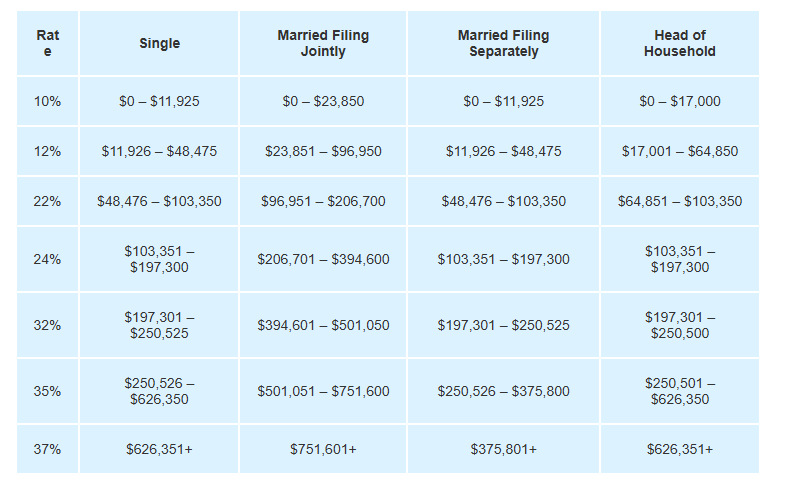
Crypto tax rates in the US depend on your income for the year. US tax is progressive, with higher earners paying more.
Tax rates for short term capital gains.
Tax rates for long-term capital gains.
Image sources: https://smartasset.com/investing/short-term-capital-gains-tax
When Does the Crypto Tax Rate Apply in the USA?
A tax rate of at least 10% is applicable to any profits from fast crypto trades of under one year. The tax rate increases upward for individuals who earn more from any income source.
On trades where the asset is held for over a year a tax rate of 15% kicks in only after the minimum threshold of $48,351 in yearly income is met.
How to Calculate Tax on Crypto in the USA?
To calculate taxes on crypto in the US you’ll need to know three key pieces of information.
- How much profit you made on crypto trades over the course of the tax year.
- How long you held those trades and whether they fall under short or long term Capital Gains tax rules.
- Your total income for the year.
New US Legislation Fuels Rapid Cryptocurrency Growth
The 2024 US elections were significant for the crypto industry as a wave of crypto-friendly electoral candidates won seats in both the House of Congress and The Senate. Donald Trump also regained the Presidency after running a crypto-positive campaign.
The election swiftly resulted in new legislation being brought forward, providing greater guidance for crypto firms and offering clues to the future of the industry.
New bills include the CLARITY Act which delineates regulatory roles between the Commodity Futures Trading Commission (CFTC) and the Securities and Exchange Commission (SEC), and the GENIUS Act which defines the rules for compliant stablecoins.
The CLARITY Act shifts the balance of oversight powers to the CFTC from the SEC. Under previous administrations the SEC gained a reputation as an overly punitive, opaque, and litigious regulator.
New compliance criteria for stablecoins under the GENIUS Act include a requirement for 1:1 reserve backing for dollar-pegged stablecoins. This would apply to stablecoins and their issuers such as Circle’s USDC and Tether’s USDT.
In July global management firm McKinsey released a report revealing the value of issued stablecoins doubled to $250 billion from just 18 months previously.
The strong performance of stablecoins and the wider cryptocurrency market suggests these changes have had a positive knock-on effect.
How to Buy NFTs in the USA
The non-fungible token (NFT) market isn’t as hot as it was just a few years ago, but some collections are still doing well. The marketcap of CryptoPunks, one of the earliest NFT projects, rose by 62% over the past year.
Other projects are fairing less well. Bored Apes Yacht Club, which peaked in popularity in 2022 with mainstream publicity and celebrity endorsements, is down by 24.5% over the same period.
Step 1: Set Up a Crypto Wallet
For US collectors of NFTs the first step is to set up an appropriate crypto wallet. The wallet you require will depend upon which blockchain network the NFT is on.
Step 2: Buy Cryptocurrency
Before you dive into the NFT market headlong, you can start by acquiring some cryptocurrency for your future purchases using Ledger Live through one of our Buy providers.
The right crypto will depend on the market you intend to purchase from. For instance, the NFT marketplace OpenSea accepts Ethereum and Arbitrum among its payment options.
Step 3: Choose an NFT Marketplace
There are a number of popular NFT marketplaces US customers can choose from including OpenSea, Rarible, Blur and SuperRare. Which one you use is a matter of personal taste.
OpenSea is perhaps the best known NFT marketplace. Launched in 2017, OpenSea quickly grew to become the market leader in the space. As of May 2025, its all-time trading volume stood at $14.6 billion.
OpenSea’s top spot has since been overtaken in the top spot by trading volume by Blur.
Another major force on the market is Magic Eden, an NFT marketplace launched on Solana in 2021, the market now caters to Ethereum (ETH), Polygon (MATIC) and Bitcoin Ordinals.
Step 4: Browse and Select an NFT
Exploring an NFT marketplace is similar to browsing an online auction house or art gallery in the real world. If you have something specific in mind you can search based on title or identifying information.
Step 5: Buy or Make an Offer
Whether you can buy an NFT outright will depend on the status of that particular artwork. If an NFT is for sale there might be a list price.
For NFTs that aren’t explicitly for sale at a specific price you may still be able to put in an offer, but the owner is under no obligation to sell under these circumstances.
Conclusion
With the information in this ultimate guide, you now have a great foundation of knowledge for all the aspects of crypto in the U.S.
You must also understand the risks of giving the ownership of your assets in crypto.
With a Ledger device such as the Ledger Stax or Ledger Flex you always retain control of your assets. In over a decade of providing secure self-custody solutions and with over 8 million devices sold, a ledger device has never been hacked.
Frequently Asked Questions about Crypto in the USA
Is Bitcoin legal in the USA?
Yes, Bitcoin is completely legal in the US.
Do you pay tax on crypto in the USA?
In the US, the Inland Revenue Service (IRS) treats cryptocurrencies as digital assets. Digital assets are not too dissimilar to other capital assets such as stocks and bonds.
Buying crypto is not a taxable event, but selling it for profit is. From 2025 onwards the reporting of crypto profits will be simplified with a single form, Form 1099-DA.
Can you mine cryptocurrency in the USA?
Yes, you can mine cryptocurrency in the USA. A number of major mining companies are based in the US.
What is the best cryptocurrency to invest in the USA?
Some cryptocurrency users argue there is no single best cryptocurrency on the market, while Bitcoin (BTC) proponents such as Michael Saylor argue the only coin worth having is BTC – with no second best option. Other coins such as Ethereum (ETH), Solana (SOL) and even Ripple (XRP) have their own proponents who argue they alone are best.
In our series of Country Guides, Ledger Academy walks you through the steps of how to buy, sell, and hold crypto assets safely and securely in various jurisdictions across the globe. We also take a look at other aspects of crypto like NFTs, the regulatory landscape, the state of Bitcoin mining, and any potential tax implications of owning crypto.
For similar guides covering other regions, check out our comprehensive crypto guides for Turkey, Thailand, Germany, and India.
